

$1 billion wagered on war globally, a U.S. soldier charged with insider trading, and Polymarket now allowing bets on a potential U.S. strike on Nigeria — Nigerian security agencies are encouraged to act before any insider trading occurs. KEHINDE ADEGOKE reports.
While Nigerian politicians and security officials remain silent, online prediction market traders around the world are betting millions of dollars on whether the United States will conduct a military strike on Nigerian territory — and federal investigators in Washington say insider trading on these war bets may be putting Nigerian lives at risk.
This development follows a 60 Minutes investigation that reported U.S. Army Master Sergeant Gannon Ken Van Dyke allegedly used classified intelligence to wager $34,000 on the timing of the surprise raid that captured Venezuelan President Nicolás Maduro, resulting in over $400,000 and later attempting to delete his Polymarket account. A Defence Department source told 60 Minutes that there may be additional cases similar to this.
The Nigerian Connection

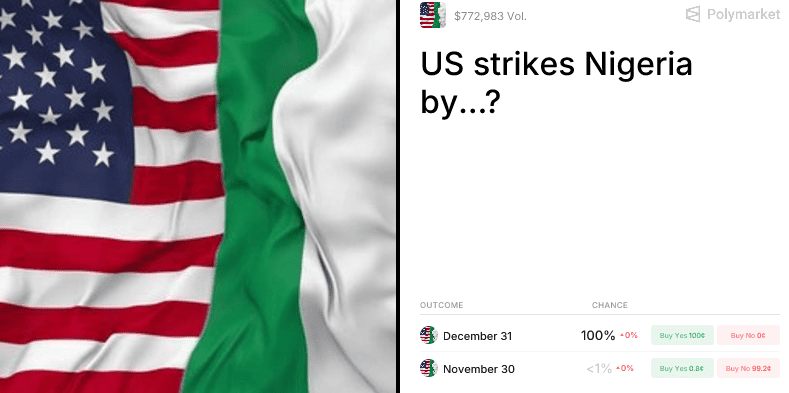
Polymarket, the world’s largest online prediction market, facilitates betting on global events. It currently provides a market titled “U.S. strike on Nigeria by…?” where traders can wager on whether U.S. aerial bombs, drones, or missiles will strike Nigerian soil. The platform is hosting this market with the leading outcome showing 100% probability assigned to a June 30 deadline — referencing December 2025 U.S. airstrikes against Islamic State militants in Sokoto State as a recent example for direct American military action on Nigerian territory.
The Global War-Betting Boom: $1 Billion Staked This Year
The wars with Iran and the U.S. military operation to capture Venezuelan President Nicolás Maduro have carried the usual hallmarks of conflict: soldiers, strategy, casualties, and cost. But they’ve also been accompanied by a new feature: betting on war.
This year alone, more than $1 billion has been staked online on military decisions and outcomes. As if they were wagering on football games or Oscar winners, bettors all over the globe have taken positions — some suspiciously timed and with information seemingly too specific for a civilian outsider — on when and how an attack might happen, and even on the fate of world leaders.
It’s created a whole new category of insider trading.
“As long as there have been wars, there have been war profiteers,” said 60 Minutes correspondent Jon Wertheim. “But never quite like this.”
The Soldier Who bet on Maduro: “One of the Worst Betrayals of Trust”
Enshrouded in night, enshrouded in secrecy, U.S. Special Operations forces captured Venezuelan President Nicolás Maduro on January 3, 2026. He was taken to the U.S. to face drug trafficking and narco-terrorism charges.
As it turned out, the president of Venezuela wasn’t the only figure in the operation to face federal charges. U.S. Army Master Sergeant Gannon Ken Van Dyke, who was “involved in the planning and execution” of the Venezuela mission, was charged last month with using classified intelligence to place bets on when the surprise raid would unfold.
Rob Schwartz, a private lawyer in Washington who until last year worked for the Commodity Futures Trading Commission (CFTC), said: “If the allegations are true, this is one of the worst betrayals of trust in this area that I can remember and possibly ever.”
The Justice Department alleges Van Dyke made a series of wagers totalling roughly $34,000, including a half-dozen the day before the raid. He ended up netting more than $400,000. According to the indictment, Van Dyke immediately withdrew his profits and then tried to delete his Polymarket betting account. The 38-year-old Army master sergeant has pleaded not guilty. Polymarket says it cooperated with law enforcement.
“If you are a corporate executive, and you’re privy to non-public business information, and you go trade on that, that’s insider trading. Everybody knows that,” Schwartz said. “But the same thing exists in prediction markets, where this soldier is alleged to have traded. Different context concerning what we usually think. But this is still meeting the definition of insider trading.”
The 98% Win Rate: $2.4 Million in Suspect War Bets
An ocean away, another team of digital detectives says they, too, have identified crooked bettors wagering on war.
Based in Paris, Nicolas Vaiman’s small data analytics firm, Bubblemaps, creates visualisations of bets on Polymarket to spot bubbles, or clusters, of suspect traders. One paradox of Polymarket: everything about the trades is totally transparent and public, except that the traders themselves remain anonymous.
“Deebs”, the firm’s head of investigations, who asked 60 Minutes to obscure his identity over fears of retaliation, shared for the first time what he believes is a more egregious insider trading case than Van Dyke’s.
We observed nine Polymarket accounts connected, which collectively earned $2.4 million betting primarily on U.S. military operations. Van Dyke made $400,000; here, $2.4 million. These accounts achieved a 98% win rate.
“Wait, wait, wait — 98%?” Wertheim asked.
“98%,” Deebs confirmed. “This is statistically improbable.”
The linked accounts placed dozens of winning bets on the specific dates of key moments in the war with Iran, even when the odds were low: the first U.S. strikes, the removal of Iran’s supreme leader, and the announcement of a ceasefire.
“Statistical chance alone does not explain these results,” Vaiman said.
The Nigeria Strike Market: What Traders Are Betting On
Polymarket, serving as a platform for event-based betting, has an ongoing market titled “U.S. strike on Nigeria by…?” which allows traders to wager on whether the U.S. will use aerial bombs, drones, or missiles to strike Nigerian territory.
Current market details:
Market title: “U.S. strike on Nigeria by…?”
Status: Live (as of May 2026)
Leading outcome: 100% probability assigned to June 30 deadline
Reference point: December 2025 U.S. airstrikes against Islamic State militants in Sokoto State
What can be bet: Whether U.S. military action will occur on Nigerian soil?
The implication: If insiders are achieving high success rates when betting on U.S. military operations globally, and there is an active market on a potential U.S. strike on Nigeria, it is important to determine who is betting on Nigeria and what information they possess.
The 52% Success Rate: Military Bets vs Sports Wagering
Michelle Kendler-Kretsch and her team at the Anti-Corruption Data Collective examined Polymarket bets on military outcomes. She looked specifically at long-shot wagers, bets with less than 35% odds. Despite being underdogs, they won more than they lost — a telltale sign, she says, of “systemic insider-trading.”
“Military bets are 52% success rate. Sports, 7%,” Kendler-Kretsch told 60 Minutes.
“Wildly disproportionate to what conventional probability should be telling you,” Wertheim said.
“Absolutely,” she replied.
The Oil Market: $80 Million Suspect Trade 15 Minutes Before Trump’s Iran Peace Post
It’s not just prediction markets that have raised intense suspicions about trades based on war. It’s happening in the old-school, heavily-regulated commodities markets, too.
David Kovel, a former commodities trader who is now a New York lawyer representing victims of fraud, walked 60 Minutes through the morning of March 23, 2026.
Fighting had been raging for three-plus weeks in the Iran conflict, and it was a slow trading day in oil futures.
“When reviewing the chart, there is minimal trading during that period. Initiating trades at that time may suggest there is an underlying rationale,” Kovel said.
Then, according to data the financial firm LSEG provided, at 6:50 a.m., more than $800 million was staked in the hope that oil prices would drop. Fifteen minutes later, President Trump posted on Truth Social that the White House and Iran had “very good and productive conversations” about ending hostilities. The news sent oil prices dropping by more than 10%.
“We’re talking tens of millions, could be $80 million,” Kovel said when asked with respect to the potential profit.
“You see this graph, and you think insider trading?” Wertheim asked.
“That is a possible conclusion. More information would be needed to confirm,” Kovel replied.
Kovel is not alone in finding this highly dubious. 60 Minutes has learned that federal investigators are also probing these oil market trades.
The Journalist Who Received Death Threats Over $22 Million in War Bets
It’s not just markets that risk manipulation by war bets. It’s true as well.
Emanuel Fabian, a military correspondent for the Times of Israel, thought little of a piece he wrote in March about an Iranian missile strike in an empty forest near Jerusalem. But soon after he published the account, Fabian received a barrage of messages asking him to change his story. He ignored most of them, but they got darker.
Fabian stated that one of the messages said, “You’re going to make us lose $900,000. We will invest more than that to prevent you from succeeding.” He also noted that personal information about his siblings was included, with the sender referencing, “I know how often you visit your family.”
He investigated and found war bets on Polymarket, hinging on whether an Iranian missile would enter Israel, specifically on March 10th. Fabian’s small news story voided the side of the bets predicting no missile, angering the losers.
“It was at $14 million that was being wagered there,” Fabian said. “But by the time it closed, it actually went up to $22 million.”
Despite these efforts to influence reporting, Fabian did not revise his coverage.
“I do worry,” he said. “We know when there’s a lot of money involved, in this case, $22 million, I think that can cause people to lie.”
Fabian reported the threats to the police and to Polymarket, which said that threatening a journalist was unacceptable and banned the accounts involved.
The Regulator: One Man, Two-Thirds Fewer Enforcement Actions
Overseeing all this, playing sheriff in this new Wild West? In the U.S., it’s the niche government agency, the Commodity Futures Trading Commission (CFTC), established in the ’70s to regulate food prices.
Traditionally led by a commission of five, today it’s run by one person: Michael Selig, a 36-year-old whom President Trump nominated chairman last fall.
“We will hold whoever’s engaging in fraudulent, manipulative or insider trading activity accountable to the American people,” Selig said.
But enforcement actions have dropped by more than two-thirds since 2024. Staffing has dropped sharply, too. Selig declined 60 Minutes’ interview request, though the CFTC told the program it is hiring more staff and using AI to go after bad actors.
And government officials are aware of the new potential for corruption. In March, the White House issued a memo to staffers noting it is a “criminal offence for anyone to use nonpublic information” on prediction markets.
The National Security Scandal: “This Could Be Putting People’s Lives at Risk”
Source after source told 60 Minutes they fear today’s insider-trading scandal will become tomorrow’s national security scandal. If market watchers can spot irregular trades, surely enemies can, too. And they’ll make their war plan appropriately.
“Just to put it plainly, this could be putting people’s lives at risk,” Deebs said. “Other adversaries may be using this information in order to plan their own strategy.”
“If you’re taking a futures position a year from now, Sergeant Van Dyke is the only person charged with insider trading?” Wertheim asked.
“No,” Vaiman replied. “I think it’s just gonna multiply from here.”
A former U.S. military officer, Deebs speaks from first-hand experience when he says military bets are ripe for corruption.
“You have obviously the government officials. But you also have the military planners, right? You have the military intelligence analysts. And even spouses, they hear things. And that means that there are consequently a lot of potential insiders.”
The Nigeria Question: Who Is Betting on a U.S. Strike?
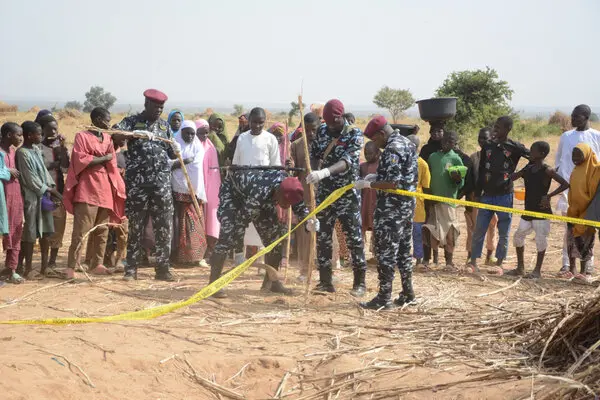
The critical question for Nigeria: If insiders are betting on U.S. military operations globally at 98% win rates, and there’s an active Polymarket market on a U.S. strike on Nigeria, who is placing those bets—and what do they know?
Potential insiders who could be betting on Nigeria:
Nigerian military planners involved in counter-terrorism operations
Nigerian intelligence analysts with access to the U.S.-Nigeria security coordination
U.S. military personnel involved in African Command (AFRICOM) operations
Diplomats involved in U.S.-Nigeria security talks.
Spouses and family members of anyone with access to classified information
Nigerian government officials privy to intelligence-sharing with the U.S.
The precedent: December 2025 U.S. airstrikes against Islamic State militants in Sokoto State already established that U.S. military action on Nigerian soil is possible.
The market: Polymarket’s “U.S. strike on Nigeria by…?” is live with 100% probability assigned to the June 30 deadline.
The risk: If insiders are betting on this market with non-public information, Nigerian lives could be at risk — just as Deebs warned about global war betting.
What Nigerian Security Agencies Must Do
The DSS, Military Intelligence, and National Intelligence Agency must immediately:
Investigate Nigerian nationals betting on Polymarket’s U.S. strike on the Nigerian market.
Monitor Nigerian military/intelligence personnel for suspicious financial activity.
Coordinate with U.S. authorities on insider trading investigations.
Issue warnings to Nigerian government officials about using non-public information on prediction markets
Audit security coordination with the U.S. for potential leaks
The White House already issued a memo to U.S. staffers in March 2026. Why hasn’t the Nigerian government issued a similar warning to Nigerian officials?
The Bottom Line
As 60 Minutes revealed, as long as there have been wars, there have been war profiteers. But never quite like this.
Online prediction market traders are making millions betting on U.S. military operations. A U.S. Army soldier allegedly used classified intelligence to bet $400,000 on the Maduro raid. A cluster of nine linked accounts generated $2.4 million at a 98% win rate in U.S. military operations. Tens of millions may have been profited from insider trading on oil markets 15 minutes before peace announcements. A journalist received death threats over $22 million in war bets.
And now, TheDiggerNews.com can report exclusively: There is an active Polymarket market betting on whether the United States will conduct a military strike on Nigeria.
The question is not whether insiders are betting on Nigeria. The question is: Who is betting, what do they know, and how much money are they making — while Nigerian lives hang in the balance?
The war with Iran and the Venezuela operation carried the usual hallmarks of conflict: soldiers, strategy, casualties, and cost. But they’ve also been accompanied by a new feature: betting on war.
Now Nigeria is part of that bet. The question is: Will Nigerian security agencies wake up before someone profits from Nigerian blood?
𝐊𝐞𝐡𝐢𝐧𝐝𝐞 𝐀𝐝𝐞𝐠𝐨𝐤𝐞 𝐢𝐬 𝐚𝐧 𝐚𝐰𝐚𝐫𝐝-𝐰𝐢𝐧𝐧𝐢𝐧𝐠 𝐢𝐧𝐯𝐞𝐬𝐭𝐢𝐠𝐚𝐭𝐢𝐯𝐞 𝐣𝐨𝐮𝐫𝐧𝐚𝐥𝐢𝐬𝐭 𝐰𝐢𝐭𝐡 𝐦𝐨𝐫𝐞 𝐭𝐡𝐚𝐧 𝟏𝟓 𝐲𝐞𝐚𝐫𝐬 𝐨𝐟 𝐝𝐢𝐬𝐭𝐢𝐧𝐠𝐮𝐢𝐬𝐡𝐞𝐝 𝐞𝐱𝐩𝐞𝐫𝐢𝐞𝐧𝐜𝐞 𝐞𝐱𝐩𝐨𝐬𝐢𝐧𝐠 𝐬𝐭𝐨𝐫𝐢𝐞𝐬 𝐭𝐡𝐚𝐭 𝐦𝐨𝐮𝐥𝐝 𝐩𝐮𝐛𝐥𝐢𝐜 𝐝𝐢𝐬𝐜𝐨𝐮𝐫𝐬𝐞. 𝐖𝐢𝐭𝐡 𝐭𝐡𝐫𝐞𝐞 𝐢𝐧𝐝𝐮𝐬𝐭𝐫𝐲 𝐧𝐨𝐦𝐢𝐧𝐚𝐭𝐢𝐨𝐧𝐬 𝐭𝐡𝐫𝐨𝐮𝐠𝐡𝐨𝐮𝐭 𝐝𝐢𝐯𝐞𝐫𝐬𝐞 𝐛𝐞𝐚𝐭𝐬, 𝐡𝐞 𝐡𝐚𝐬 𝐞𝐚𝐫𝐧𝐞𝐝 𝐫𝐞𝐜𝐨𝐠𝐧𝐢𝐭𝐢𝐨𝐧 𝐟𝐨𝐫 𝐟𝐞𝐚𝐫𝐥𝐞𝐬𝐬 𝐫𝐞𝐩𝐨𝐫𝐭𝐢𝐧𝐠, 𝐢𝐧𝐜𝐢𝐬𝐢𝐯𝐞 𝐚𝐧𝐚𝐥𝐲𝐬𝐢𝐬, 𝐚𝐧𝐝 𝐚 𝐜𝐨𝐦𝐦𝐢𝐭𝐦𝐞𝐧𝐭 𝐭𝐨 𝐚𝐜𝐜𝐨𝐮𝐧𝐭𝐚𝐛𝐢𝐥𝐢𝐭𝐲. 𝐀𝐬 𝐌𝐚𝐧𝐚𝐠𝐢𝐧𝐠 𝐄𝐝𝐢𝐭𝐨𝐫 𝐚𝐧𝐝 𝐂𝐄𝐎 𝐨𝐟 𝐓𝐡𝐞𝐃𝐢𝐠𝐠𝐞𝐫𝐍𝐞𝐰𝐬.𝐜𝐨𝐦, 𝐀𝐝𝐞𝐠𝐨𝐤𝐞 𝐥𝐞𝐚𝐝𝐬 𝐚 𝐩𝐢𝐨𝐧𝐞𝐞𝐫𝐢𝐧𝐠 𝐧𝐞𝐰𝐬𝐫𝐨𝐨𝐦 𝐝𝐞𝐝𝐢𝐜𝐚𝐭𝐞𝐝 𝐭𝐨 𝐞𝐱𝐩𝐨𝐬𝐢𝐧𝐠 𝐮𝐧𝐬𝐞𝐞𝐧 𝐭𝐫𝐮𝐭𝐡𝐬, 𝐚𝐦𝐩𝐥𝐢𝐟𝐲𝐢𝐧𝐠 𝐦𝐚𝐫𝐠𝐢𝐧𝐚𝐥𝐢𝐬𝐞𝐝 𝐯𝐨𝐢𝐜𝐞𝐬, 𝐚𝐧𝐝 𝐞𝐬𝐭𝐚𝐛𝐥𝐢𝐬𝐡𝐢𝐧𝐠 𝐧𝐞𝐰 𝐬𝐭𝐚𝐧𝐝𝐚𝐫𝐝𝐬 𝐢𝐧 𝐢𝐧𝐯𝐞𝐬𝐭𝐢𝐠𝐚𝐭𝐢𝐯𝐞 𝐣𝐨𝐮𝐫𝐧𝐚𝐥𝐢𝐬𝐦.
𝐓𝐡𝐞𝐃𝐢𝐠𝐠𝐞𝐫𝐍𝐞𝐰𝐬.𝐜𝐨𝐦 | 𝐰𝐰𝐰.𝐭𝐡𝐞𝐝𝐢𝐠𝐠𝐞𝐫𝐧𝐞𝐰𝐬.𝐜𝐨𝐦 | 𝟎𝟖𝟎𝟑𝟗𝟏𝟑𝟓𝟒𝟕𝟐 | 𝐈𝐛𝐚𝐝𝐚𝐧, 𝐍𝐢𝐠𝐞𝐫𝐢𝐚
editor@thediggernews.com

