

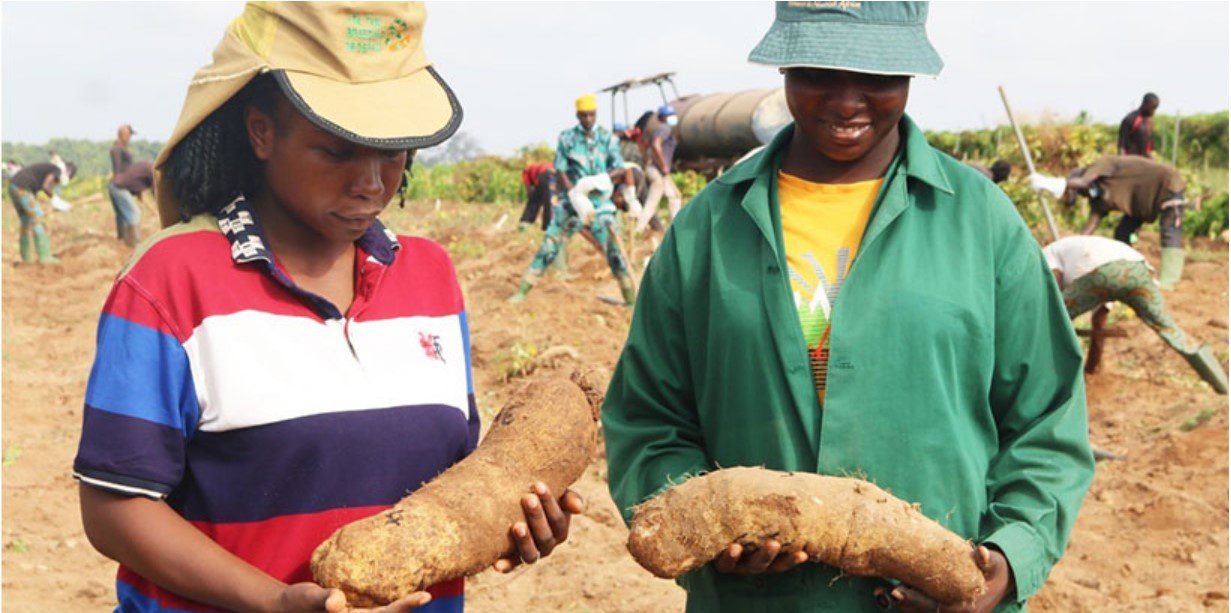
Ibadan (Nigeria): The International Institute of Tropical Agriculture (IITA), through the Programme for Seed System Innovation for Vegetatively Propagated Crops in Africa (PROSSIVA), has trained Commercial Seed Entrepreneurs (CSEs) in the yam seed production business.
The workshop, held in Ibadan on Monday, aimed to equip entrepreneurs with the necessary knowledge and skills to ensure the profitable production and distribution of high-quality yam seeds within their regions.
The training combines agronomic best practices with business strategies to help participants build a sustainable and successful yam seed enterprise.
PROSSIVA-Yam Component Lead, Prof. Morufat Balogun, while speaking at the event, said that seed entrepreneurs play a crucial role in the seed system due to their ability to produce and sell to farmers located in remote areas, beyond the reach of private seed companies.

Balogun, however, decried the lack of a fully functional formal seed system that should ordinarily support the production and distribution of high-quality seeds, thereby hindering farmers’ access to sufficient planting materials.
According to her, this hindered Nigeria from featuring significantly in yam export even though the country leads in yam production.
“The full potential of yams in filling the hunger gap and agribusiness development is yet untapped.
PROSSIVA is working with Yam, Cassava, Sweet Potato, Banana, and Plantain in four African countries. The Yam component is implemented in six states of Nigeria and two regions of Ghana in collaboration with 13 public and private partners.
“Development research and awareness creation through value proposition trials and field days, as well as capacity building, are being used to engage willing potential seed entrepreneurs.
“This has birthed hydroponics-based seed production systems and use of leaf bud cuttings for generating disease-free yam planting materials as well as sprout control systems, leading to a 100-fold increase in seed propagation rates, clearly higher than traditional planting materials,” Balogun said.
The plant geneticists urged the government to motivate commercial seed entrepreneurs without resources with subsidised access to farm inputs, including initial planting materials, loans, and irrigation support.
Additionally, Director of the IITA West Africa Hub, Prof. Michael Abberton, reiterated that Nigeria needs an effective seed system and sustainable varieties, driven by the active involvement of commercial seed entrepreneurs, to achieve sufficient yam production.
“It is also important to convince the government that yam is a priority crop in Nigeria.
“Achieving this will attract more investments from donor organisations and companies into yam farming,” he said.
Earlier, the Oyo State Commissioner for Agriculture and Rural Development, Mr Olasunkanmi Olaleye, reaffirmed the Oyo government’s commitment to supporting any initiative that builds capacity, creates jobs, and expands market opportunities for farmers and agripreneurs.
The commissioner, represented by Deputy Director Dr Funmilola Ilori from the ministry, promised to work with IITA, PROSSIVA, and their partners to ensure that the workshop’s objectives translate into concrete, scalable actions across the state.
In his remarks, the Oyo State Chairman of the All Farmers Association of Nigeria (AFAN), Mr Abass Adewumi, stated that the workshop had exposed participants to best farm practices and modern business strategies to become successful yam seed entrepreneurs.
The capacity-building programme was conducted in collaboration with Sahel Consulting Agriculture and Nutrition Limited and other partners.