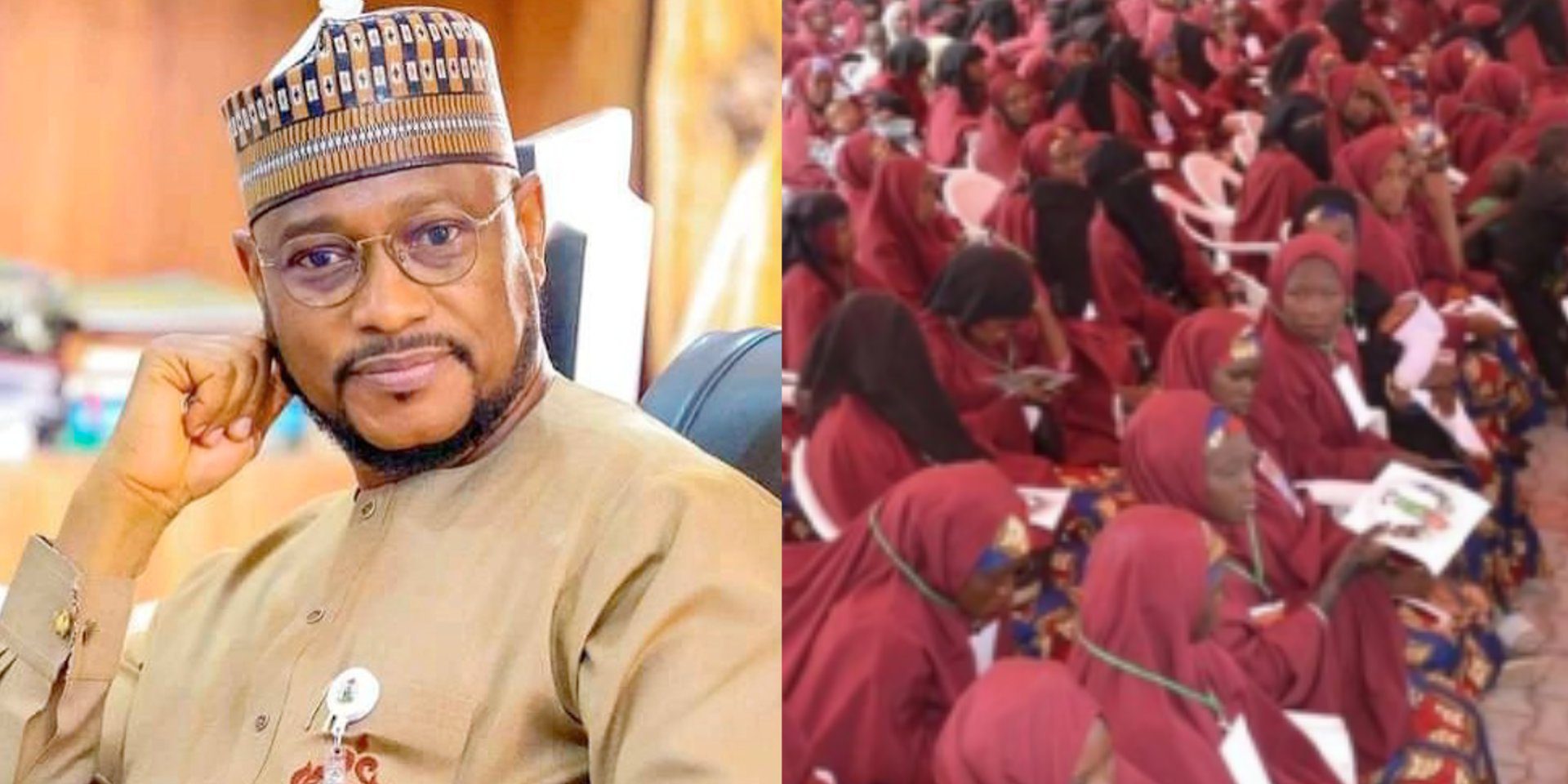
Mass weddings in Northern Nigeria have become a recurring spectacle: governors sponsor ceremonies, dowries are paid, household items are distributed, and hundreds of couples are ushered into matrimony under the banner of “social intervention.” Yet behind the pageantry lies a deeper question — do these programmes alleviate poverty or entrench it? This five‑part series by KEHINDE ADEGOKE examines the political, economic, cultural, and social dimensions of mass weddings, arguing that what appears as welfare may in fact function as patronage, perpetuating vulnerability rather than resolving it.
Numbers are not neutral. In Northern Nigeria, they are a verdict.
When the Zamfara State Government sponsored weddings for 100 “vulnerable” couples on April 22, 2026, it did so within a demographic context where a charitable gesture can have lasting social consequences. Understanding that context requires careful consideration of data that Northern governors do not always emphasise in their press releases.
Zamfara is among Nigeria’s states with the highest fertility rates, grouped with Sokoto, Yobe, and Jigawa in the Northwest. In these states, each woman has an average of 6 to 7 children. Modern contraceptive use is the lowest in the country here—just 3 to 4% of women use them.
The gap between those two numbers is influenced by policy choices, including the prioritisation of certain interventions over others.
The Zamfara government facilitated 100 new marriages without incorporating family planning infrastructure. Statistically, those 100 unions are likely to produce between 600 and 700 children who will grow up in households too poor to afford their own weddings.
The NAN’s report on the Zamfara mass wedding does not mention the brides’ ages. In most Nigerian contexts, that omission would be unremarkable. In Zamfara, it is alarming.
UNICEF reports that nearly 67% of girls in Zamfara are married before age 18, ranking it as one of the top three states for child marriage in Nigeria. In the Northwest and Northeast combined, 48% of girls marry by age 15, and 78% by age 18.
When a Northern state governor sponsors a “mass wedding for vulnerable couples,” he operates in a context where the average marriage age for girls tends to be 13 to 16. The ceremony typically provides no age verification, legal safeguard, or independent voice for the brides. This context means the state plays a significant role in shaping social norms.
In December 2025, UNICEF and the Accelerate Research Hub — a collaboration between the Universities of Oxford, Cape Town, and Witwatersrand — published an analysis that should be mandatory reading for every Northern Nigerian governor.
The findings: “If every girl in Northern Nigeria completed secondary school, child marriage could drop by up to two-thirds, adolescent pregnancy would decline sharply, and economic productivity would rise, breaking intergenerational poverty cycles.”
The study modelled the costs and returns of targeted interventions for out-of-school girls aged 10 to 18 in just two northern states. The conclusion: an investment of $114 million would yield $2.5 billion in societal benefits — a 21:1 return on investment.
In comparison, the Zamfara mass wedding allocated roughly N30 million to create 100 new households, without a designated education component, family planning, or a clear economic pathway forward. This approach differs from evidence-based interventions, which offer greater long-term returns.
The link between girls’ education and child marriage is direct and bidirectional: girls who leave school are more likely to marry early, and those who marry young rarely return to school.
Small financial grants cannot break this cycle. Nigeria has the largest number of out-of-school primary-aged children in the world, with girls in the North making up more than 60% of this group. Girls who marry at age 14 do not return to school, and their daughters often follow suit.
This is the demographic pattern the Zamfara mass wedding programme may reinforce, one ceremony at a time.
A joint study by Nigeria’s Federal Ministry of Women Affairs and UNICEF estimates that child marriage costs Nigeria $10 billion every year.
The same study projects that ending child marriage could increase Nigeria’s GDP by nearly 25%.
The political will to end child marriage in Nigeria’s Northwest remains limited. Meanwhile, political support for sponsoring mass weddings continues. This contrast may be viewed as an indicator of challenges in regional governance.