

PART FIVE: Political Shari’a
Mass weddings in Northern Nigeria have become a recurring spectacle: governors sponsor ceremonies, dowries are paid, household items are distributed, and hundreds of couples are ushered into matrimony under the banner of “social intervention.” Yet behind the pageantry lies a deeper question — do these programmes alleviate poverty or entrench it? This five‑part series by KEHINDE ADEGOKE examines the political, economic, cultural, and social dimensions of mass weddings, arguing that what appears as welfare may in fact function as patronage, perpetuating vulnerability rather than resolving it.
In 2004, Human Rights Watch conducted extensive interviews across five Northern Nigerian states on the implementation of Shari’a law. What the researchers heard surprised them. It was not hostility to Islam. It was not a rejection of Shari’a. Interview after interview, they heard a distinction that most Western analysts had rarely considered: the difference between Shari’a as an ideal and what ordinary Northern Nigerians called “political Shari’a.”
The majority of interviewees expressed dissatisfaction. They had supported the introduction of Shari’a and remained committed to their faith. However, they were disillusioned because the government selectively enforced moral codes while issues such as poverty, corruption, and injustice remained largely unaddressed. Interviewees described this as “political Shari’a,” distinguishing it from what they considered “proper Shari’a.”
This phrase — used by those experiencing it — provides a clear lens for understanding the Zamfara mass wedding of April 22, 2026, as an example of “political Shari’a.”

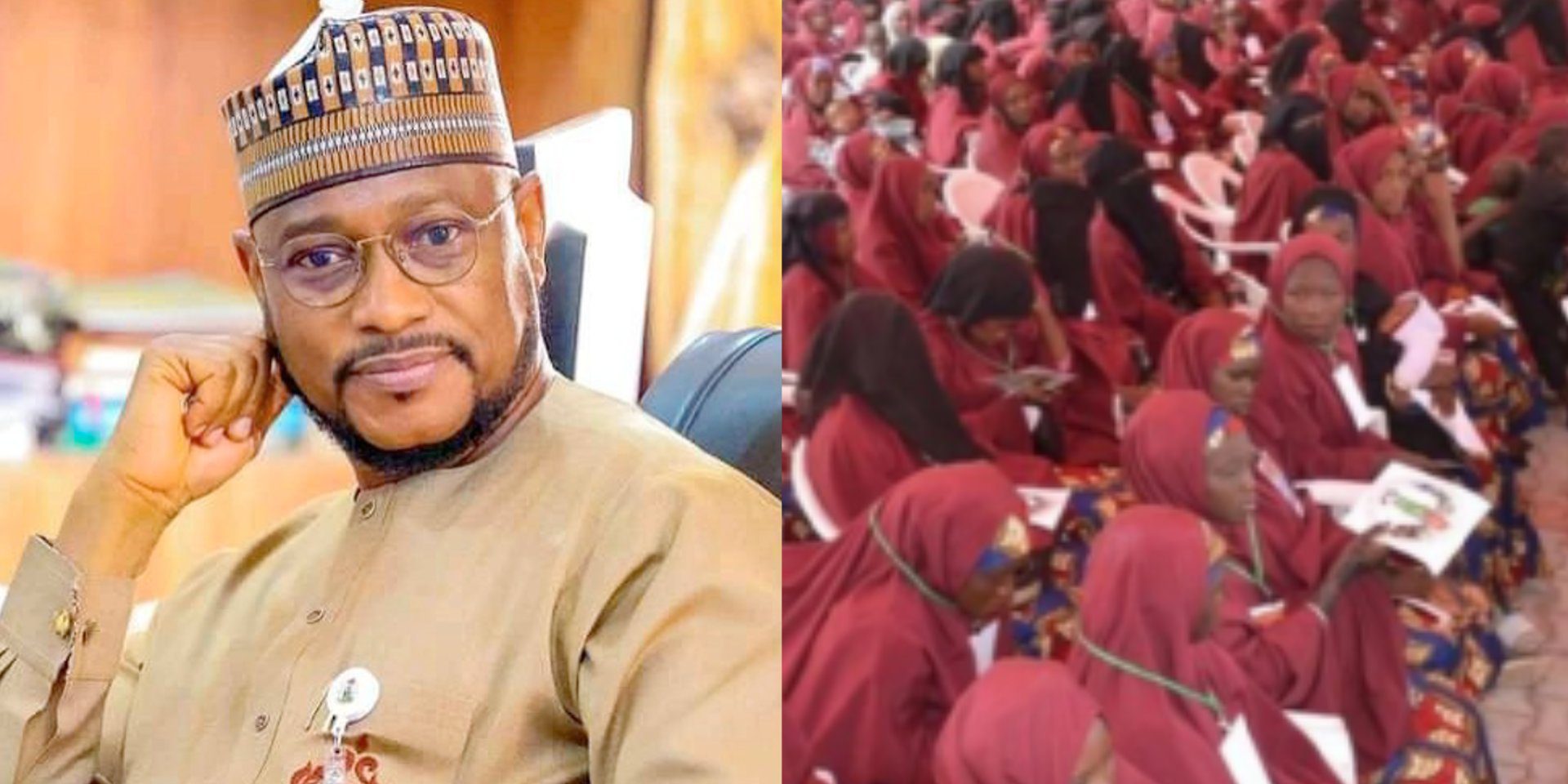
The NAN report on the ceremony ends with a paragraph many might overlook. Sheikh Umar Hassan, Chairman of the Zamfara State Hisbah Commission, praised the government for building permanent Hisbah offices in all 14 local government areas. He said this expansion would strengthen operations and improve service delivery statewide. Read with the mass wedding, these are not separate stories. They are two sides of the same governance approach.
The Hisbah enforces Islamic morality by policing gender segregation, dress codes, alcohol, and sexual conduct. Its recent expansion into all local government areas, announced with the mass wedding programme, highlights a broader philosophy: the state facilitates marriages while the Hisbah enforces conduct standards.
In Kano, Hisbah’s mass wedding programmes have at times been integrated with its enforcement operations. Older reports described instances where women arrested for prostitution-related offences were offered the option of marriage instead of prosecution. In some states, state-sponsored marriages are directly linked with active morality policing.
The Emir of Kaura Namoda’s presence at the Zamfara ceremony was significant. He acted as the bride’s representative and formally gave them in marriage. In Islamic jurisprudence, a wali (marriage guardian) is required for a valid nikah. By performing this role at scale, the Emir linked state resources, religious authority, and tradition.
This integration means that the marriages are endorsed by the state, Islamic law, and local custom. Critics argue that such arrangements restrict individual choice within these overlapping powers, highlighting a tension between collective authority and personal agency.
Here lies a key point of divergence between the implemented model and classical Islamic jurisprudence on marriage. In the classical tradition, marriage is a contract in which the woman is an active party. Her consent is required, not a formality. The mahr (dowry) is her property. She has the right to insert conditions into the contract. These may include continued education, restrictions on residence, or greater clarity on divorce rights. The Prophet Muhammad is reported to have prohibited compulsion in marriage. Scholars across the four major Sunni schools developed extensive jurisprudence on the wife’s rights to maintenance and to seek divorce through khul’.
In the Zamfara event, the state provided ₦200,000 as dowry for each groom and ₦50,000 to each bride, designated for small-scale trading within the matrimonial home. While the programme was presented as support for vulnerable groups (including orphans and the poor), the collective nature of the ceremony and the state’s financing of the mahr shift the dynamics away from the individual contract envisaged in classical jurisprudence.
Two decades after Shari’a was extended to criminal law in twelve Northern states in 2000, many expectations remain unmet. Poverty and corruption persist. Infrastructure and justice systems still struggle. The ulama, who strongly advocate Shari’a, have largely accepted a system that prioritises visible moral enforcement and social programmes over structural reform. Still, some Northern Nigerian scholars, activists, and leaders highlight the gap between political expediency and core Islamic ethics: justice, consent, and the pursuit of knowledge. Yet these voices rarely take centre stage at such ceremonies.
Breaking the cycle requires targeting several factors simultaneously: promoting girls’ education, ensuring strong enforcement of the Child Rights Act across all states, reforming governance to reduce patronage-based budgeting, and developing an Islamic counter-narrative that highlights consent, women’s rights in marriage, and the religious obligation to educate all Muslims. Education for girls is the most effective intervention—UNICEF notes that secondary school completion can cut child marriage rates by up to two-thirds. Legal clarity around minimum marriage age is critical, especially in Northern states where gaps persist.
The Zamfara mass wedding on April 22, 2026, is modest in a large, challenged state. It will likely join the governor’s re-election narrative and appear in a few official photographs. Yet, as such initiatives recur across states and over the years, they shape demographics. Many unions are likely to produce large families entering the same strained system of schools, healthcare, and limited economic opportunity that failed their parents.
The ceremony, the poverty, and the political incentives that sustain both can become self-reinforcing. Northern Nigeria’s challenge is not a lack of governors willing to pay for weddings, but a shortage of leaders focused on building institutions and expanding opportunities. These should provide quality education, functional healthcare, transparent governance, and meaningful economic pathways—needs that remain unmet at scale.
Until citizens of Northern Nigeria, including young women and brides, are equipped with both education and a political voice to demand more, the cycle is likely to continue. Cameras will record the ceremonies. Traditional leaders will give brides in marriage. Hisbah offices will expand to enforce the prevailing order.