

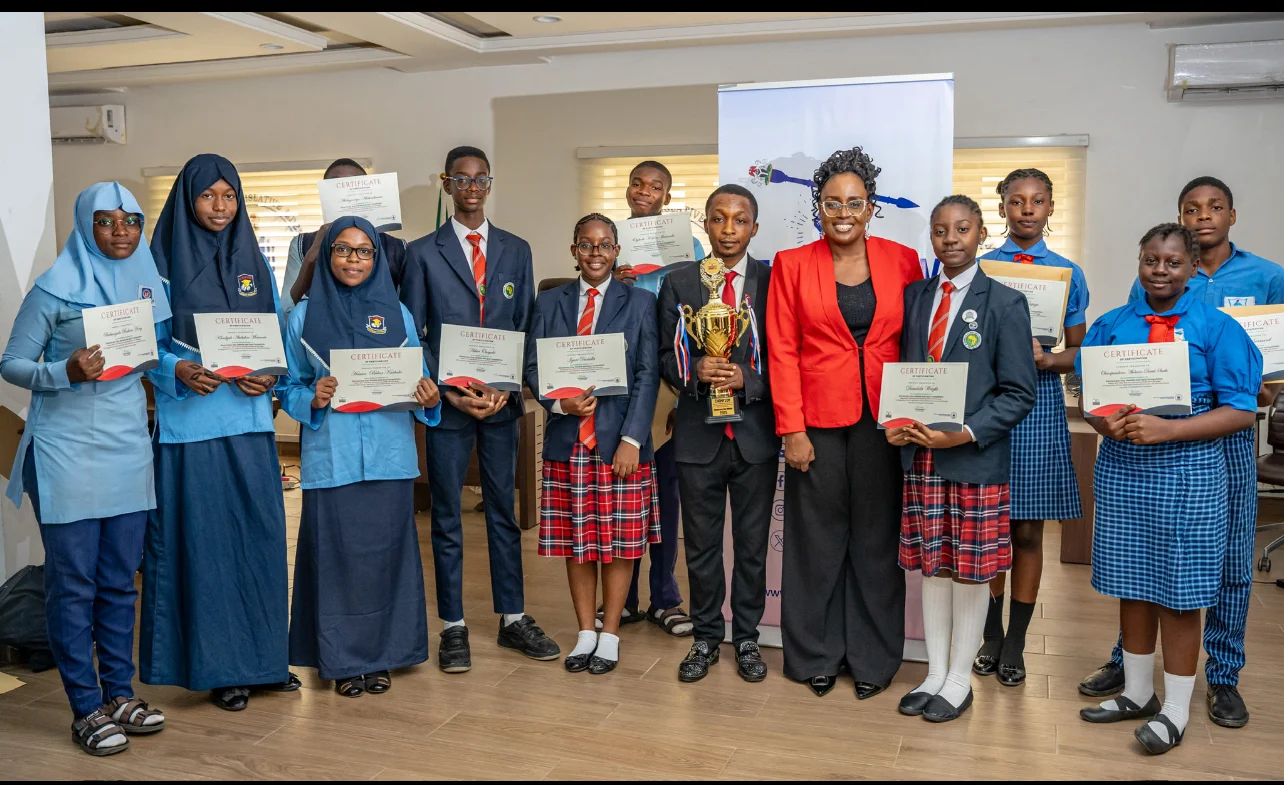
Abuja: On Wednesday, calls for lowering the voter age and rejecting e-voting dominated the maiden edition of the National Institute for Legislative and Democratic Studies (NILDS)-Democracy Secondary School debate in Abuja.
Students from Africa Community School, Asokoro, and Intelligence Quotient Academy, who emerged winners, made the call at the debate, which was organised to mark Nigeria’s 26th anniversary of unbroken democracy.
The topic of this year’s debate was “Is E-Voting the Future of Nigeria’s Democracy/Should the Voting Age Be Lowered to 16 Years.”
Miss Khadijah Matawale, a student of Intelligence Quotient Academy, said that every citizen had the right to life, freedom of speech and movement, and should be given the right to vote.

Matawale described voting as a process of electing leaders in a democratic setting by citizens, arguing that teenagers under 16 are equally citizens.
According to her, if the elderly have the right mindset to vote and have a say in government, teenagers at age 16 should also be allowed to vote.
“If everybody, irrespective of age or experience, is affected by bad governance, why can’t the voting age be reduced to accommodate those of 16?
“In countries like Australia, Cuba and Brazil, they allow teenagers, 16 and 17 years of age, to vote; why can’t that be implemented in Nigeria?” she queried.
For her part, Miss Oluwadamilola Wright of Africa Community School argued that though technology seemed like the way forward, there were many constraints.
Wright said that transparency could not be assured, as the system’s operators were those appointed by people in power, making it difficult to know if the output was the will of the people or government officials.
She also stated that electronic systems could be costly to acquire and operate.
In his own contribution, Master Ogbodo Kelvin of Government Secondary School, Area 10, Garki, argued that e-voting is the future of Nigeria’s electoral system and the world’s.
Kelvin noted that the world was changing regarding technological advancement and that e-voting would ensure empowerment, transparency and reduced electoral fraud.
“We’re in a world where climate change affects us a lot. We will consume a lot of parts with manual voting, but with e-voting, it will reduce the use of paper; we are conscious of our plight; it is a democracy with a conscience,” he said.
However, Miss Oluwapamilerinayo Abobarin, an SS II student of Treasure Homes International Schools, argued that adult citizens should vote alone.
Abobarin said it was risky to allow younger teenagers to vote to decide the fate of a complex nation like Nigeria.
“A 16-year-old is not emotionally stable. Science shows that the part of the brain responsible for decision-making has not yet developed until the mid-twenties.
“This is enough reason for us to see that a 16-year-old is not mature enough for such a decision for the whole nation.
“They are still very dependent on their parents; they are easily influenced and manipulated by social media influencers, easy prey for cyber bullies and can be forced by someone in their neighbourhood to vote for a particular candidate.
“Imagine a 16-year-old becoming president of Nigeria because the right to vote comes with the right to be voted for,” she said.
In an interview with NAN, Mrs Uju Nwachukwu, the General Manager of NILDS-Democracy Radio, said that the initiative was centred around questions of interest to young people.
Nwachukwu said that following social media comments of young people after the 2023 elections, the debate was designed to propel new thinking among young people.
“We are trying to increase younger people’s awareness of governance and politics.
“At NILDS-Democracy Radio, our mandate is to bridge the information gap between the governed and the government, and we are not leaving the younger generation.
“We want to get the younger generation talking; they are the younger demography that is most often overlooked; they will turn 18 in two years.
“At some point, they will be part of the system, so getting them involved now is a better strategy than waiting until they express their discontent through other means, like riots and protests.
“Getting them intellectually involved now, getting them to do research and understand things for themselves is the essence of this conversation,” she said.
Nwachukwu said that young people were very impressionable and could easily convince their peers to run with such ideas.
The general manager said that the debate would not be a one-off event but would be expanded to include university students.