

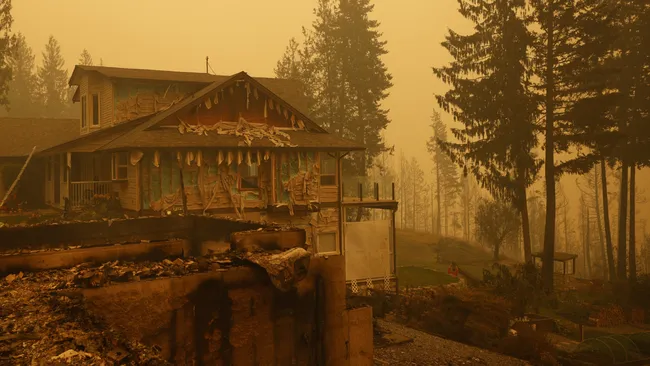
The health impacts from Canada’s worst wildfire stretched into Europe, Asia, and Africa, a new study reveals.
Stephanie Pappas reports that over 87,000 premature deaths worldwide can be traced to the impact of Canada’s explosive 2023 wildfire season, as estimated by a comprehensive study that analyzed the global health effects of the fires in detail.
Fires burned 71,043 square miles (18.4 million hectares) of Canadian forest that year, about 5% of the total forest in the country. The smoke plumes from the fires heavily impacted the U.S. Northeast and Midwest, and they even wafted across the Atlantic to Europe and northern Africa.
Now, a new study published September 10 in the journal suggests that short-term exposure to particulate pollution from these fires contributed to an estimated 5,400 deaths in the United States and Canada.

The fires, which burned for weeks, also contributed to chronic pollution exposure, which accumulates over each person’s lifetime.
This chronic exposure from the fires was responsible for another 82,100 premature deaths worldwide, according to the new study.
In the study, “acute deaths capture the short-term health impacts that occur during ‘Canada smoke days’, when daily PM2.5 levels spiked well above health guidelines and could immediately trigger fatal events such as heart attacks or respiratory failures,” study lead author Qiang Zhang, an environmental scientist at Tsinghua University in Beijing, told Live Science in an email.
“Chronic deaths reflect the health burden of longer-term exposure, which increases the risks of cardiovascular and respiratory diseases and leads to premature mortality that accumulates over time,” Zhang explained.
There is uncertainty in these numbers, but the health risk from wildlife smoke exposure is a significant issue, said Emily Fischer, an atmospheric scientist at Colorado State University who was not involved in the new study.
“There will be more such events with climate change, and what’s difficult is to put specific numbers [on it],” Fischer told Live Science. “But this would only be the tip of the iceberg.”
In the short term, wildfire smoke can cause eye and respiratory tract irritation, bronchitis (inflammation of lung airways), and exacerbation of lung diseases like asthma, according to the Environmental Protection Agency.
Both acute and long-term smoke exposure can also stress the cardiovascular system, raising the chances of a heart attack or stroke. Smoke exposure has also been linked to problems with memory and learning, and over the long term, may increase the risk of developing dementia.
To quantify the effects of the 2023 Canadian fires, researchers from China, the U.S., and Canada first modelled how the smoke travelled around the globe.
They then gathered global data on observed PM2.5 concentrations, or particulate matter with a diameter of 2.5 micrometres or smaller — small enough to be inhaled deep into the lungs and even enter the bloodstream.
Using a machine-learning approach, the researchers estimated how much of the observed PM2.5 came from the Canadian fires.
They then used established epidemiological models to determine the likely death toll that would be attributable to the Canadian fire PM2.5, based on how many people were exposed.
Their results suggested that Canada’s fires that summer were responsible for 13% of the total PM2.5 released by all fires around the world in 2023.
Approximately 354 million people in the U.S. and Canada were exposed to the pollution, increasing the yearly PM2.5 exposure in North America by 1.08 micrograms per cubic meter. And because of how far the smoke travelled, people in Europe also saw an increase in exposure of 0.41 micrometres per cubic meter, on average.
“We know when the pollution goes up, we’re going to get a compared to the day before or compared to an average day,” said study co-author Michael Brauer, an environmental health researcher at the University of British Columbia.
About 4,100 of these acute deaths occurred in the U.S. and 1,300 in Canada, the researchers estimated. Though Canada’s air quality was worse than that of the United States, the affected regions of the U.S. were more populous, meaning more actual exposure, Brauer told Live Science.
The researchers also estimate that the long-term exposure to the smoke cut short the lifespans of 82,100 people worldwide, including 33,000 in the U.S. alone. (Air pollution as a whole is estimated to contribute to about 100,000 deaths per year in the U.S., according to 2020 research.)
Europe saw approximately 22,400 lives shortened by the Canadian smoke, accounting for 3.8% of PM2.5-related deaths on the continent in 2023, the researchers reported.
“It’s not an inconsequential number of people, and they’re far away from Canada,” said study co-author Steven Davis, a Stanford University professor of Earth System Science.
Fire-related pollution, he told Live Science, doesn’t respect international borders, and thus fires are a global problem that requires a united, international response.
The results highlight that society needs to prepare for smoke events with better monitoring and public education, Fischer said.
For example, people should know that smoke doesn’t smell smoky after about a day of travelling through the air, but that doesn’t mean it’s any safer to breathe it in.
With mitigations such as mask-wearing outside on bad fire days and improving building design to filter air better, many of the worst health impacts of wildfire smoke can be avoided, Brauer said. And those mitigations will need to be made, as wildfires are likely to increase in a warming world, he emphasised.
“This was a historically significant event, but I think we’ll break this record at some point,” Brauer said of the 2023 fires.
“This is not something extreme that we’re never going to see again.” This underscores the need for robust preparedness and resilience measures in the face of future wildfire events.