

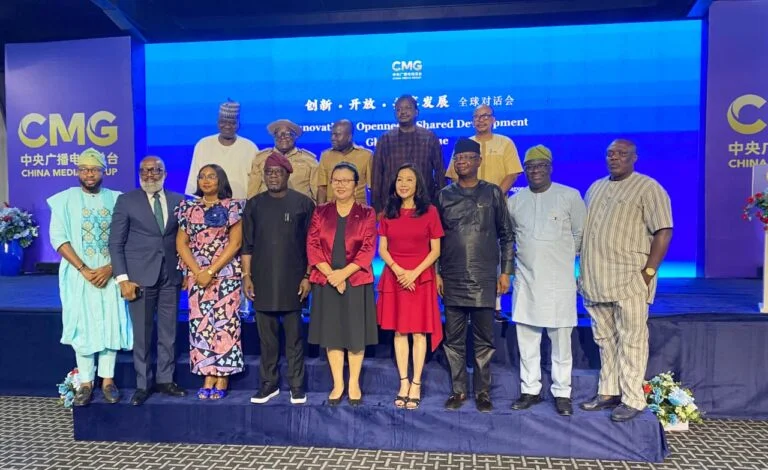
Lagos: China has reaffirmed its commitment to strengthening bilateral relations with Nigeria as trade between the two nations surged to $12.89 billion (approximately ₦10.05 trillion) in the first half of 2025 — marking a 29.4% increase compared to the same period last year.
The announcement was made during a dialogue jointly organised by the China Media Group (CMG) and the Chinese Consulate on Friday in Lagos, as part of Beijing’s renewed Five-Year Plan, which outlines deeper economic cooperation, infrastructure investment, and strategic partnerships aimed at boosting Nigeria’s development and regional influence.
The event’s theme, “Innovation, Openness, Shared Development,” highlighted opportunities for deepened economic, cultural, and technological collaboration between the two countries.
It followed the Fourth Plenary Session of the 20th Central Committee of the Communist Party of China (CPC), held in Beijing from October. 20 to October 23.

The plenary reviewed China’s achievements under the previous five-year plans and outlined strategies for national development over the next five years.
During the session, China officially unveiled its 15th Five-Year Plan, setting out a roadmap for high-quality growth, innovation, and sustainable development.
Delivering the keynote address, Chinese Consul General in Lagos, Ms Yan Yuqing, said the Plan offers boundless potential for China-Nigeria collaboration.
She highlighted that China’s focus on high-quality development and expanded openness would create more market opportunities, investments, and joint ventures for Nigeria.
Yan said China was ready to align its Plan with Nigeria’s Renewed Hope agenda, particularly its eight priority development areas, through the Belt and Road Initiative.
The Consul General encouraged both countries to leverage the 55th anniversary of diplomatic relations in 2026 and the China-Africa Year of People-to-People Exchanges.
“Our partnership should deepen in areas such as infrastructure, agriculture, industrialisation, green development, and cultural exchanges,” she emphasised, underscoring mutual benefits for both nations.
Nigeria remains one of China’s most important partners in Africa, with bilateral trade and investment ties steadily strengthening each year.
The trade between the two countries reached $12.89 billion in the first half of 2025, representing a 29.4% year-over-year increase.
Yan said China would continue to support Nigeria in upgrading its transport and energy infrastructure, while promoting agricultural modernisation and food security.
Industrialisation remains a priority, with China assisting Nigeria in expanding its manufacturing capabilities, creating jobs, and developing expertise in green energy and digital technologies.
She also emphasised the importance of people-to-people exchanges, particularly in media, education, culture, and health, as crucial for strengthening the foundation of bilateral friendship.
“Nigeria is a major African country with immense development potential. China remains a reliable partner in building an even closer China-Africa community,” she said.
Highlighting China’s governance model, Yan said five-year plans reflect long-term strategic planning and socialist governance, guiding the nation’s remarkable transformation since 1953.
From an impoverished nation, China has become the world’s largest manufacturing economy and the second-largest economy overall, a testament to disciplined planning and execution.
Reflecting on the 14th Five-Year Plan, Yan said China achieved historic milestones despite global economic challenges, positioning the country for continued growth.
China’s total economic output is projected to reach 140 trillion yuan ($19.6 trillion) by the end of 2025, reinforcing its role as a global growth engine.
The country contributes approximately 30 per cent annually to global economic growth, with innovations in aviation, shipbuilding, and artificial intelligence strengthening its competitive edge.
China has also built the world’s most extensive clean power generation system, with renewable energy capacity surpassing coal output, signalling a commitment to green development.
The 15th Five-Year Plan sets seven primary goals, including technological self-reliance, deepened reform, social advancement, and high-quality development across key sectors.
It outlines 12 strategic tasks, from establishing a modern industrial system to accelerating technological innovation and expanding high-standard international cooperation.
Yan assured that China will continue sharing development opportunities globally, as a more open China brings stability, certainty, and economic benefits to the world.
In his remarks, Mr Eze Anaba, President of the Nigerian Guild of Editors, praised CMG and the Chinese Consulate for fostering mutual understanding via media and culture.
He described the dialogue as more than a diplomatic event, calling it a celebration of communication, collaboration, and the transformative power of storytelling.
Anaba said China’s successful five-year plans demonstrate accountability, vision, and mission-driven leadership, inspiring other developing nations to adopt similar approaches.
He noted the 15th Plan’s emphasis on innovation, digital transformation, green growth, and human development offers a model for sustainable development worldwide.
He urged media professionals to continue reporting China’s story fairly, objectively, and insightfully while authentically telling Nigeria’s story to Chinese audiences.