

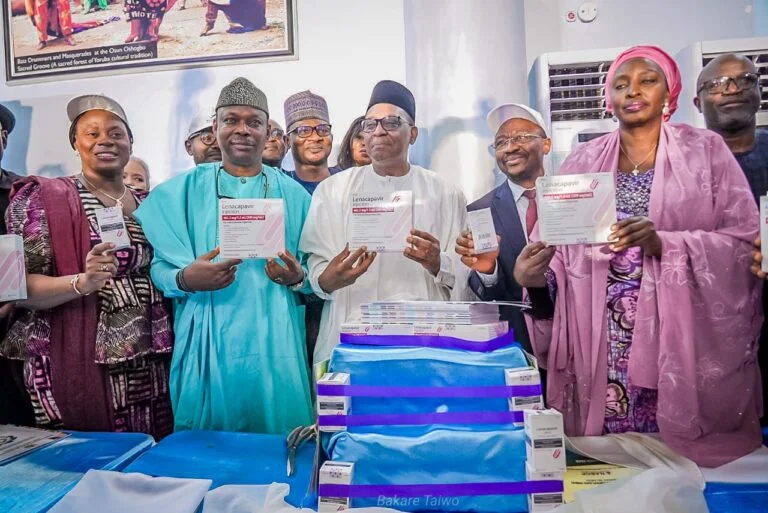
Abuja: As global health aid evaporates and international donors retreat, Nigeria is refusing to wait. With a $346 million domestic health commitment locked into the 2026 budget and the launch of a twice-yearly HIV prevention injection, Abuja is signalling a decisive break from decades of aid dependency — and a determined push to take ownership of its own health future.
The Coordinating Minister of Health and Social Welfare, Prof. Muhammad Pate, declared at the national launch of the long-acting injectable treatment.
The National AIDS, Viral Hepatitis and Sexually Transmitted Infections Control Programme (NASCP) organised the launch on Tuesday in Abuja.
He said the funding, approved by President Bola Tinubu, will be in the 2026 national budget. It aims to strengthen key health interventions.
“This major bilateral co-financing for 2026 totals almost 346 million dollars additional.”

Pate said, “Mr President has already directed the Budget Office of the Federation to ensure its inclusion in the 2026 budget.”
He explained that the funding would pay for commodities, lab surveillance, reagents, primary healthcare expansion, and financial protection.
“That means that some of the commodity costs, the laboratory surveillance costs, the reagents, primary health care, and expansion of financial protection should be included,” he said.
Pate said the move showed Nigeria’s shift to stronger domestic financing. This comes as global health funding declines and international priorities change.
He said global space is changing fast. Financing has become limited worldwide, and it is even tighter in Nigeria.
“While we have had tremendous success over the last 25 years thanks to global partnerships, the headwinds we are facing in terms of the changing global landscape force us to think differently,” he said.
Pate emphasised the need for innovation and efficiency, noting that new tools such as Lenacapavir would help Nigeria consolidate gains in HIV, tuberculosis, and malaria control.
He said the government uses a sector-wide approach to reduce fragmentation and use scarce resources more effectively across the health system.HHe added that Nigeria’s long-term goal is less reliance on external funding and more domestic control of health programmes.“By 2030, Nigeria should be able to put its own domestic resources toward priority diseases instead of relying on external grants,” Pate said.
He said over 90 per cent of Nigeria’s health spending is now domestically financed. External funds act mainly as catalysts. Pate also called on civil society and stakeholders to ensure that allocated funds were not only approved but also released and effectively utilised.
The Minister of State for Health and Social Welfare, Dr Iziaq Salako, said Nigeria had made significant progress in HIV response indicators over the past few years.
Salako said 93 per cent of people with HIV in Nigeria know their status. Of those diagnosed, 99 per cent receive antiretroviral therapy.He added that 95 per cent of those on treatment have viral suppression. Mother-to-child transmission rates rose from 33 per cent in 2023 to nearly 70 per cent in 2025.“As we progress toward epidemic control, the need to intensify prevention strategies remains critical,” Salako said.
He described Lenacapavir as transformative: highly effective, convenient, and discreet. It serves especially those facing adherence issues. He emphasised, however, that behavioural prevention remains essential.
“Abstinence or avoiding risky behaviours, being mutually faithful and consistent condom use remained key for HIV prevention.
“If you know you are at risk for HIV, get tested.
“If your result shows you are positive, ensure immediate commencement of treatment in a health facility with Highly Active Antiretroviral Therapy . If you are negative, but at high risk, commence use of oral preventive medications or injections for PrEP (Pre-Exposure Prophylaxis), such as Cabotegravir and the newly launched Lenacapavir, under appropriate medical guidance,” he said.
The Permanent Secretary, Federal Ministry of Health and Social Welfare, Ms Daju Kachollom, said the introduction of the drug marked a major advancement in HIV prevention in Nigeria.
“This long-acting injectable offers new hope, particularly for populations at higher risk,” Kachollom said.
She said this innovation aligns with Nigeria’s plan to expand prevention, reduce new infections, and accelerate epidemic control. Lenacapavir is a long-acting injectable antiretroviral, administered twice yearly among high-risk HIV-negative individuals.
NAN also reports that Anambra, Ebonyi, Gombe, Kwara, Akwa Ibom, Cross River, Benue and the Federal Capital Territory have been selected for the initial rollout of the injection.
The Coordinating Minister of Health and Social Welfare, Prof. Muhammad Pate, the Minister of State for Health and Social Welfare, Dr Iziaq Salako and other stakeholders at the launch of Lenacapavir, a long-acting injectable for HIV prevention on Tuesday in Abuja.