

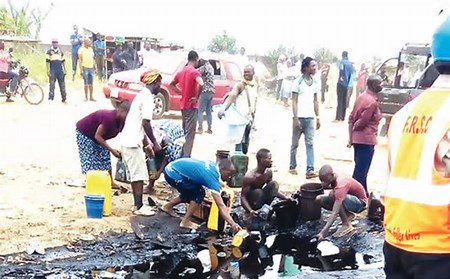
Makurdi: The Federal Road Safety Corps (FRSC), Benue Sector Command, has said that 411 Nigerians lost their lives while scooping fuel from fallen tankers in 2024.
The Sector Commander, Mr Steve Ayodele, disclosed in Makurdi on Tuesday at a town hall meeting with trailer and tanker drivers on crash prevention.
Ayodele said that the number represents 7.6 per cent of total road traffic deaths in 2024 alone, noting it was beyond fatalities.
The sector commander stated that the town hall meeting, with the theme “Discourage Fuel Scooping and Other Anti-Road Traffic Attitudes,” aimed to mitigate such crashes.

These incidents often cause life-threatening burns and destroy shops, vehicles, and infrastructure, while also deepening the economic hardships of victims’ families.
The economic impact of these incidents is significant, with specific statistics on economic losses.
“Fuel scooping and other anti-traffic behaviours were turning avoidable road accidents into major disasters.
“Tanker and trailer crashes often leave behind devastating consequences, worsening tragedies with unsafe conduct of people at crash sites.
“Fuel scooping, reckless driving, disobedience to traffic rules, and roadside trading near accident-prone areas are actions that put lives at risk.
“Fuel scooping has become one of the deadliest practices on Nigerian roads. Instead of recognising spilt fuel as a hazard, many Nigerians rush to collect it.
“We have witnessed tragic incidents where lives were lost due to fires caused by this reckless act,” Ayodele said.
The sector commander emphasised that unregulated driving hours, overloaded tankers, and inadequate safety inspections continue to be major contributors to accidents.
He called on participants, including drivers, community leaders, and government agencies, to commit to changing attitudes and protecting lives.
Mr Babalola Sheba, Head of Operations, Nigerian Midstream and Downstream Petroleum Regulatory Authority (NMDPRA), decried the environmental and health hazards linked to fuel scooping.
He warned that fuel spills pollute the soil, water, and air, contaminate drinking water, and harm agriculture and aquatic life.
Sheba, who said that inhaling fuel fumes can also cause respiratory problems and skin irritation, stated that the agency had resolved to mandate the installation of anti-spill safety valves and speed limiters on all petroleum product tanker trucks. He said that the agency had introduced a colour-coding system for fuel trucks.
He disclosed that light blue is for petrol, deep yellow and light blue for diesel, deep yellow for kerosene, black for aviation fuel, and deep green for biofuels. Each colour corresponds to a specific type of fuel, making it easier for [specific stakeholders] to identify and handle the trucks accordingly.
Mr Emmanuel Ogbanje, State Coordinator, Vehicle Inspection Officer (VIO), Computerised Vehicle Inspection Service, in Benue, emphasised that preventing fuel scooping required a culture of regular vehicle inspection, compliance with axle load regulations, and strict adherence to traffic laws.
The Computerised Vehicle Inspection Service plays a crucial role in this process by specific role or function.
Ogbanje said that safety was not a goal, but a continuous process, and urged drivers to always carry valid licences, avoid overloading, and report unsafe practices.
Increased public education and collaboration among stakeholders are crucial to building a culture of road safety across the state and beyond.