President Bola Tinubu’s ambition to build a $1 trillion economy by 2030 hinges on revitalising Nigeria’s steel industry—a sector historically plagued by corruption, policy summersaults, and infrastructural decay.
While the administration has set ambitious targets for steel production and job creation, the path forward is fraught with systemic challenges. Urgent and radical reform, coupled with unwavering political will, is the only way to navigate these challenges and ensure the success of the steel industry revival.
Steel as the Backbone of Economic Diversification:
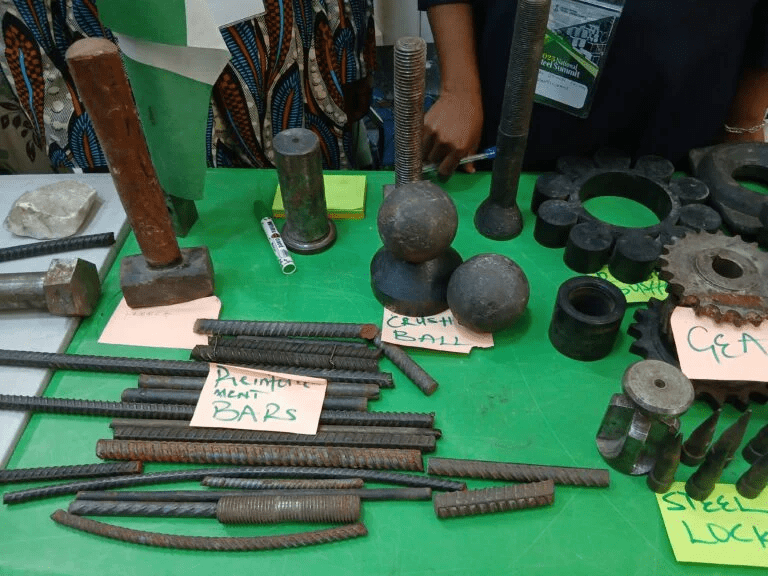
Steel is indispensable to modern economies. From construction and transport to defence and agriculture, it underpins industrialisation. Nigeria’s overreliance on imported steel—despite abundant raw materials—bleeds over $4 billion in foreign exchange annually. The revival of Ajaokuta Steel Company and NIOMCO in Itakpe is central to reversing this trend.

But the dream is not new. Since 1979, successive governments have poured over $8 billion into Ajaokuta, yet it remains comatose. The summit held in August 2025 reignited hope, but history warns us: hope without execution is just another ghost in Nigeria’s policy graveyard.
The Nigerian Factor – Barriers to Industrial Resurrection:
Like a recurring virus, policy somersaults and the lack of continuity are Nigeria’s industrial curse. Historically, Nigeria’s industrial policies have been short-lived, often tied to political cycles rather than national interest.
The steel sector has been a victim of abrupt changes in leadership, inconsistent funding, and abandoned reforms. Without a binding legislative framework, the 10-year roadmap could become another shelved document, rather than a catalyst for change.
Further to this is the issue of corruption and mismanagement. From inflated contracts to phantom vendors, corruption has hollowed out Nigeria’s industrial ambitions.
Ajaokuta’s stagnation is a textbook case of elite capture and bureaucratic sabotage.
However, with the implementation of forensic audits, transparent procurement processes, and whistleblower protections, the steel revival could be shielded from such malpractices, instilling confidence in its future.
Another significant challenge to achieving the goal of a trillion-dollar economy by 2030 is the power supply deficit. Steel production is energy-intensive. Nigeria’s erratic power supply and overreliance on diesel generators render local production uncompetitive, making it a herculean and very taxing task.
Although plans for mini-LNG plants in Ajaokuta are promising, they must be scaled and integrated with national grid reforms to ensure reliability.
Logistics and infrastructure gaps are another area of germane importance. Steel undisputedly needs rail, ports, and roads. Nigeria’s transport corridors are fragmented, and port inefficiencies inflate costs. The proposed industrial corridors must be backed by real investment—not just ribbon-cutting ceremonies.
The government must be prepared to address its weak institutional capacity head-on. The Ministry of Steel Development, despite being newly created, needs to evolve from a ceremonial body into a regulatory powerhouse. It must enforce standards, monitor concessions, and coordinate with other ministries to avoid siloed implementation.
Political Will vs. Political Optics:
Tinubu’s administration has shown intent, but intent has no impact. The real test lies in resisting patronage politics, enforcing merit-based appointments, and shielding the sector from election-year distractions.
Economic Projection: Steel as a Catalyst or Mirage?
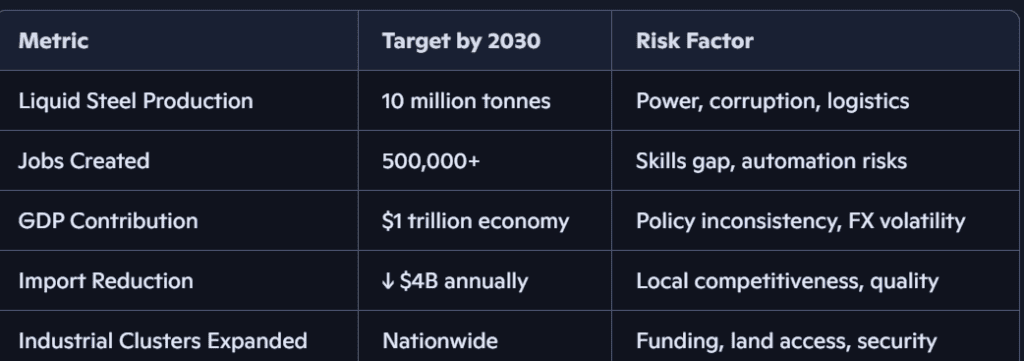
Recommendations for Real Impact:
The national Assembly should legislate a Steel Sector Act (SSA) to protect long-term plans from political interference, just as it should establish Independent Oversight Committees (IOC) with civil society and private sector representation.
The government must also ensure it deploys smart infrastructure such as digitised supply chains, biometric workforce tracking, and AI-powered maintenance.
Similarly, the federal government must create a Sovereign Steel Fund (SSF) to ring-fence financing from budgetary politics. It should link Steel to Education by funding metallurgy departments, vocational training, and Research and Development (R&D) partnerships with universities.
Conclusion: Will Nigeria Build or Break?
The steel sector is Nigeria’s litmus test for industrial credibility. If the country can overcome its chronic governance failures, the $1 trillion economy is not just possible—it’s inevitable. But if old habits persist, Ajaokuta will remain a monument to missed opportunity, and the trillion-dollar dream will rust before it’s forged.
TheDigger Intelligence Unit will continue to track this story.