
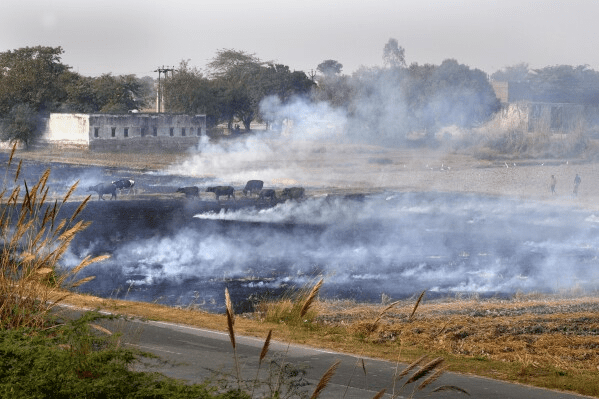
From the smog-choked skyline of Delhi to the hazy horizons of Lake Chad, a pioneering climate initiative led by the WCZ is confronting the growing threat of urban acidification. Armed with cutting-edge data and cross-border collaboration, the program aims to decode the chemical culprits polluting city air and reshape environmental policy across continents.
In an era where climate change is no longer a distant threat but a lived reality, New Delhi stands as a stark warning.
The city’s skies are thick with acidification, forming toxic “super-bubbles” that choke life and disrupt the oxygen-carbon dioxide balance essential for survival.
But this isn’t just Delhi’s crisis—it’s a glimpse into Nigeria’s potential future. As projections point to the complete disappearance of Lake Chad by 2033, experts warn that the surrounding region could face a similar fate.

The WCZ Climate-Maker Program, powered by EVO-POWAIR technology, emerges as a bold, science-driven solution—offering not just hope, but a blueprint for survival in the face of atmospheric collapse.
Industrial emissions from neighbouring regions and congested air corridors have created a suffocating “super-bubble” of toxic air. Oxygen masks are no longer futuristic accessories—they’re becoming daily necessities, even indoors.
This isn’t just pollution. It’s a breakdown of the oxygen-carbon dioxide cycle, the very rhythm of life. Acid rain, free radicals, and dwindling oxygen molecules are turning Delhi’s micro-atmosphere into a desert, threatening food production, water quality, and biological survival. But where the air turns hostile, innovation rises.
The WCZ Climate-Maker Solution
Enter the WCZ Climate-Maker Program, powered by EVO-POWAIR technology—a revolutionary system designed to dismantle these acidification super-bubbles from the ground to the mid-troposphere. At its core is the Autonomous POWAIR Suborbital Satellite.
This go-and-return marvel neutralises acid rain and greenhouse gases while delivering water carbonate to the ground for agricultural revival.
Water Carbonate here refers to water enriched with carbonates—compounds that help neutralise acidity in soil and water. When applied in agriculture, it can restore pH balance, improve soil health, and boost crop yields, especially in areas affected by acid rain or desertification.
Supporting this aerial effort is the POWAIR Micro-Station—a tri-hybrid, off-grid unit that transforms atmospheric air into bespoke water and electric power. It also generates carbon credits, making sustainability not just possible, but profitable.
In the same vein, “bespoke water” in this context means water that is custom-produced from atmospheric air using advanced filtration and condensation technologies.
It’s not just purified—it’s engineered to meet specific quality standards for agricultural, industrial, or even drinking use, depending on the application.
With over 3,340 configurations and zero need for subsidies, each station is a plug-and-play solution installed in just one hour and remotely managed via satellite.
The numbers speak volumes: a 21-year CAPEX of just $0.004839/kWh, OPEX between 3–6.6% of annual revenue, and a return on investment multiplying over 29 times.
This isn’t just a pitch. It’s a lifeline for Delhi—and a blueprint for every city gasping under the weight of industrial air. The WCZ Climate-Maker does more than clean the air. It’s rewriting the future of urban survival.
Nigeria’s Looming Environmental Crisis
The Author of the pitch, who doubles as the founder of WCZ and Chairman, CEO WCZ Group, Mario Verissimo Horta Lopes, a medical doctor cum Aeronautical Engineer turned physicist, in an exclusive interview with TheDiggerNews, warned that Nigeria and other regions surrounding Lake Chad are at risk of acidification if proactive measures are not urgently taken.
While New Delhi grapples with the harsh realities of atmospheric acidification, its experience serves as a cautionary tale for other vulnerable regions. One such area is Nigeria’s Lake Chad basin, where early signs of environmental decline mirror Delhi’s trajectory.
Though Nigeria has not yet reached a critical stage, experts warn that without urgent intervention, the same toxic super-bubble effect could emerge by 2033—driven by desertification, evaporative loss, and intensifying Saharan air corridors.
The lessons from Delhi are not distant—they are a preview of what could unfold in West Africa.
Nigeria’s Looming Environmental Crisis: Lessons from New Delhi. Lopes hinted that “fortunately, Nigeria has not yet reached the critical stage of atmospheric acidification seen in places like New Delhi.
“However, projections suggest that by around 2033, the region surrounding the former Lake Chad Basin could face a similar fate. This is why proactive measures must be taken now—before the crisis escalates.
“Many people don’t yet grasp the urgency. By examining New Delhi’s example, they can begin to understand what’s coming.
“By 2033, Lake Chad is expected to disappear entirely, and the Saharan air corridors will intensify the spread of acidification and desertification.”
Explaining further, he said: “This will likely lead to the formation of an ‘acidification super-bubble’—a dome of toxic air that traps pollutants and progressively contaminates surrounding areas.
“With an evaporation rate of 18 cubic meters per second, the region’s micro-atmosphere will degrade rapidly, threatening biodiversity, agriculture, and breathable air,” the renowned physicist stated.
The time to act is now. Waiting for the bubble to form means waiting too long.