

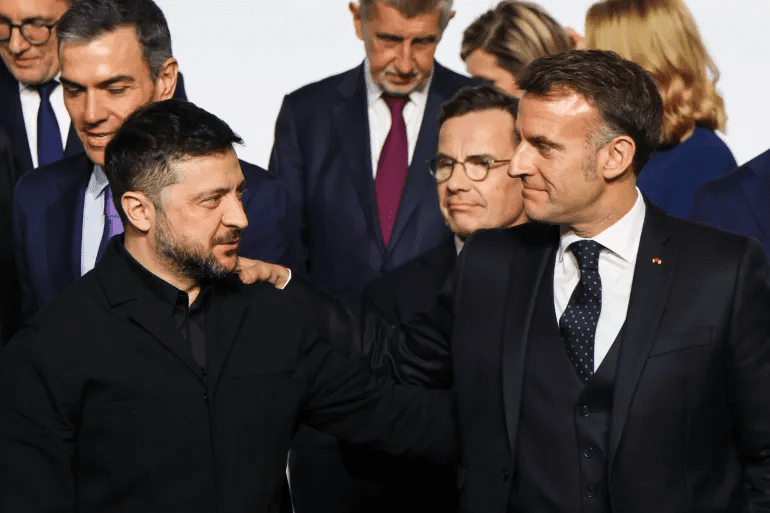
Macron, Zelenskyy, and Starmer unveil multinational support plan amid progress on ceasefire monitoring and long-term defence commitments.
Paris: In a landmark move that could reshape the trajectory of the war in Ukraine, French President Emmanuel Macron announced on Tuesday that talks in Paris had yielded “significant progress” on security pledges for Kyiv.
The declaration, signed by Ukrainian President Volodymyr Zelenskyy, Macron, and British Prime Minister Keir Starmer, commits a coalition of allies — including the United States — to deploy multinational forces in support of Ukraine’s defence, reconstruction, and strategic stability if a ceasefire with Russia is agreed.
The size and composition of the supporting forces were not disclosed, but officials confirmed that mechanisms for monitoring and verifying any ceasefire would be led by the United States.

More than two dozen countries, dubbed the “coalition of the willing,” have been working for months on ways to deter future Russian aggression should Moscow agree to halt its offensive.
Starmer emphasized that allies would participate in US-led monitoring, ensure long-term provision of armaments for Ukraine’s defence, and pursue binding commitments to guarantee support in the event of renewed Russian attacks.
“Peace in Ukraine is closer than ever,” he said, while cautioning that “the hardest yards still lie ahead.” He added that the UK and France would establish military hubs inside Ukraine if a peace deal is reached.
US envoy Steve Witkoff described the talks as a turning point, noting that security protocols for Ukraine are “largely finished” and that a “prosperity plan” is being developed to underpin reconstruction. “Durable security guarantees and robust prosperity commitments are essential to a lasting peace,” Witkoff said in a post on X.
German Chancellor Friedrich Merz echoed the sentiment, stressing that Ukraine’s economic strength is inseparable from its security. “Economic strength will be indispensable to guarantee that Ukraine will continue to credibly block Russia in the future,” he said.
But Merz also warned that compromises would be necessary to achieve a peace settlement, acknowledging that “we will not achieve textbook diplomatic solutions.”
While Kyiv and its allies hailed the Paris talks as a breakthrough, Moscow offered no immediate comment. Russian officials have reiterated demands for a comprehensive settlement and insisted that no ceasefire can be agreed until their conditions are met.
President Vladimir Putin has ruled out any deployment of NATO troops on Ukrainian soil, underscoring the gulf that remains between the two sides.
Despite the uncertainties, the Paris declaration marks the most concrete step yet toward a peace framework. With multinational forces, US-led monitoring, and commitments to Ukraine’s defence and prosperity, the coalition of allies is signaling its readiness to underwrite both the security and the reconstruction of a nation battered by nearly 4 years of war.