
By Park Jin-seong | THE CHOSUNILBO
An Artificial intelligence (AI) and a human engaged in a competition to translate a Korean literary work into English. Who won?
Recently, the Literature Translation Institute of Korea, under the Ministry of Culture, Sports and Tourism, conducted a blind test with 16 domestic English-language literature professors.

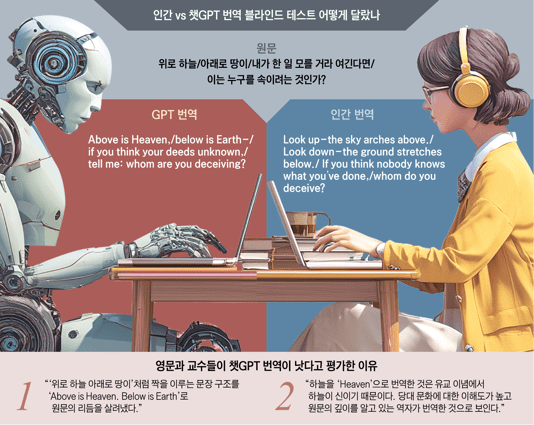
The test compared an English translation by a professional translator with one by ChatGPT of the Joseon-era poet Jang Yu’s poem ‘Shindokjam’ (Caution When Alone), slated for export to English-speaking markets.
Without revealing the translators’ identities, the professors were shown the original Korean text and the two translations and asked which was better. As a result, 12 professors chose the ChatGPT translation, 2 selected the human translation, and 2 declared it “undecidable.”
AI Translation Wins… “Language Learning Volume Surpasses Threshold”
Professors who supported the AI praised the ChatGPT translation for its deep understanding of Korean history and culture and for effectively preserving the original’s rhythm and style.
For example, in the line “If you think the sky above and the earth below will not know what I have done, whom are you trying to deceive?” the human translator rendered “sky” as “Sky,” while ChatGPT used “Heaven.”
Considering the author was a Confucian scholar, “Heaven,” which carries a divine concept, was deemed more appropriate than the physical “Sky.” Other evaluations noted, “The parallelism of the original was well expressed in English literary terms,” and “The concise word count preserves the original’s feel.”
Professors who preferred the human translation cited “fewer non-grammatical sentences” and “a more natural title translation.” One professor who declared it undecidable said, “If one of these were an AI translation, it would be difficult to argue which is better, as the difference was not significant,” adding, “It should be noted that AI has advanced to the point where it is hard to distinguish from human translation.”
Experts assess that large language models (LLMs) like ChatGPT are designed to understand context well, giving them an inherent strength in translation, and that their learning volume has reached a mature stage.
Choi Byung-ho, a research professor at Korea University’s Human-Inspired AI Research Centre, said, “At least in Korean-to-English translation, it has reached a level where it can replace human translators,” adding, “It is safe to assume that all publicly available data on the web has already been learned, and the learning volume has surpassed a critical threshold.”
The test was conducted by the office of the Democratic Party of Korea Representative Min Hyung-bae, a member of the National Assembly’s Culture, Sports, and Tourism Committee. Representative Min said, “AI is already an irreversible reality,” and “While leveraging AI’s efficiency, it is time to consider the cultural context and ethics unique to humans.”
‘World Literature Collection’ Stronghold Cracked… Absurd Mistranslations Like “I Don’t Care”
As AI’s translation skills have improved, publishers previously seen as strongholds for “World Literature Collections,” such as Minumsa and Munhakdongne, are emerging. They are using AI to translate works by masters whose copyright protection periods (70 years after the author’s death) have expired, without spending money.
Recently, a publisher that has released science and technology academic books for over 30 years became a topic of discussion in the publishing industry. From last October, they released 12 books, including ‘The Little Prince’ and ‘Metamorphosis’, in just three months. This publisher, without professional translators, used Gemini for translation and had human editors review the translations.
The problem arose with their translation of Homer’s epic ‘The Odyssey’: “Futile conversation is useless. Alppano? (It’s none of my business).” New slang like “Kingbapne! (I’m pissed!)” and “Subuljae (self-inflicted disaster)” also appeared in classical translations.
The publisher’s representative said, “We couldn’t afford translation fees, so we used AI translation. We intentionally left the slang translations to facilitate fun communication between generations.”
“Human Translators Will Use AI”
Overseas, business models that combine humans and AI have emerged. The UK-based *GlobeScribe* started a service last summer offering to translate a book for 100 dollars (approximately 145,000 Korean won). Considering that the minimum translation fee for a novel of around 1,000 manuscript pages in Korea is 3–4 million won, this is very affordable.
The publisher has AI translate most of the text, with human translators refining parts with high literary value or complexity. British translators are protesting. Ian Giles, president of the Society of Authors and Translators, told *The Guardian*, “Claiming that AI can match or even surpass the delicate work of human translators is completely wrong.”
Domestic translator Noh Seung-young said, “Since AI learns and uses translation sentences that humans have refined, most existing translated books will soon be sufficient with AI,” adding, “However, proofreading has become more important to prevent poor translations from AI.”