
TheDigger Intelligence Unit
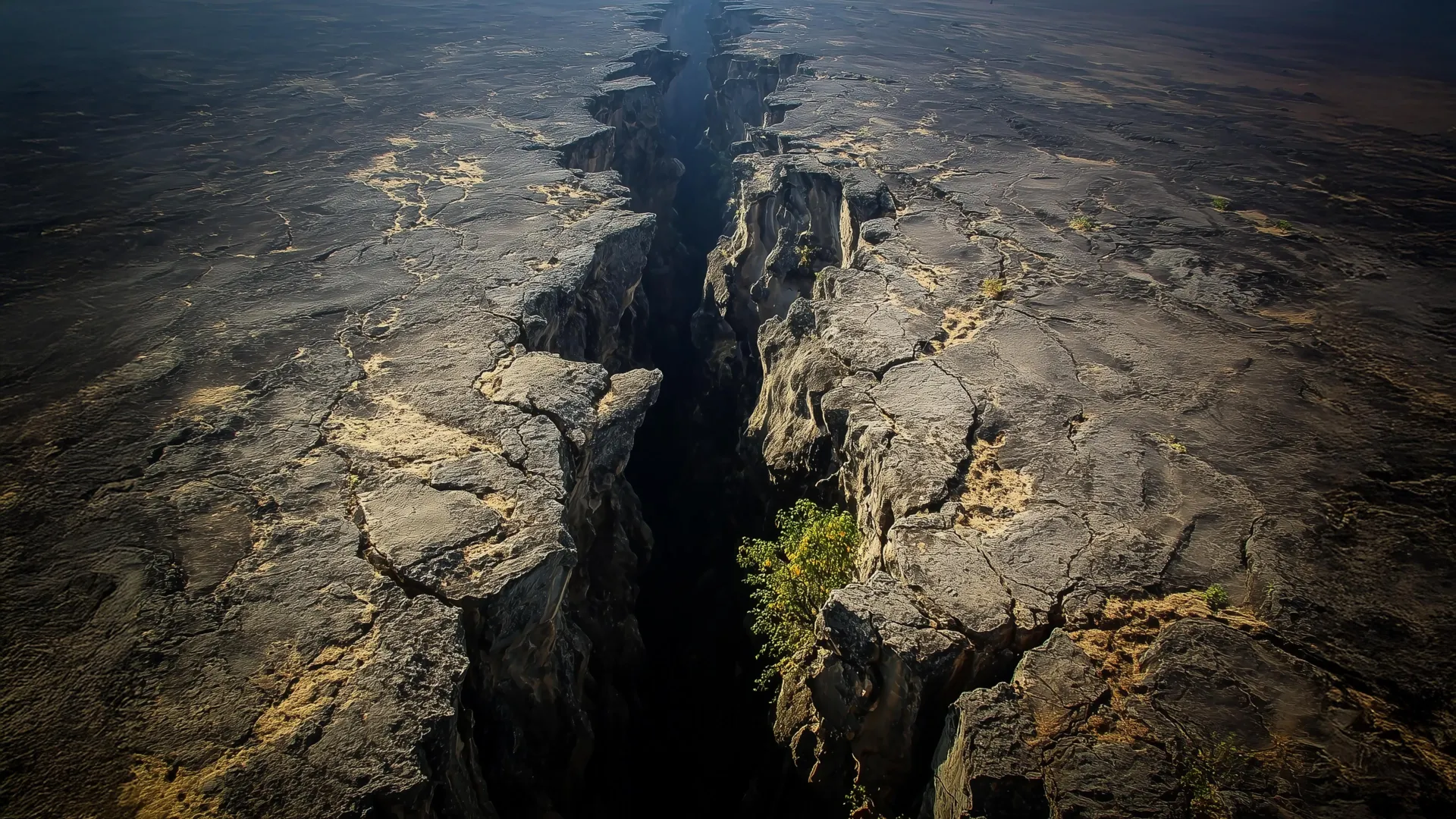
Scientists have discovered that East Africa is splitting apart more quickly than they once thought. New evidence shows the crust in the Turkana Rift has reached a crucial point.
The findings, published in Nature Communications, show that under the Turkana Rift, which stretches 500 kilometres across Kenya and Ethiopia, the Earth’s crust is only 13 kilometres thick in some places.
In other areas, it is more than 35 kilometres thick. This thinning, called “necking,” is a sign that the rifting process is far along. Over millions of years, this could cause Africa to split and a new ocean to form.

“Eastern Africa has progressed further in the rifting process than anyone had recognised,” said lead author Christian Rowan of Columbia University’s Lamont-Doherty Earth Observatory.
He said that as the crust gets weaker, it is more likely to break, which speeds up the separation of tectonic plates.
The Turkana Rift is part of the large East African Rift System, where the African and Somali plates are slowly moving apart by about 4.7 millimetres each year.
This movement causes volcanic eruptions and changes the landscape. It has also helped preserve one of the world’s richest collections of fossils.
Over 1,200 hominin fossils have been found in Turkana, making up almost a third of Africa’s discoveries.
These fossils are important because they give a rare and detailed look at early human evolution and the environment.
Scientists now think that the sinking caused by rifting made it easier for fossils to be preserved, making Turkana more of an archive of humanity than its birthplace.
The study also found signs of earlier failed rifts that weakened the crust and helped set the stage for today’s splitting.
“This is the first time we’ve seen a continent actively extending out like this,” said co-author Anne Bécel. “It’s a rare chance to watch a major earth process that has shaped continents around the world.”
Although this process takes millions of years, researchers warn that Africa’s geological future is already taking shape under Turkana’s thinning crust.