

Table of Contents
A committee was formed, a report submitted, FEC approval secured—yet Nigeria’s embassies remain in disrepair. In Abuja, knowing what to do rarely leads to action.
KEHINDE ADEGOKE unearths.
When Ambassador Sola Enikanolaiye appeared before the Senate this week for his screening as Minister of State for Foreign Affairs, he said something that should have stopped every Nigerian in their tracks — but didn’t.
He said a committee he was personally part of had already identified over 500 Nigerian government properties worldwide. A rescue plan for Nigeria’s crumbling foreign missions had already been prepared. The Federal Executive Council had already approved it. The legal framework was already in place.
In other words, Nigeria already knows exactly what to do. It has been known for years. It has committees, reports, approvals, and frameworks.
What it does not have — and has not had across three consecutive presidential administrations — is the will to act.

THE REPORT THAT NOBODY HAS SEEN
The committee report referenced by Enikanolaiye is not new. It is the latest in a series of rescue plans for Nigeria’s foreign missions produced and set aside over more than a decade.
In 2022, the federal government inaugurated the Presidential Committee to review the number and resourcing strategy of Nigeria’s diplomatic missions. The committee’s remit covered assessing missions’ revenue potential, causes and levels of indebtedness, and identifying cost-cutting and other measures to reduce expenses.
The committee’s report, submitted April 5, 2023, presented 115 recommendations for Nigeria’s diplomatic missions. Boss Mustapha stated it would be forwarded to President Buhari, but since the administration was set to exit in seven weeks, it would also be included in transition documents for the incoming Tinubu administration.
A 115-recommendation report on how to rescue Nigeria’s foreign missions was handed to a government with seven weeks left in office — and passed to the next administration as a transition document.
After two years, nothing was heard of the committee or its report.
Until this week, when a newly confirmed minister cited it at his Senate screening and said the Federal Executive Council (FEC) had just approved it.
Timeline: 2022 committee inaugurated. April 2023 report submitted. Buhari exits, Tinubu inherits. Two years of silence. May 2026 — FEC approves. Three years after submission. Three presidents. Zero implementation.
THE JONATHAN CHAPTER — WHERE IT REALLY BEGAN
The 2022 committee repeated a pattern that began even earlier.
Enikanolaiye himself acknowledged at his Senate screening that the missions had deteriorated since the Jonathan administration and that a proposal submitted during that era could have generated revenue to sustainably fund Nigeria’s missions. That proposal was set aside.
Former envoy Chuka Udedibia, a former ambassador to the Netherlands and ex-acting permanent secretary in the foreign ministry, points to the collapse of Nigeria’s once deliberate policy of buying embassy properties abroad — a programme that slowed after 1999.
The pattern is now unmistakable across three administrations:
Jonathan — proposal submitted, set aside.
Buhari — new committee inaugurated in 2022, 115-recommendation report submitted in April 2023, passed to successor as transition document.
Tinubu — inherited the report, sat on it for 2 years, the FEC approved it in 2026, but implementation has yet to begin.
Three presidents. Three opportunities. One result.
WHAT 115 RECOMMENDATIONS AND THREE YEARS OF SILENCE COST NIGERIA
While the report gathered dust, the consequences of inaction accumulated — in measurable, documented, and deeply embarrassing ways.
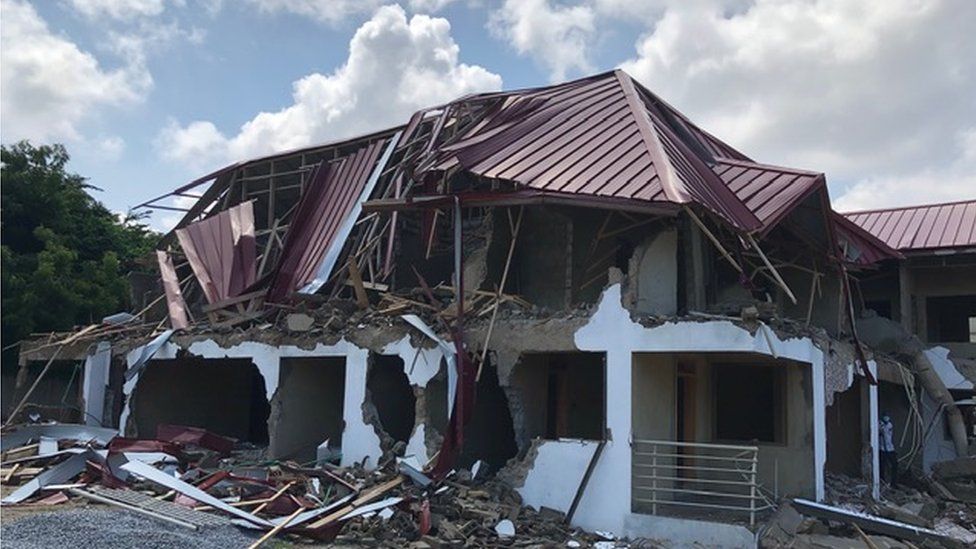
Years of budgetary shortfalls and foreign exchange fluctuations have left embassies crippled. Career diplomats and locally recruited staff are keeping the lights on — sometimes literally by begging landlords or power companies not to cut supply. Some embassy staff, diplomats for that matter, have taken their children out of school because they could not pay school fees.
Geoffrey Onyeama, former Foreign Affairs Minister, called the missions a “terrible embarrassment” and said underfunding harms Nigeria’s international image.
For a country campaigning for a seat on the United Nations Security Council and fielding candidates for top international posts, such as the Chief Justice of the International Court of Justice, the neglect of its foreign missions is more than embarrassing.
And the ambassador crisis compounded the funding crisis. In September 2023, Tinubu recalled all ambassadors and high commissioners worldwide. Nearly two years later, the embassies remained leaderless. This prolonged diplomatic vacuum echoes the delays seen during former President Muhammadu Buhari’s administration, which took 17 to 20 months to establish ambassadorial positions.
Despite receiving investment commitments worth $50.8 billion, foreign direct investments plunged by 70 per cent to $126.29 million in the first quarter — a situation analysts attributed to the absence of ambassadors to help broker deals.
The numbers tell the story that the reports were never fixed.
500 PROPERTIES — AND THE QUESTION NOBODY IS ASKING
At his Senate screening, Enikanolaiye revealed that Nigeria owns more than 500 government properties worldwide — many of which are either abandoned or underutilised.
This is the most explosive detail in the entire embassy crisis—and the one that has received the least scrutiny.
Nigeria owns property in London. In Washington. In New York. In Paris. In Beijing. In Tokyo. In Riyadh. In every major global capital, where prime real estate has appreciated dramatically since Nigeria’s properties were acquired, many of them decades ago.
The combined market value of 500 government-owned properties in global capitals could conservatively run into billions of dollars. Yet Nigerian missions cannot pay their electricity bills. Nigerian diplomats are withdrawing their children from school. Nigerian embassies are begging landlords not to lock their doors.
Nobody has published a full list of those 500 properties. Nobody has valued them. Nobody has explained why — across three administrations and more than a decade of committees and reports — those assets have not been unlocked to fund the very missions they are supposed to support.
The committee reported that the FEC just approved the report that was supposed to answer those questions. The report has never been published. Its 115 recommendations have never been tabled before the National Assembly. The Nigerian public — which owns those 500 properties through its government — has never been told what is in it.
THE ACCOUNTABILITY GAP
The accounts of Nigeria’s foreign missions were last audited about 14 years ago.
That single sentence encapsulates the governance failure at the heart of this crisis. A network of 109 missions across the world — spending public funds, generating consular revenue from passports and visas, managing hundreds of government properties — has not been comprehensively audited in fourteen years.
In that fourteen-year period, three presidents have come and gone. Multiple committees have been inaugurated and reported. One 115-recommendation rescue plan has been prepared, submitted, and approved. Zero comprehensive implementation has followed.
The Tinubu administration should revisit the report and draw on its recommendations where useful. As for resources, to strengthen Nigeria’s institutional capacity, the government should boost funding for the foreign ministry along with its parastatals.
That recommendation — from the International Crisis Group — was published in December 2024. It is still awaiting action.

WHAT ENIKANOLAIYE MUST NOW DO
Ambassador Sola Enikanolaiye has been confirmed. He has acknowledged the crisis. He was personally part of the committee that produced the rescue plan. He told the Senate that the FEC has approved it. He said the legal framework is in place.
He now has no excuse.
TheDiggerNews.com is putting five specific demands to the new Minister of State for Foreign Affairs — publicly and on the record:
1. Publish the full committee report — all 115 recommendations — for public scrutiny within 30 days of assumption of office.
2. Publish the complete list of Nigeria’s 500-plus government-owned properties abroad — with locations, current status, and estimated valuations.
3. Commission an immediate comprehensive audit of all 109 foreign missions — their debts, revenue, expenditure, and asset status.
4. Present a specific, costed, time-bound implementation plan for the Federal Executive Council (FEC)-approved recommendations to the National Assembly within 60 days.
5. Establish a public reporting mechanism — quarterly, published online — showing implementation progress against the committee’s recommendations.
These are not extraordinary demands. They are the basic minimum of accountability owed to citizens after a decade of national embarrassment.
THE BOTTOM LINE
Nigeria’s embassy crisis is not a mystery. It is not a complex, unsolvable problem. It is a governance failure with a documented diagnosis, a documented prescription, and a documented history of three consecutive administrations choosing not to fill it.
The committees have met. The reports have been written. The FEC has approved. The minister has been confirmed.
What happens next will tell Nigerians — and the world — whether this administration is different from the last two.
Or whether this is simply the beginning of a fourth chapter in the same story.
TheDiggerNews.com is seeking an audience with the Minister of State for Foreign Affairs, Ambassador Sola Enikanolaiye, the Ministry of Foreign Affairs, and the Federal Executive Council Secretariat. A Freedom of Information request for the full committee report and the complete list of Nigeria’s 500-plus overseas government properties is being filed. Responses will be published in full upon receipt. This investigation is ongoing.