

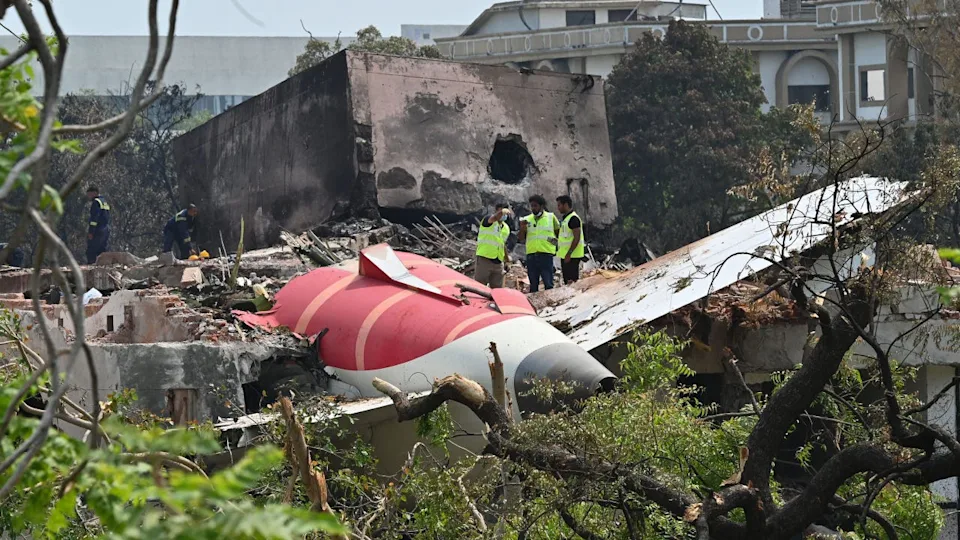
New Delhi: A preliminary report depicted confusion in the cockpit shortly before an Air India jetliner crashed and killed 260 people last month, after the plane’s engine fuel cutoff switches flipped almost simultaneously and starved the engines of fuel.
The Boeing 787 Dreamliner bound for London from the Indian city of Ahmedabad began to lose thrust and sink shortly after takeoff, according to the report on the world’s deadliest aviation accident in a decade released on Saturday by Indian accident investigators.
The report by India’s Aircraft Accident Investigation Bureau (AAIB) about the June 12 crash raises fresh questions over the position of the critical engine fuel cutoff switches.
Almost immediately after the plane lifted off the ground, closed-circuit TV footage showed that a backup energy source, known as a ram air turbine, had deployed, indicating a loss of power from the engines.

In the flight’s final moments, one pilot was heard on the cockpit voice recorder asking the other why he cut off the fuel. “The other pilot responded that he did not do so,” the report said.
It did not identify which remarks were made by the flight’s captain and which by the first officer, nor which pilot transmitted “Mayday, Mayday, Mayday” just before the crash.
The commanding pilot of the Air India plane was Sumeet Sabharwal, 56, who had a total flying experience of 15,638 hours and, according to the Indian government, was also an instructor at Air India. His co-pilot was Clive Kunder, 32, who had 3,403 hours of total experience.
The fuel switches had almost simultaneously flipped from run to cutoff just after takeoff. The preliminary report did not say how the switches could have flipped to the cutoff position during the flight.
“We care for the welfare and the well-being of pilots, so let’s not jump to any conclusions at this stage, let us wait for the final report,” Civil Aviation Minister Ram Mohan Naidu told local news channels.
The crash presents a challenge for Tata Group’s ambitious campaign to restore Air India’s reputation and revamp its fleet, following the carrier’s takeover by the government in 2022.
Air India acknowledged the report in a statement. The carrier stated that it was cooperating with Indian authorities but declined to provide further comment.
FUEL SWITCHES
Experts have stated that a pilot would not be able to move the fuel switches accidentally.
“If they were moved because of a pilot, why?” asked U.S. aviation safety expert Anthony Brickhouse.
The switches flipped a second apart, the report said, roughly the time it would take to shift one and then the other, according to U.S. aviation expert John Nance. He added that a pilot would typically never turn the switches off in flight, especially as the plane is starting to climb.
Flipping to the cutoff almost immediately cuts the engines. It is most often used to turn engines off once a plane has arrived at its gate at the airport and in specific emergencies, such as an engine fire. The report does not indicate there was any emergency requiring an engine cutoff.
At the crash site, both fuel switches were found in the run position, and there had been indications of both engines relighting before the low-altitude crash, said the report, which was released around 1:30 a.m. IST on Saturday (2000 GMT on Friday).
Asked about the report, the father of first officer Kunder told reporters, “I am not from the airline”, declining to comment further during a prayer meeting held in memory of the airline’s crew on Saturday in Mumbai, where emotional scenes played out among grieving relatives.
The U.S. National Transportation Safety Board thanked Indian officials in a statement, noting that the report contained no recommended actions aimed at operators of Boeing 787 jets or the GE engines.
The U.S. Federal Aviation Administration stated that its priority was to follow the facts wherever they led and was committed to promptly addressing any risks identified throughout the process.
Boeing said it continued to support the investigation and its customer, Air India. GE Aerospace did not respond immediately to a request for comment.
CRASH PROBE
The AAIB, an office under India’s civil aviation ministry, is leading the probe into the crash, which killed all but one of the 242 people on board and 19 others on the ground.
Most air crashes are caused by multiple factors, with a preliminary report due 30 days after the accident, according to international rules, and a final report expected within a year.
The plane’s black boxes, combined cockpit voice recorders and flight data recorders, were recovered in the days following the crash and later downloaded in India.
The report said “all applicable airworthiness directives and alert service bulletins were complied with on the aircraft as well as engines.”
The airport’s closed-circuit TV recording from Ahmedabad had earlier shown the Air India plane rising to a height of 650 feet after takeoff, but then suddenly losing altitude, crashing in a fireball into a nearby building.
The investigation report stated that as the Dreamliner lost altitude, it initially made contact with several trees and an incineration chimney before hitting the building.
Air India has faced additional scrutiny on other fronts after the crash.
The European Union Aviation Safety Agency announced last week that it plans to investigate its budget airline, Air India Express, after Reuters reported that the carrier failed to promptly replace engine parts of an Airbus A320 by a directive and falsified records to show compliance.
India is banking on a boom in aviation to support its broader development goals, with New Delhi stating that it aims for India to become a job-creating global aviation hub, similar to Dubai.