
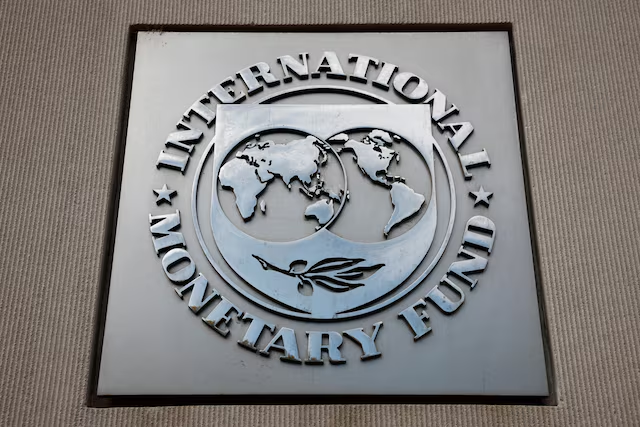
Washington: The International Monetary Fund (IMF) says strong institutions and policies are crucial to economic growth.
The Managing Director of the IMF. Kristalina Georgieva said this on Monday DIGGER 37in Washington while interacting with Civil Society Organisation (CSOs) on the sidelines of the 2025 Annual Meetings of the IMF/World Bank Group.
Georgieva said that independence of central banks and their supervisors would also be a significant focus at the meetings.
“You will hear us during these meetings talk a lot about the precious value of strong institutions and sound policies.

“You will hear us talking about independence of central banks and supervisors so we can have that strength, resilience coming from this foundation,” she said.
According to her, the IMF has been advocating over the years for transferring a significant portion of economic activity from the state’s hands to the private sector’s hands.
She noted that state-owned enterprises in countries where they remain significant are now better positioned on a competitive footing than before.
“And what we find is that the private sector is more agile and adaptable when a shock hits. It is faster to redirect resources to adapt to this shock,” she said.
Georgieva said that the impact of US tariffs was no longer as dramatic as feared, adding that US tariffs are lower today than they were at the announcement in May.
She described trade as a powerful engine of growth, adding that access to finance has remained somewhat better than was expected in April.
“In other words, conditions are better than we feared, but they are at the same time worse than we did. Growth is slow. Debt is high and the risks of financial downturn are quite prevalent,” she said.
She said that countries would have to be much more focused on bringing debt levels down, adding that a very high level of debt indicates a crisis.
She noted that, ironically, debt levels in advanced economies and emerging markets continued to rise, whereas in low-income countries, they were decreasing.
“But they are going down because they have no access to finance. And even if they are going down, it is still challenging for low-income countries to cope with these levels of debt.
“That concentration of policies to bring debt down, for us, is going to be very, very present.
“We have come up to the Global Sovereign Debt Roundtable with the rulebook for debt restructuring.
“We are working quite intensively with the World Bank on the so-called three-pillar approach for countries that may not have unsustainable debt but have very severe liquidity problems.
“We are looking more into how to deploy the fund, our good offices, to help debtors and creditors identify pathways for resolving debt differences,” she said.
She said that the annual meetings would focus on a credible assessment of the actual debt situation and then get a path forward.
Georgieva said that there would also be continuous engagements with the G20.
According to her, the G20 Common Framework has made progress in its development, and we want this to be a high priority.
“Countries can only grow out of debt, and the attention on growth and how to create better conditions for economies will be a significant focus of the IMF and the World Bank.
“The focus is to create jobs for people, to create growth opportunities. This is very important both for us and the World Bank. We have established an external advisory panel for the fund.
“It is on entrepreneurship and growth. So, every quarter, we meet with people from outside to discuss how we can improve our efforts to help our countries grow their economies.
“A huge focus in this growth conversation is on young people,” she said.