

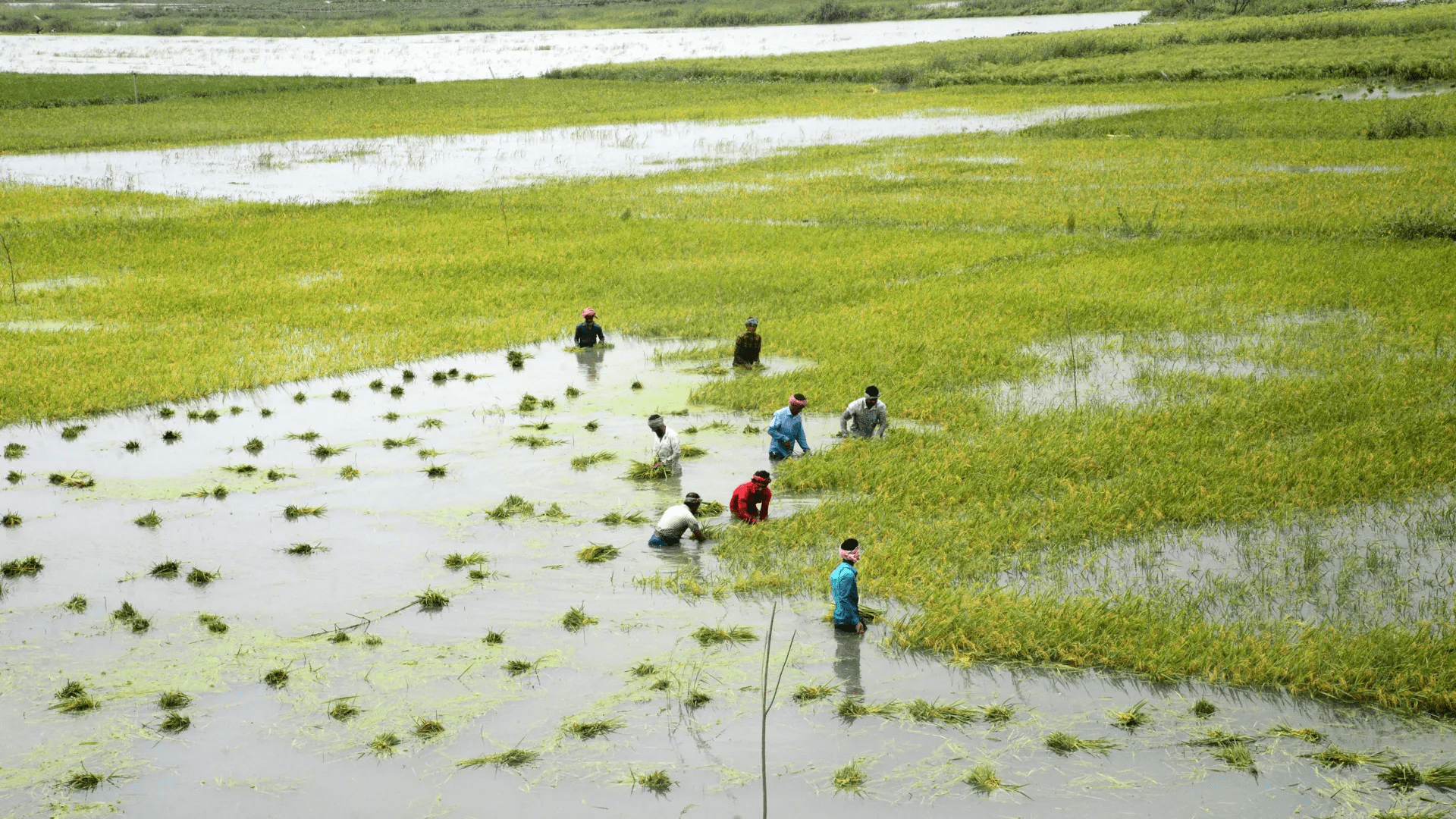
Flooding is emerging as a silent but powerful destroyer of global rice supplies—and the danger is accelerating.
Scientists discovered that a week of complete submergence is enough to kill most rice plants, making flooding a far greater threat than previously understood. Intensifying extreme rainfall events may amplify these losses unless vulnerable regions adopt more resilient rice varieties.
A new study from Stanford University reveals that intense flooding has significantly reduced rice harvests worldwide in recent decades, putting the food supply of billions of people who rely on the grain as a dietary staple at risk. Between 1980 and 2015, annual losses averaged approximately 4.3%, or roughly 18 million tons of rice per year, according to research published by Stanford University on November 14 in Science Advances.
The researchers found that the damage has worsened since 2000, as extreme floods have become more common in many of the planet’s major rice-growing regions.

They report that climate change is likely to increase further the frequency and severity of these destructive floods in the coming decades.
Droughts, Floods, and a Delicate Balance for Rice
Scientists and farmers have long known that rice yields fall during droughts.
The new study provides fresh insights into this picture, estimating that droughts reduced rice yields by an average of 8.1% per year during the 35-year study period.
At the same time, the work draws attention to a related but less-examined danger from too much water. Rice plants benefit from shallow standing water during early growth, yet prolonged or deep flooding can severely damage or kill the crop.
“While the scientific community has focused on damage to rice yield due to droughts, the impacts of floods have not received enough attention,” said Steven Gorelick, the study’s senior co-author and a professor of Earth system science in the Stanford Doerr School of Sustainability.
“Our research documents not only areas where rice yields have suffered due to past flooding, but also where we can anticipate and prepare for this threat in the future.”
What Counts as a ‘Rice-Killing’ Flood
The research team clearly spells out, for the first time, the conditions that turn a flood into a lethal event for rice, said lead study author Zhi Li, who worked on the project as a postdoctoral fellow in Gorelick’s lab at Stanford and recently joined the faculty of the University of Colorado Boulder.
They found that a whole week of complete submergence during the plant’s growth cycle is the critical tipping point. “When crops are fully submerged for at least seven days, most rice plants die,” Li said.
“By defining ‘rice-killing floods,’ we were able to quantify for the first time how these specific floods are consistently destroying one of the most important staple foods for more than half of the global population.”
How the Researchers Measured Flood and Drought Damage
To estimate the impact of past droughts and floods on rice production, scientists combined several lines of evidence.
They drew on information about rice growth stages, annual global rice yields, a worldwide database of droughts and floods dating back to 1950, a model of how floods behave across landscapes, and a simulation of soil moisture levels over time in major rice-growing river basins.
Their analysis indicates that, in the coming decades, the most intense week of rainfall in key rice-growing basins worldwide could deliver 13% more rain than the average for those regions during the 1980-2015 baseline period.
This projected increase suggests that rice-killing flood conditions may become more common as the climate continues to warm.
Flood-Resistant Rice Varieties and High-Risk Regions
The broader adoption of flood-resistant rice varieties could help mitigate future losses, particularly in areas that face the highest risk of flooding.
The study highlights the Sabarmati Basin in India, which experiences the longest rice-killing floods, along with North Korea, Indonesia, China, the Philippines, and Nepal, where the impact of such floods on rice yields has grown the most in recent decades.
The most significant total losses have occurred in North Korea, East China, and India’s West Bengal.
The researchers also identified exceptions, such as India’s Pennar Basin, where flooding appears to boost rice yields. They suggest that in these locations, hot and dry conditions may allow standing floodwater to evaporate quickly, reducing long-term damage and sometimes even creating favourable moisture conditions for the crop.
Compounding Climate Stresses on Rice
For Gorelick and Li, the new findings underscore the importance of understanding how rice responds not only to floods and droughts, but also to heatwaves and cold stress, both individually and when they occur in succession.
Earlier research has shown that rapid swings from drought to flood and back again can nearly double rice yield losses compared with single flood or drought events on their own.
According to the authors, “How these combined effects can be mitigated remains a major challenge.”