Abuja: President Bola Ahmed Tinubu has called on G20 leaders to prioritize equitable technology transfer and inclusive investment strategies that empower African nations.
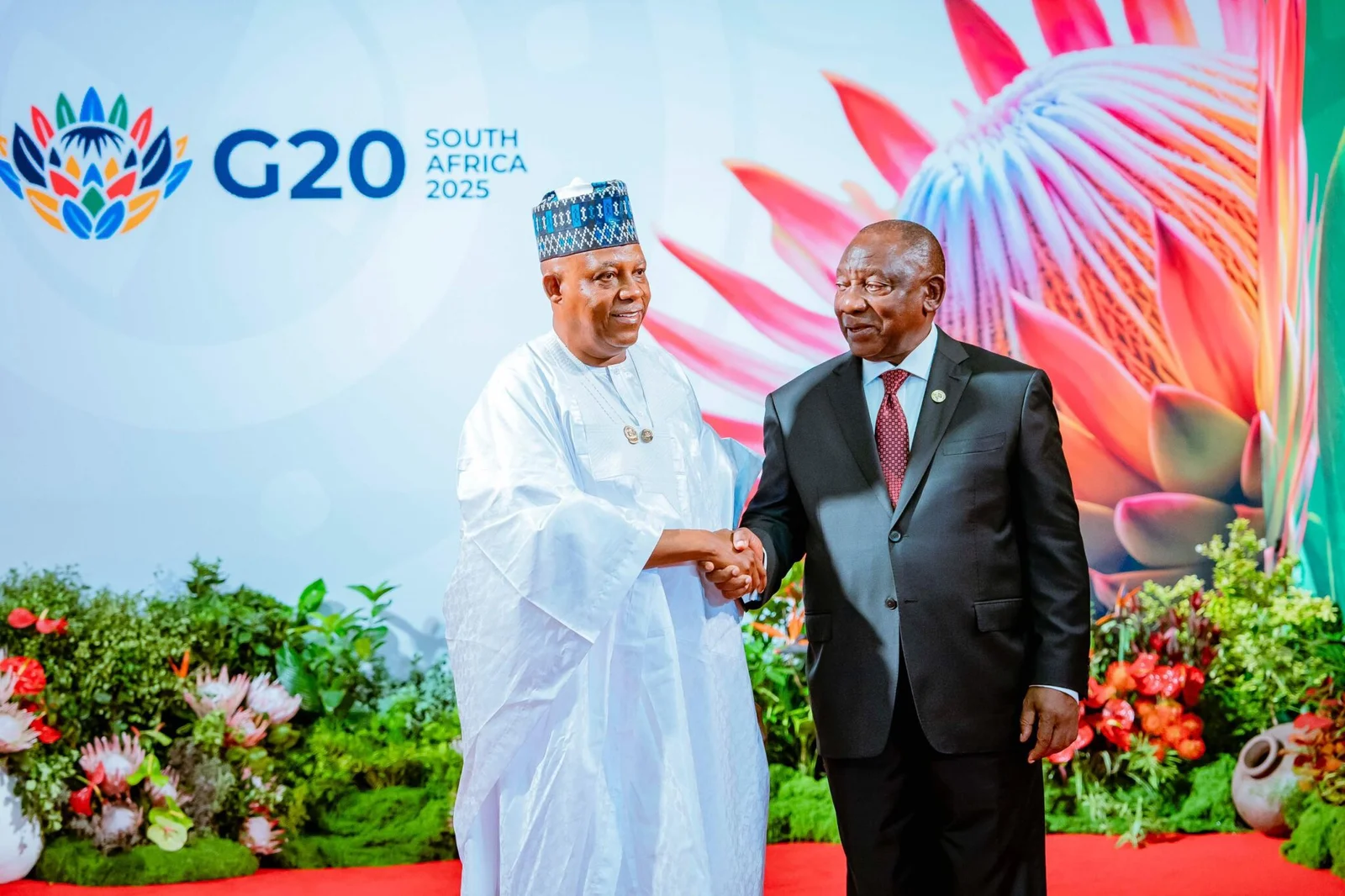
Tinubu, represented by Vice President Kashim Shettima, made the call at the Third Session of the 2025 Group of 20 (G20) Leaders’ Summit, held at the Johannesburg Expo Centre in South Africa.
The theme of the summit is “A Fair and Just Future for All: Critical Minerals, Decent Work, Artificial Intelligence.”
He noted that the task before G20 leaders, development partners, and governments is to ensure that AI remains a servant of humanity, not a force that reshapes society at the expense of those it ought to uplift.

He urged the G20 leaders and partners to build a future in which Africa is not merely a supplier of raw materials but a continent of value creation, innovation, and dignity in work.
Similarly, Tinubu advised global leaders to develop a more equitable and responsive system to manage international financial flows and to sincerely address recurring debt crises in ways that meet the needs of all nations.
This, he said, had become necessary because many developing countries still grapple with systemic barriers that constrain economic growth, undermine trade, and limit financial inclusion.
He regretted that the multilateral frameworks currently relied on no longer reflect the complexities of the present world, as they were “built in an era far removed from” the challenges of the present.
The Nigerian leader called for a global framework that benefits communities hosting critical minerals in Nigeria and Africa, ensuring value addition at the source.
The President highlighted that for Nigeria and Africa, critical minerals are more than natural deposits, as they hold the promise of industrial transformation for the continent.
He stressed that relevant authorities and stakeholders must ensure that the extraction and trade of critical minerals are governed by fairness, transparency, and accountability.
Tinubu emphasised that such responsible extraction and trade are necessary to ensure that the wealth generated from hosting communities translates into shared progress.
” Nigeria calls for a global framework that promotes value addition at the source, supports local beneficiation, and ensures that communities hosting these resources are not left behind.
” The issue before us reaches far beyond the narrow arithmetic of economics and speaks to the moral character of the world we aspire to build.”
The Nigerian leader further stated that as the world advances through green and digital transitions, progress must remain people-centred.
“Decent work is the anchor that makes these transitions fair, inclusive, and sustainable. It is the foundation of development that ensures every person has the opportunity to contribute, thrive, and share in national prosperity. “
Tinubu disclosed that Nigeria, through the Renewed Hope Agenda, is investing in future-ready skills by empowering Nigerian youths through digital literacy, vocational training, and entrepreneurship.
” Nigeria supports the creation of global ethical standards for AI that uphold safety, transparency, and equity.
” We must ensure that AI becomes a tool of empowerment, not exclusion; of job creation, not displacement,” Tinubu said.
The President called for deliberate partnerships between developed and developing nations, between the public and private sectors, and between innovation and inclusion.
“The G20 must therefore address systemic bias and foster sustained multilateral dialogue to ensure that the benefits of AI are shared equitably and its risks responsibly managed. “
The President noted that within a broader vision of shared responsibility and global stewardship, critical minerals, decent work, and artificial intelligence are bound by a single calling.
” Which is to shape an economy that uplifts rather than excludes; an economy that measures its strength not only by growth but by the dignity it affords every human being.”
“For trade to be truly inclusive, the G20 must take bold and deliberate steps towards reforming the international financial architecture and the global institutions that sustain it.
“Only a more equitable and more responsive system can manage global financial flows with fairness, address recurring debt crises with sincerity and meet the needs of all nations.
” Especially those in the Global South who have too often stood at the margins of global opportunity.”
President Tinubu said it would be difficult for Africa to realise a positive paradigm shift “in its development trajectory without a collective resolve of the G20.”
He noted that the continent cannot rise on the wings of aspiration alone without confronting the persistent regional challenges.
” Particularly, the urgent need for sustainable financing to ensure the effective implementation of our developmental priorities.”
The Nigerian leader observed that rising debt burdens have continued “to drag economies back into cycles of fragility,” transforming “local difficulties into global vulnerabilities.”
Tinubu implored the G20 to place debt sustainability and the responsible utilisation of critical minerals at the heart of its agenda for inclusive development.
” The G20 must, in adopting the Leaders’ Declaration, take with utmost seriousness the responsibility to advance policies that drive sustainable growth, promote financial inclusion and confront emerging risks.”