
The Tinubu administration has banned the establishment of new tertiary institutions for 6 years, betting that consolidation will fix a broken system. With 2.2 million students competing for fewer than 600,000 university places, not everyone is convinced. TOYE FALEYE writes:
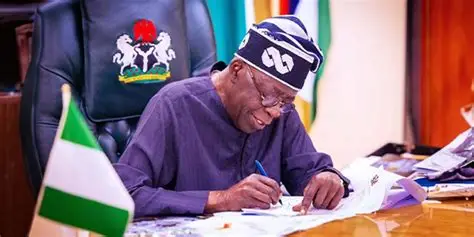
On March 5, 2026, President Bola Ahmed Tinubu’s administration imposed a six‑year embargo on the establishment of new universities, polytechnics, and colleges of education in Nigeria.
The Federal Executive Council (FEC) approved the decision, framing it as a chance to consolidate and stabilise the country’s sprawling tertiary education sector.
The Policy Shift

Nigeria has seen a rapid expansion of tertiary institutions over the past two decades, particularly private universities. Yet many of these schools struggle with sustainability, low enrollment, and poor infrastructure.
Education Minister Tunji Alausa said the embargo aims to improve the quality of existing institutions rather than multiply new ones that cannot be properly regulated or funded.
This breaks sharply from the expansionist approach of previous administrations, which routinely celebrated the licensing of new universities as evidence of progress. Tinubu’s government is signalling that unrestrained growth has become a liability.
The Silent Gaps
Nigeria’s public universities remain chronically underfunded, plagued by strikes, overcrowded classrooms, and decaying infrastructure.
Private universities, though more agile, often struggle to attract enough students to stay financially viable. Accreditation standards are inconsistently enforced, casting doubt on the quality of degrees awarded.
The freeze acknowledges these gaps, but raises harder questions. Will halting new institutions improve the fortunes of existing ones, or will it simply shut out a growing youth population desperate for higher education?
Historical Background
Nigeria’s higher education system has expanded rapidly since independence. The first generation of universities — Ibadan, Nsukka, Ahmadu Bello, and Ife — were elite institutions modelled on British counterparts.
By the 1980s and 1990s, surging demand prompted the creation of more federal and state universities, but funding never kept pace.
The 2000s brought a wave of private universities licensed by the National Universities Commission (NUC), many founded more for prestige than sustainability. Tinubu’s embargo is the latest attempt to shift the focus from expansion to consolidation,
Voice from the Sector
Lecturers have cautiously welcomed the move. A University of Lagos professor remarked, “We don’t need more universities; we need better universities. Expansion without investment is meaningless.”
Students, however, are alarmed. With over 2.2 million JAMB candidates in 2026 competing for fewer than 600,000 slots, many fear being locked out.
A candidate in Ibadan asked: “If they stop creating new universities, where will the rest of us go?”
ASUU has stressed that without greater funding and improved lecturer welfare, the freeze will be cosmetic. Parents’ associations fear reduced access, while private investors argue the embargo chills much‑needed private-sector participation.
Comparative Data: Nigeria vs. Peers
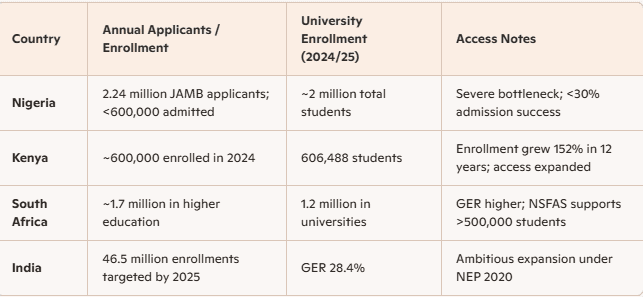
This comparison shows Nigeria’s crisis starkly: while Kenya and South Africa have expanded access significantly, and India is pushing toward a 50% Gross Enrollment Ratio by 2035, Nigeria admits fewer than one‑third of its applicants each year.
The Road Ahead
Tinubu’s embargo is more than a bureaucratic freeze; it is a statement about the state of Nigerian higher education. By halting expansion, the government is acknowledging that quality has been sacrificed for quantity. Yet the success of this policy will depend on whether reforms — funding, regulation, and modernisation — follow.
Without urgent investment in existing institutions, the embargo risks deepening the very crisis it set out to solve.