

Three bodies. Three processes. Three documents. And not a single Nigerian legislator, journalist, or citizen has seen one page of any of them.
TheDigger Intelligence Unit
The governors say they have submitted a framework. The Inspector-General has a committee working on one. The Senate has pledged to amend the constitution by year-end. Yet, no Nigerian legislator, journalist, or citizen has seen a page of these documents. This is what coordination looks like when the goal is announcement, not accountability.
THE ANNOUNCEMENT

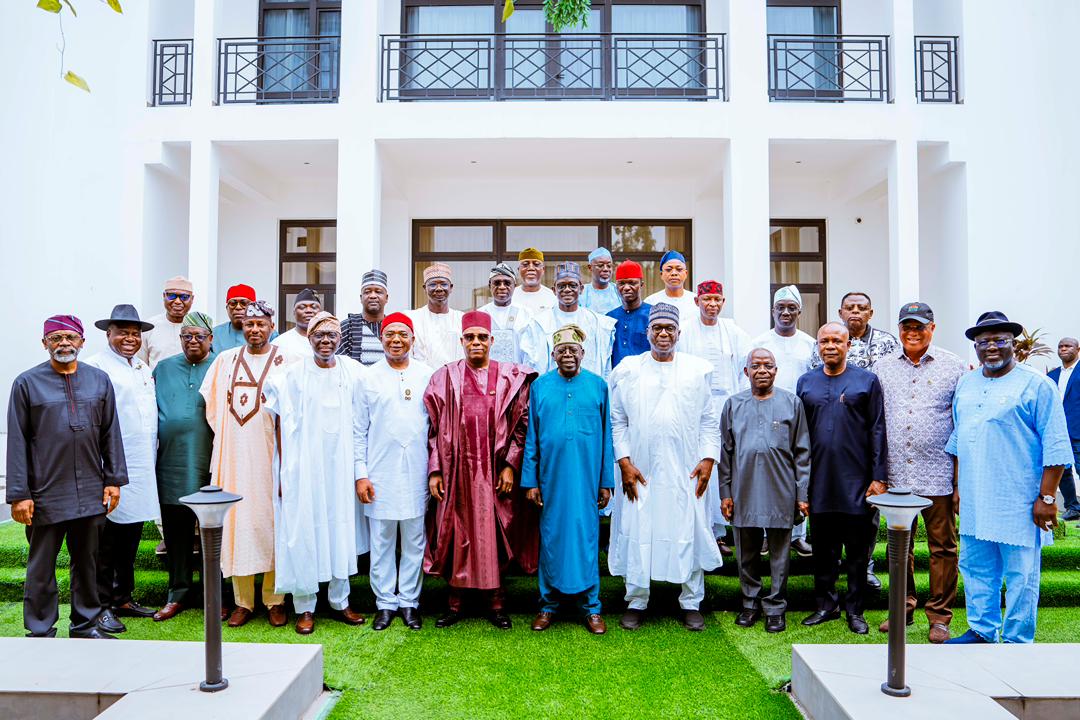
On Sunday, March 22, 2026, the Nigeria Governors’ Forum announced that it had submitted a framework for the establishment of state police to the National Assembly, describing the move as part of renewed and unified efforts under President Bola Ahmed Tinubu to address the nation’s continuing security challenges.
NGF Chairman and Kwara Governor Abdulrahman AbdulRazaq made the disclosure during a Sallah homage to President Tinubu at his Ikoyi residence in Lagos, stating that discussions were ongoing among various security organisations led by the National Security Adviser, Mallam Nuhu Ribadu, and that the NGF had made its contribution. “That document will be taken to the National Assembly to see how we can have a legislative framework for state police,” he said.
By Monday morning, virtually every major Nigerian media outlet had carried the announcement. All reported the same thing: the announcement. None has seen or described the document. Not a single page has been published.
That is not a framework. That is a press release dressed as one.
THREE BODIES, THREE PROCESSES, ZERO COORDINATION
What the NGF announcement obscured is that the “broad framework” it references is not one document. It is at least three separate processes, running simultaneously, with no publicly visible coordination between them.
Process One: The NGF Submission
The governors have submitted their contribution to the National Security Adviser, Nuhu Ribadu. What it contains — specific recommendations on funding, recruitment, oversight, constitutional triggers, or accountability mechanisms — has not been described by any governor or official. AbdulRazaq’s statement was the sum total of the public disclosure: a document exists, it has been submitted, and it will go to the National Assembly. That is all Nigerians have been told about a proposal that will fundamentally reshape the nation’s security architecture.
Process Two: The IGP’s Implementation Committee
On March 4, 2026 — barely two days after his confirmation — Inspector-General of Police Tunji Disu inaugurated an eight-member committee to drive the implementation of state police, chaired by Professor Olu Ogunsakin, Director-General of the National Institute for Police Studies.
The committee is charged with formulating comprehensive policy systems, operational guidelines, and coordination mechanisms for state police structures, covering critical areas such as training, recruitment, resource allocation, funding models, oversight, and intergovernmental collaboration.
Over three weeks after its inauguration, the committee has produced no interim report, public consultation, or conditions of reference. It is working — but working in private, on a matter of deep public consequence.
Process Three: The Senate Constitutional Review
Senate spokesperson Yemi Adaramodu confirmed that the upper chamber would immediately resume work on the constitutional review once plenary reconvened, following President Tinubu’s formal request to the National Assembly to begin amending the constitution to incorporate state police.
The Senate has pledged to complete the amendment before the end of 2026, with Adaramodu stating: “We are giving our assurance that before the end of this year, the amendment will be done so that we can have the state police.”
Yet the Senate’s committee — which reportedly conducted consultations and compiled stakeholder submissions — has published none of those findings. The consultations happened. The reports exist. They remain invisible to the public.
THE NSA BOTTLENECK
Here is the structural question nobody is asking: why is the National Security Adviser—whose main mandate is intelligence and national security strategy—serving as the central coordinating body for efforts that should be guided by the legislative process, such as constitutional amendments?
The NSA, as a security official, focuses on intelligence coordination and national security. While the state police establishment requires a constitutional amendment—legally and democratically the domain of the legislature—the NGF submitted its framework to Ribadu rather than the National Assembly. The IGP’s committee reports within police structures, and the Senate’s committee proceeds separately. This elicits questions about why the NSA is serving as the apparent hub for all processes, given that the task is a legislative one.
Three processes. Three institutions. One National Security Advisor serves as the informal clearinghouse among them, and none of their outputs is visible to the public or the legislature, which must ultimately vote on any amendment.
President Tinubu himself, during his address to the House of Representatives, warned that the creation of state police must not be “a straight free fall for everybody,” stressing the need for checks and balances drawn from past experiences to prevent abuse by governors. That warning is sound. But the process used to design those very checks and balances is itself operating without checks, transparency, or public accountability.
WHAT THE EXPERTS ACTUALLY RECOMMEND
The most detailed publicly available framework on state police comes not from the governors, not from the IGP’s committee, and not from the Senate — but from the National Assembly’s own research institution.
The National Institute for Legislative and Democratic Studies published a policy brief in February 2026 laying out three specific legislative options:
First, amending Section 214 of the 1999 Constitution to move policing onto the Concurrent Legislative List, allowing states to be constitutionally empowered to oversee policing while federal oversight is retained. This approach — moving policing over the Concurrent List — has been endorsed by APC chieftain Ayodele Arise, who argued it would allow the federal government to retain its police while states establish their own forces.
Second, alongside any constitutional amendment, establishing defined recruitment standards, operational rules, funding formulas, and responsibility systems for state Police Service Commissions — the institutional infrastructure without which any state police force risks becoming a tool of gubernatorial power rather than public safety.
Third — and most significantly — a phased pilot implementation in 12 states, 2 per geopolitical zone, with lessons from the pilot guiding the national rollout. This is the most cautious, evidence-based option available. It also happens to be the option none of the three parallel processes has publicly endorsed or rejected.
That NILDS document is the closest thing Nigeria has to a published framework. It was produced by the National Assembly’s own research arm. It has not been referenced in a single official statement by any governor, the IGP, or the Senate leadership in the weeks since its publication.
THE WEAPONISATION QUESTION NOBODY IS ANSWERING
The central concern about state police — raised by civil society, security analysts, opposition voices, and even the President himself — is the risk of weaponisation by state governors against political opponents, ethnic minorities, and press freedom.
Senate Leader Opeyemi Bamidele, Vice Chairman of the Senate Committee on the Review of the 1999 Constitution, has publicly warned that any police structure must include strong mechanisms for oversight, accountability, and transparency, noting that the path to constitutional amendment must be carefully navigated and requires broad consensus among federal, state, and local governments.
That warning has been made. But the supervisory mechanisms Bamidele calls for remain undesigned in public. The NGF framework — whose governors benefit from state police powers — was produced without published consultation with civil society, the judiciary, minorities, or the press. The IGP’s committee has consulted no one publicly. The Senate committee’s geopolitical consultations produced compiled reports — reports that remain unpublished.
Nigeria is designing a game-changing — and potentially dangerous — security instrument entirely behind closed doors. The public has only been told that a framework exists, but not what it says, who designed it, what safeguards it contains, or whether any independent voice shaped it.
THE QUESTIONS THAT DEMAND ANSWERS
TheDiggerNews puts the following questions to the NGF Secretariat, the Office of the Inspector-General of Police, the Office of the National Security Adviser, and the Senate Committee on Constitutional Review:
What are the specific contents of the NGF’s submission to the NSA on state police?
Has the IGP’s implementation committee produced any interim report, and if so, will it be published?
On what legal or procedural basis is the NSA coordinating a constitutional amendment process rather than the National Assembly’s own committees?
What supervision and accountability mechanisms have been proposed to prevent the weaponisation of state police by governors?
Has any civil society organisation, minority rights body, or independent security analyst been formally consulted in any of the three framework processes?
Will the text of the NGF submission, the IGP committee’s framework, and the Senate constitutional review committee’s compiled findings be published before any constitutional amendment is tabled?
Nigerians are waiting.
WHAT NEXT
The Senate’s own spokesperson described state police as “a popular demand,” adding that the President, the governors, and the National Assembly were all committed to it. That political alignment is real. It may also be the problem. When everyone in power agrees on something, the impulse to scrutinise the details weakens. The history of Nigerian governance is littered with popular reforms that turned into instruments of the very abuses they were designed to prevent.
State police may well be the right reform for Nigeria. The security case for decentralisation is strong; the comparative evidence from Germany, Australia, and Ethiopia is instructive; and the failure of centralised policing to contain insurgency, banditry, and separatist agitation is beyond dispute.
But a reform this consequential — one that will place armed, uniformed forces under the direct authority of 36 state governors — deserves more than three parallel secret processes, a security official acting as an informal clearing house, and a press conference announcing a document nobody has read.
Nigerians are not being asked to trust the framework. They are being asked to trust that one exists.
That is not good enough.
TheDiggerNews is seeking the audience of the NGF Secretariat, the Office of the Inspector-General of Police, the Office of the National Security Adviser, and the Senate Committee on Constitutional Review, requesting the published text of all framework documents relating to the proposed establishment of state police. We will update their responses once we receive them.