
As internal power struggles grip Nigeria’s main opposition party, the existing alliance between Nyesom Wike and the ruling government raises urgent questions about the PDP’s independence, unity, and survival before 2027. KEHINDE ADEGOKE writes.
Dan Ulasi’s intervention on Arise TV this week wasn’t merely the frustration of an ageing party founder venting at the cameras; it directly addressed the main contradiction that has prevented the Peoples Democratic Party (PDP) from acting as a credible opposition before 2027. Ulasi, who spoke, was no outsider—he was at Alex Ekueme’s side at the founding of the party.
That biographical detail is important. When a PDP co-founder says he no longer recognises the party, the crisis is structural, not just factional.
The Core Contradiction Ulasi Identified

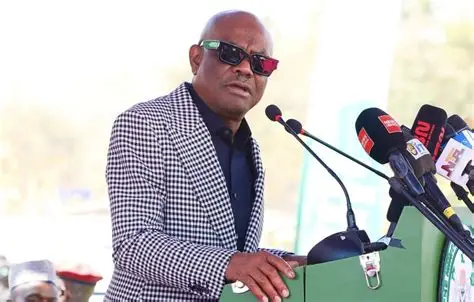
The logic Ulasi laid out is devastatingly simple. Nyesom Wike holds the title of PDP National Leader. Nyesom Wike also holds one of the best cabinet portfolios in the FCT, as FCT Minister in President Bola Tinubu‘s administration. These two facts cannot exist together in any functioning democratic opposition party without producing paralysis.
A national leader is the symbolic and calculated party head, expected to organise, energise, and ultimately defeat the ruling party at the polls.
But Wike draws his salary and authority over the Federal Capital Territory from the very man the PDP is supposed to dislodge. He also accesses federal patronage networks and ensures his political survival through Tinubu. He cannot attend a PDP convention and a Tinubu campaign rally with equal energy. He also cannot weaponise the party structure against an administration that has absorbed him.
The two roles are, as Ulasi puts it with admirable precision, “very unconstructive.”
Inspecting these contradictions raises a critical question: Is Wike technically pocketing the PDP for Tinubu?
This is the question serious political analysts must now ask without flinching, and the circumstantial evidence is difficult to dismiss.
Consider the pattern. After the 2023 election, Wike failed to secure the PDP presidential ticket and clashed bitterly with Atiku Abubakar. He did not go quietly, leave the party, or fade into private life. Instead, he accepted a plum ministerial appointment from Tinubu and kept his grip on PDP structures, especially in Rivers State. He then engineered the suspension of Governor Siminalayi Fubara‘s political allies. This move destabilised the state-level structure, serving neither PDP’s national opposition interests nor the interests of Rivers voters. It did, however, serve the cause of federal-executive dominance over the state.
Now he holds the title “National Leader”—the position without the loyalty, the platform without the mission.
If you wanted to neutralise Nigeria’s most structurally formidable opposition party from within, this arrangement would be hard to improve. You would want someone with deep roots in the party, credible enough for its highest symbolic office, yet dependent on and loyal to the presidency he is supposed to challenge. Wike fits that description with uncomfortable precision.
Whether this is Tinubu’s strategy or mutual opportunism is secondary. The result is the same: PDP’s leadership is compromised at the top.
The Peter Obi Subtext
Ulasi’s disclosure that Peter Obi has visited his residence four times already in 2026, most recently assembling prominent Southeasterners on short notice, is not a casual social update. It is political intelligence embedded in a television interview. Ulasi is signalling that an active courtship is underway — and that he has not yet committed himself to any direction.
His praise of Obi remains notably qualified. He did not announce an alignment. He talked of hope, of concept, of vision — words that describe potential, not partnership. But the fact that a PDP co-founder, who says he may leave the party, is simultaneously hosting Peter Obi at his private residence is a data point that 2027 strategists in both the PDP and the Labour Party will have logged immediately.
It raises a legitimate question: if men like Ulasi, with deep structural roots in PDP and genuine cross-regional credibility, drift toward an Obi alignment, what does that do to the calculus of opposition consolidation ahead of 2027? Does it strengthen a multi-party challenge to Tinubu, or does it fragment the opposition further, eventually benefiting the incumbent?
The Structural Weakness of PDP in 2026
PDP enters the 2027 election cycle carrying wounds that have not healed. The Atiku-Wike rupture of 2022-2023 was never genuinely sutured — it was papered over with titles and appointments. The party’s national leadership is still contested in both perception and practice. Its governors are divided between those who maintain a genuine opposition posture and those who, like Wike, have made accommodations with the federal executive that compromise their oppositional utility.
The party still commands significant structures in the South-South, the North-West, and parts of the North-East. It has governors, senators, and local government networks that the APC cannot easily replicate in those zones. Ulasi calls PDP ‘structurally formidable.’ On paper, the machinery exists.
But machinery without coherent command is just expensive hardware. A party whose national leader is a Tinubu appointee, whose former presidential candidate is sulking in strategic ambiguity, and whose founding members are threatening public exits on national television is not a party capable of executing a disciplined presidential campaign.
What Wike Must Now Answer
Ulasi framed the question perfectly. If another candidate appears as PDP’s presidential flag-bearer in 2027, what will Wike do? Will he attend the party’s rallies or Tinubu’s? Will he mobilise the FCT’s resources for the opposition candidate, or will he protect his ministerial tenure by making sure the opposition candidate loses, as any rational political actor in his position would?
These are fundamental, not hypothetical, issues. Any serious PDP presidential candidate must realise that having a party leader unable to fully support their campaign is more than a challenge—it is a major obstacle.
The Verdict
Ulasi is right. The crisis in PDP is not building; it has already been built. We are now watching its public acknowledgement by those who once were too loyal to say out loud what insiders already knew. Wike’s dual positioning represents either a catastrophic failure of party governance or a deliberate infiltration strategy. The distinction between the two is less important than their common consequence: an opposition party that cannot credibly oppose.
PDP must resolve the Wike question before the presidential primaries, or it will get to 2027 with its structure intact but its strategy in ruins. Tinubu’s campaign managers, watching this unfold, will not be losing sleep.