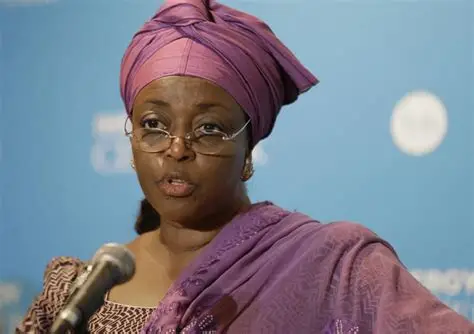
After 46 hours of deliberation, a Southwark Crown Court jury acquitted Nigeria’s former Petroleum Minister of all bribery charges. Final under UK law, the verdict in Nigeria opens — not closes — the decade’s most consequential accountability questions. KEHINDE ADEGOKE writes.
The jury at Southwark Crown Court deliberated for more than 46 hours before returning its verdict on April 17, 2026. On all six bribery counts against former Minister of Petroleum Resources Diezani Alison-Madueke, the answer was the same: not guilty.
The United Kingdom’s three-year criminal case against one of Nigeria’s most powerful former officials is over. The National Crime Agency’s prosecution has ended without a conviction. Diezani Alison-Madueke walks free under English criminal law.
But a verdict in London is not an answer in Abuja.

Based on court testimony from Southwark Crown Court, US Department of Justice forfeiture filings, and Federation Account and NLNG payment records reviewed by TheDiggerNews.com, six investigative files remain open — underreported, unresolved, and demanding answers that no Nigerian institution has yet provided.
File One: The “Third-Party Payment” System That Nobody Has Audited
The most structurally significant disclosure from the Southwark trial did not involve Diezani directly. It came from former President Goodluck Jonathan.
In a written statement submitted to the court, Jonathan told jurors that “third parties making payments on behalf of ministers on foreign assignments was not unusual” — and that he had approved the use of private jets for ministerial travel through such arrangements.
The defence deployed this statement to argue that Diezani’s use of a private jet provided by businessman Kolawole Aluko was consistent with an established practice, not evidence of corruption unique to her conduct.
The jury appeared to accept that argument, or at least found that it introduced sufficient doubt to preclude conviction.
But Jonathan’s statement raises a question that the UK prosecution never had to answer — and that Nigeria has never asked publicly: if third-party payment of ministerial travel costs was standard practice between 2010 and 2015, how many other ministers used this system, who paid for their travel, and where are the records?
The Office of the Accountant-General of the Federation holds payment records covering that period. The Auditor-General’s reports for those years contain entries on ministerial travel expenditure. Neither has been publicly interrogated on this specific question.
If third-party funding of ministerial travel was policy, it was a budget bypass on an unknown scale — and no audit has ever been published to determine its extent. If it was abuse dressed as policy, then the UK case prosecuted one minister for what may have been a systemic practice across multiple ministries.
TheDiggerNews.com has filed a Freedom of Information request to the Office of the Accountant-General of the Federation for ministerial travel payment records for the period 2010 to 2015.
File Two: The NNPC Authority Chain That Has Never Been Mapped
One of the central arguments of Diezani’s defence was that she exercised limited direct control over oil contract decisions — and that NNPC management took key operational decisions before files reached the minister’s desk.
The jury found the argument sufficiently credible to acquit.
But if operational authority over oil contracts sat primarily with NNPC management rather than the minister, then the accountability question shifts to the Group Managing Directors who held office during her tenure.
Austen Oniwon served as NNPC GMD from 2010 to 2012. Andrew Yakubu served from 2012 to 2014. Both presided over the contract approval processes that formed the basis of the prosecution’s case.
Neither was charged by the UK’s National Crime Agency. Neither has been publicly named as a target of the EFCC’s domestic investigation. The contract approval signatures should exist in NNPC board minutes and management records for those years — documents that would definitively map where authority actually resided.
Did the NCA share its evidence with the EFCC? If so, does that evidence point to NNPC management as well as political appointees? The EFCC has not stated publicly whether its domestic case targets the management chain or only ministerial-level officials.
The authority chain remains publicly unmapped. That gap is not an oversight. It is the space where the most consequential accountability questions live.
File Three: Kolawole Aluko’s Money Trail — Ruled “Proceeds of Crime” in America, Unexamined in Nigeria
Prosecutors at Southwark alleged that businessman Kolawole Aluko spent more than £2 million at Harrods on items for Diezani and provided access to UK properties. Aluko was not on trial. The jury’s verdict on Diezani does not constitute a finding on the source of Aluko’s wealth.
But American courts have already made that finding.
The US Department of Justice has been forfeiting Aluko-linked assets since 2017, recovering more than $50 million. Court filings in the Southern District of New York allege that the funds came from NNPC contracts and oil swap deals — and US federal judges have accepted those allegations as a sufficient basis for civil forfeiture.
The UK jury did not rule on where Aluko’s money came from. It ruled only on whether Diezani knowingly received bribes from him. Those are two separate legal questions with two separate answers.
The PACER court filing system in the United States makes the DOJ’s forfeiture complaints publicly accessible. They name specific transactions, specific contracts, and specific financial flows. They have been available for years. They have been almost entirely unreported in Nigeria.
TheDiggerNews.com is reviewing the relevant SDNY filings and will publish a detailed account of what US federal courts have found about the source of Aluko’s wealth — and its connection to Nigeria’s oil sector.
File Four: EFCC’s 13-Count Case — Still Active, Still Silent
The threshold for criminal conviction in an English court is proof beyond a reasonable doubt. The jury found that the threshold was not met on any of the six counts.
Nigeria’s legal framework operates differently. The Corrupt Practices and Other Related Offences Act and the EFCC Act both contain provisions for “gratification” and “abuse of office” that do not require the same standard of proof as the UK’s specific bribery offences. The EFCC arraigned Diezani Alison-Madueke in absentia in 2018 on 13 separate counts.
Not guilty in London does not mean the case is closed in Abuja.
Yet since the Southwark verdict was delivered, the EFCC has made no public statement on the status of its domestic prosecution. It has not announced whether it will discontinue its charges, amend them in light of the UK trial evidence, or proceed to trial.
The Nigerian public — whose oil revenues form the subject matter of both the UK prosecution and the EFCC charges — deserves a status update.
TheDiggerNews.com is formally requesting that update from the EFCC’s Director of Public Affairs.
File Five: Assets Seized Across Four Jurisdictions — Nobody Has Published the Current List
The Southwark acquittal is a criminal verdict. It is not an asset forfeiture ruling.
Under UK law, the High Court can order assets to remain forfeited through unexplained wealth orders — a civil process that operates on the balance of probabilities standard, significantly lower than the criminal “beyond a reasonable doubt” threshold. A criminal acquittal does not automatically overturn a civil asset forfeiture.
In the years since investigations into Diezani Alison-Madueke began, authorities across four jurisdictions — the United Kingdom, Nigeria, the United States, and Dubai — have frozen properties, jewellery, cash, and shareholdings worth hundreds of millions of dollars linked to her and her associates.
Since the April 17 verdict, no agency in any of those four jurisdictions has published an updated accounting of which assets remain frozen, which have been formally forfeited, and which — if any — have been released.
If assets that were seized on the basis of alleged criminal conduct remain frozen after a criminal acquittal, that is itself a significant legal and public interest story. If they have been released, Nigerian citizens whose public resources allegedly funded those assets deserve to know.
TheDiggerNews.com is formally requesting asset status updates from the EFCC, the NCA, the US DOJ’s Asset Forfeiture and Money Laundering Section, and Dubai’s financial regulatory authorities.
File Six: The 10-Year Delay — What Triggered the NCA in 2023?
The alleged conduct at the centre of the UK prosecution took place between 2011 and 2014. The NCA brought charges in August 2023 — a gap of approximately nine to twelve years between the alleged offences and the criminal charges.
The NCA has stated that its investigation was triggered by “international cooperation” and “financial intelligence.” It has not specified what that cooperation involved or which intelligence it received.
The timing matters. Three significant disclosure events occurred between the alleged conduct and the NCA charges: the Panama Papers in 2016, the FinCEN Files in 2020, and the extensive US DOJ forfeiture proceedings against Aluko-linked assets from 2017 onwards.
Identifying which of these — or which combination — gave the NCA the evidence it needed to charge is not merely of historical interest. It is a forward-looking intelligence question.
If Panama Papers data triggered the NCA’s interest in Diezani, then every other former Nigerian official whose name appears in offshore financial disclosures from that period is potentially within the scope of ongoing investigations. If the FinCEN Files data provided the trigger, the same applies to those identified in that dataset. If Aluko’s US forfeiture proceedings supplied the evidence, then every Nigerian official connected to NNPC contracts and oil swap deals during that era is potentially exposed.
The NCA’s trigger event is a matter of direct national security and governance interest for Nigeria. It has never been disclosed. No Nigerian institution has formally requested it.
TheDiggerNews.com is formally requesting the NCA’s public affairs office to confirm which category of intelligence triggered the 2023 prosecution.
What the EFCC Must Now Do
TheDiggerNews.com has filed a Freedom of Information request to the EFCC compelling disclosure on three specific points:
One — The current status of the 13-count charge against Diezani Alison-Madueke filed in 2018, and whether the EFCC intends to proceed to trial, amend the charges, or discontinue the prosecution in light of the Southwark verdict.
Two — Whether the EFCC has received evidence from the UK National Crime Agency in connection with the Southwark prosecution, and whether that evidence has expanded or altered the scope of Nigeria’s domestic investigation.
Three — A full accounting of Nigerian assets linked to Diezani Alison-Madueke and her associates that remain frozen, forfeited, or under investigation — updated to reflect the position as of the date of the Southwark verdict.
TheDiggerNews.com will publish the EFCC’s response, or its refusal, in full and without redaction.
The Dig
A jury of twelve Englishmen and women deliberated for 46 hours and found the UK prosecution had not proven its case beyond a reasonable doubt. That verdict is final under English criminal law and deserves to be stated clearly and without qualification.
But accountability is not a courtroom. It does not begin and end with a single verdict in a single jurisdiction. It is a system of institutions, records, assets, and obligations — that continues to operate whether or not any particular prosecution succeeds.
The third-party payment system that former President Jonathan described has never been audited. The NNPC authority chain has never been publicly mapped.
Kolawole Aluko’s money trail has been documented in American federal courts for nearly a decade and barely reported in Nigeria. The EFCC’s 13-count domestic case is in legal limbo without public explanation. Assets seized across four countries remain unaccounted for in any public document. And the intelligence trigger that launched the UK’s entire investigation has never been disclosed.
Six files. One acquittal. Zero answers.
The jury has spoken for London. Abuja has not yet spoken at all.
TheDiggerNews.com has filed Freedom of Information requests to the EFCC and is formally seeking information from the NCA, the US Department of Justice Asset Forfeiture and Money Laundering Section, the Office of the Accountant-General of the Federation, and Dubai’s financial regulatory authorities. All responses will be published in full upon receipt. This investigation is ongoing.
All facts in this report are drawn from Southwark Crown Court proceedings, US DOJ forfeiture complaints filed in the Southern District of New York, EFCC public charge sheets, and Federation Account payment records. TheDiggerNews.com stands ready to correct any error with documentary evidence.
𝐊𝐞𝐡𝐢𝐧𝐝𝐞 𝐀𝐝𝐞𝐠𝐨𝐤𝐞 𝐢𝐬 𝐚𝐧 𝐚𝐰𝐚𝐫𝐝-𝐰𝐢𝐧𝐧𝐢𝐧𝐠 𝐢𝐧𝐯𝐞𝐬𝐭𝐢𝐠𝐚𝐭𝐢𝐯𝐞 𝐣𝐨𝐮𝐫𝐧𝐚𝐥𝐢𝐬𝐭 𝐰𝐢𝐭𝐡 𝐦𝐨𝐫𝐞 𝐭𝐡𝐚𝐧 𝟏𝟓 𝐲𝐞𝐚𝐫𝐬 𝐨𝐟 𝐝𝐢𝐬𝐭𝐢𝐧𝐠𝐮𝐢𝐬𝐡𝐞𝐝 𝐞𝐱𝐩𝐞𝐫𝐢𝐞𝐧𝐜𝐞 𝐞𝐱𝐩𝐨𝐬𝐢𝐧𝐠 𝐬𝐭𝐨𝐫𝐢𝐞𝐬 𝐭𝐡𝐚𝐭 𝐦𝐨𝐮𝐥𝐝 𝐩𝐮𝐛𝐥𝐢𝐜 𝐝𝐢𝐬𝐜𝐨𝐮𝐫𝐬𝐞. 𝐖𝐢𝐭𝐡 𝐭𝐡𝐫𝐞𝐞 𝐢𝐧𝐝𝐮𝐬𝐭𝐫𝐲 𝐧𝐨𝐦𝐢𝐧𝐚𝐭𝐢𝐨𝐧𝐬 𝐭𝐡𝐫𝐨𝐮𝐠𝐡𝐨𝐮𝐭 𝐝𝐢𝐯𝐞𝐫𝐬𝐞 𝐛𝐞𝐚𝐭𝐬, 𝐡𝐞 𝐡𝐚𝐬 𝐞𝐚𝐫𝐧𝐞𝐝 𝐫𝐞𝐜𝐨𝐠𝐧𝐢𝐭𝐢𝐨𝐧 𝐟𝐨𝐫 𝐟𝐞𝐚𝐫𝐥𝐞𝐬𝐬 𝐫𝐞𝐩𝐨𝐫𝐭𝐢𝐧𝐠, 𝐢𝐧𝐜𝐢𝐬𝐢𝐯𝐞 𝐚𝐧𝐚𝐥𝐲𝐬𝐢𝐬, 𝐚𝐧𝐝 𝐚 𝐜𝐨𝐦𝐦𝐢𝐭𝐦𝐞𝐧𝐭 𝐭𝐨 𝐚𝐜𝐜𝐨𝐮𝐧𝐭𝐚𝐛𝐢𝐥𝐢𝐭𝐲. 𝐀𝐬 𝐌𝐚𝐧𝐚𝐠𝐢𝐧𝐠 𝐄𝐝𝐢𝐭𝐨𝐫 𝐚𝐧𝐝 𝐂𝐄𝐎 𝐨𝐟 𝐓𝐡𝐞𝐃𝐢𝐠𝐠𝐞𝐫𝐍𝐞𝐰𝐬.𝐜𝐨𝐦, 𝐀𝐝𝐞𝐠𝐨𝐤𝐞 𝐥𝐞𝐚𝐝𝐬 𝐚 𝐩𝐢𝐨𝐧𝐞𝐞𝐫𝐢𝐧𝐠 𝐧𝐞𝐰𝐬𝐫𝐨𝐨𝐦 𝐝𝐞𝐝𝐢𝐜𝐚𝐭𝐞𝐝 𝐭𝐨 𝐞𝐱𝐩𝐨𝐬𝐢𝐧𝐠 𝐮𝐧𝐬𝐞𝐞𝐧 𝐭𝐫𝐮𝐭𝐡𝐬, 𝐚𝐦𝐩𝐥𝐢𝐟𝐲𝐢𝐧𝐠 𝐦𝐚𝐫𝐠𝐢𝐧𝐚𝐥𝐢𝐬𝐞𝐝 𝐯𝐨𝐢𝐜𝐞𝐬, 𝐚𝐧𝐝 𝐞𝐬𝐭𝐚𝐛𝐥𝐢𝐬𝐡𝐢𝐧𝐠 𝐧𝐞𝐰 𝐬𝐭𝐚𝐧𝐝𝐚𝐫𝐝𝐬 𝐢𝐧 𝐢𝐧𝐯𝐞𝐬𝐭𝐢𝐠𝐚𝐭𝐢𝐯𝐞 𝐣𝐨𝐮𝐫𝐧𝐚𝐥𝐢𝐬𝐦.
𝐓𝐡𝐞𝐃𝐢𝐠𝐠𝐞𝐫𝐍𝐞𝐰𝐬.𝐜𝐨𝐦 | 𝐰𝐰𝐰.𝐭𝐡𝐞𝐝𝐢𝐠𝐠𝐞𝐫𝐧𝐞𝐰𝐬.𝐜𝐨𝐦 | 𝟎𝟖𝟎𝟑𝟗𝟏𝟑𝟓𝟒𝟕𝟐 | 𝐈𝐛𝐚𝐝𝐚𝐧, 𝐍𝐢𝐠𝐞𝐫𝐢𝐚