NIGERIA’S $400 BILLION ECONOMY STRANGLED: 70% of States Failing Business Standards, Investors Trapped in Systemic Collapse
Abuja: A confidential assessment by Nigeria’s Presidential Enabling Business Environment Council (PEBEC) has delivered a devastating verdict: more than 70% of Nigerian states have failed to establish even the most basic systems to support businesses, protect investors, or facilitate commerce.
The report, marked for executive review and obtained exclusively, paints a picture of systemic collapse across over 25 states — a collapse insiders warn is “strangling Africa’s largest economy” and driving capital flight on a historic scale.
Eight years after PEBEC’s creation, the findings are damning. Over 39 million small and medium enterprises — the backbone of Nigeria’s economy — remain trapped in a hostile environment where credit systems are “virtually non-existent,” investor protection is hollow, and commercial dispute resolution is broken.

The report concludes bluntly: these failures are “systemic rather than isolated.”
Investors Enter, But Can’t Get Help When Things Go Wrong
The Council’s assessment reveals a chilling reality: in over 70% of states, businesses that invest millions have nowhere to turn when problems arise. “Limited structured post-investment support” and “weak issue resolution” have created what the report calls “low reinvestment confidence” — a polite term for capital flight.
“These are not just administrative gaps. These are institutional black holes,” said one reform official familiar with the findings, speaking on condition of anonymity. “You can register a business, but good luck enforcing a contract, getting credit, or moving goods across state lines.”
The Credit Desert: SMEs Locked Out of Financing
For Nigeria’s 39 million MSMEs, survival has become a daily battle. The report confirms that access to credit remains “critically weak” across most states, with collateral systems barely functional. Businesses are forced to operate on cash, personal savings, and informal networks.
“Low credit availability” and “weak credit information systems” mean even viable enterprises cannot scale, cannot hire, and cannot compete. The Council warns this structural constraint is holding back national competitiveness at a scale previously unacknowledged.
Internal Trade Barriers: Nigeria’s Self-Imposed Sanctions
The report exposes Nigeria’s fractured economic reality: “high transit friction,” “fragmented permits,” and “multiple levies and checkpoint delays” make interstate commerce more difficult than international trade.
The Council recommends immediate elimination of haulage fees and redundant levies, warning that Nigeria is effectively operating as 36 separate economies rather than one integrated market. The cost: billions lost annually in delays, bribes, and abandoned transactions.
Justice Delayed, Commerce Denied
Investor confidence depends on enforceable contracts. Yet the report describes commercial dispute resolution as fundamentally broken. “Slow dispute resolution,” “limited commercial courts,” and “weak enforcement of judgments” mean contracts are often worthless.
The Council’s recommendation to expand small-claims courts and adopt KPIs for commercial cases is an implicit admission: Nigeria’s justice system offers no predictable path to resolution for businesses.
The Power Crisis: Still Unsolved, Still Crippling
Despite decades of promises, the report confirms that “unreliable supply” and “limited Band A coverage” continue to devastate productivity. The call to accelerate state electricity regulators underscores a shocking reality: nearly a decade after power sector reforms, basic regulatory infrastructure remains absent in many states.
The Winners and the Warning
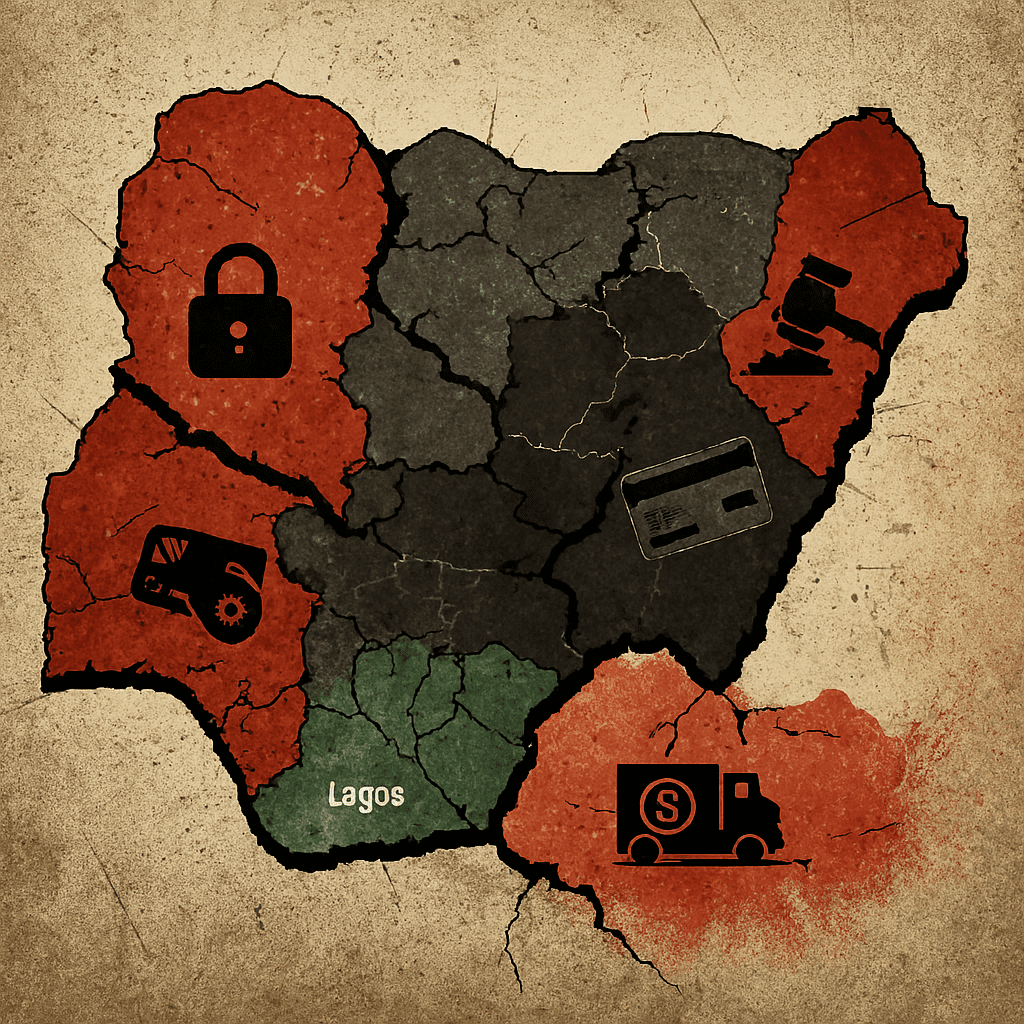
Only five states — Lagos, Kaduna, Oyo, FCT, and Ogun — demonstrate “consistent, data-driven and well-coordinated” reform.
Lagos leads with an 85.6% score, but even the top performer falls short of global standards.
The North-East region is identified as the lowest-performing overall, with “deeper structural constraints” — diplomatic language for insecurity, institutional weakness, and chronic underinvestment.
A Dual Reality: Islands of Progress in a Sea of Dysfunction
The report describes a “dual reality” where pockets of modernisation coexist with institutional collapse. Digital payment systems are advancing, but investor protection, credit access, and dispute resolution remain largely unaddressed.
“The overall picture,” the report states bluntly, “reveals… underlying institutional weaknesses that continue to hold many states back.”
The $400 Billion Question
Nigeria’s GDP exceeds $400 billion, yet the report raises an uncomfortable question: how much larger could the economy be if 70% of states weren’t failing at basic business enablement?
The Council has issued five “high-impact interventions for quick implementation,” but admits this is only “the first iteration of a renewed approach.” Translation: previous efforts have failed, and comprehensive reform remains years away.
For the 39 million business owners navigating this fractured landscape daily, the report offers both validation and a sobering reminder: most of Nigeria’s states are simply not ready for serious business.
Context
The Presidential Enabling Business Environment Council was established in 2016 to remove bureaucratic constraints and drive regulatory reform. This assessment represents its most comprehensive evaluation of state-level business environments to date — and its most damning.