PEBEC held its highest-level investor dialogue yet, with a brand new Acting IGP in attendance and a Finance Minister joining virtually just 48 hours after his nomination. Yet Nigerians still don’t know what the investors actually said.
TheDigger Intelligence Unit
THE HIGH TABLE AT ASO VILLA
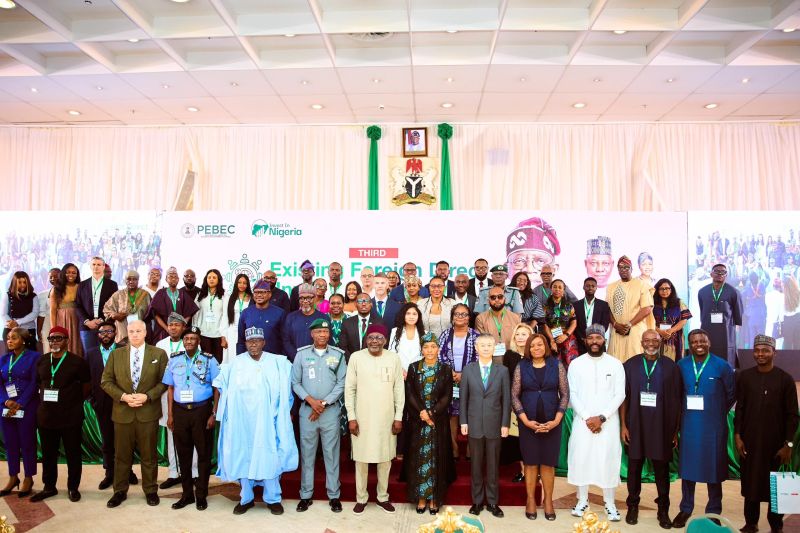
On Thursday March 5, 2026, the Presidential Enabling Business Environment Council — known as PEBEC — convened what it called the Third Existing Foreign Direct Investors Roundtable at the Banquet Hall of the Presidential Villa in Abuja.

The high-level meeting brought together senior government officials and leading foreign investors for a dialogue aimed at strengthening Nigeria’s investment climate. This formed part of the council’s ongoing efforts to deepen collaboration between government and the private sector, while ensuring that reforms translate into measurable improvements in the operating environment for investors.
On the surface, it was an impressive gathering. Four of Nigeria’s most consequential economic officials sat in the same room: Dr. Zacch Adedeji, Executive Chairman of the Nigeria Revenue Service; Bashir Adewale Adeniyi, Comptroller-General of the Nigeria Customs Service; IGP Olutunji Rilwan Disu, Acting Inspector-General of Police; and Princess Zahrah Mustapha Audu, Director-General of PEBEC. Joining virtually was Taiwo Oyedele — newly nominated Minister of State for Finance, subject to Senate confirmation, and immediate past Chairman of the Presidential Committee on Fiscal Policy and Tax Reforms.
But as official statements flowed and photographs circulated, TheDiggerNews.com noticed what was missing from every single media report of the event — the questions that actually matter.
WHAT THE PRESS RELEASES DID NOT SAY
PEBEC’s Director-General Princess Zahrah Mustapha Audu emphasised the Council’s commitment to sustained investor dialogue and coordinated reform implementation across government institutions, noting that existing foreign investors remain critical partners in Nigeria’s economic development through their contributions to job creation, capital investment, and technology transfer.
Deputy Chief of Staff Senator Ibrahim Hadejia, representing the Vice President, reiterated the Federal Government’s commitment to fostering a stable, transparent, and competitive business environment that supports investment expansion and long-term economic growth.
Fine words. But the press statement said the discussions were “highly engaging” and that investors raised “technical questions.” It did not say what those questions were. It did not name a single foreign investor or company in the room. It did not specify what commitments — if any — were made by any of the officials present.
In other words: Nigeria’s most senior economic officials spent a day in dialogue with the foreign investors whose capital this country desperately needs — and the Nigerian public was told almost nothing about what was actually said.
THE NUMBERS BEHIND THE ROUNDTABLE
To understand why this engagement matters — and why it is more urgent than the official statements suggest — consider Nigeria’s FDI trajectory carefully.
Total capital importation into Nigeria reached $5.64 billion in Q1 2025 — a 67 per cent increase year-on-year, and an encouraging headline number. Combined Foreign Portfolio Investment and Foreign Direct Investment surged in the first nine months of 2025, surpassing total inflows for the entire year of 2024.
But the headline conceals a structural alarm bell.
FDI — the long-term, productive, factory-building kind of investment — stood at just $126.29 million in Q1 2025, representing a mere 2.2 per cent of total capital importation. Portfolio investment, by contrast, accounted for over 92 per cent of total inflows — $5.2 billion pouring into money market instruments such as OMO bills and Treasury Bills.
More alarming still: FDI actually fell by 70 per cent quarter-on-quarter in Q1 2025 — collapsing from $421.88 million in Q4 2024 to $126.29 million — even as total capital importation was rising. Foreign investors were sending more money to Nigeria, but committing less of it to long-term productive investment.
This distinction matters enormously. Portfolio investment is hot money — it arrives fast and leaves faster when conditions change. Foreign Direct Investment is what builds factories, creates jobs, transfers technology, and anchors long-term economic transformation. Nigeria is attracting the former in abundance. The latter — the kind that actually changes lives — remains stubbornly, dangerously low.
The more enduring task is to expand foreign direct investment into sectors that can transform Nigeria’s growth trajectory. Infrastructure, energy, ICT, agriculture, and manufacturing require long-term commitments that portfolio flows cannot deliver. Achieving this will demand consistency in reform, improvements in security, and the institutional strengthening that investors regard as critical for confidence.
FIVE QUESTIONS THE ROUNDTABLE MUST ANSWER
TheDiggerNews.com has identified five questions that the Nigerian public deserves answers to — questions that no official statement has addressed:
1. Who exactly were the foreign investors in the room?
PEBEC has not named a single company or individual investor who attended. Were they from oil and gas? Telecoms? Manufacturing? Technology? Agriculture? The identities of participants at a government-hosted investment roundtable are a matter of legitimate public interest. Nigerians deserve to know who is advising their government on investment policy — and what interests those investors represent.
2. What specific complaints did they raise?
The official statement says discussions were “highly engaging” with investors asking “technical questions.” But what were those questions? Were investors complaining about foreign exchange repatriation? Customs delays? Tax disputes? Security in the Niger Delta or the Northwest? Multiple taxation by state and federal authorities? These are the specific operational grievances that define whether foreign investors stay or leave — and they deserve to be on the public record.
3. What happened after Roundtables One and Two?
This was the Third Existing FDI Roundtable. The first and second roundtables also produced official statements about “productive dialogue” and “commitment to reform.” What specific commitments were made at those earlier sessions? Have they been honoured? Are the same investors returning with the same complaints — or has genuine progress been made? Without answers to these questions, each new roundtable risks becoming another photo opportunity rather than a genuine accountability mechanism.
4. Why was a brand new Acting IGP in the room?
IGP Disu’s presence at a foreign investment roundtable is the single most significant signal in this entire event — and it has received zero analytical attention in media coverage. A country’s Inspector General of Police does not attend investment dialogues unless security is among the top grievances of foreign investors. Which sectors are being affected? Which geographies? Are kidnappings, pipeline vandalism, or community-level conflicts driving investor anxiety?
What makes this even more significant is that IGP Disu is himself a newly appointed Acting Inspector-General — taking over after the resignation of his predecessor, Kayode Egbetokun, just days before the roundtable. Nigeria therefore had a brand new Acting IGP attending a foreign investor security dialogue within days of assuming office. What message does that send to investors about the stability of Nigeria’s security leadership? The IGP’s presence — and his newness to the role — raises these questions with particular urgency. His attendance alone is a story.
5. Why was Nigeria’s freshly nominated Finance Minister attending as a designate?
Taiwo Oyedele was nominated as Minister of State for Finance on March 3, 2026 — just 48 hours before the PEBEC roundtable. His Senate screening and confirmation remains pending. Nigeria’s most important fiscal architect was therefore sitting at a major investor dialogue as a nominee yet to be confirmed by the Senate, at the very moment foreign investors were asking the most technically demanding tax and fiscal policy questions.
The Senate needs to move swiftly. Every day of delay is a day Nigeria’s reform credibility hangs in the balance — and every investor in that room on Thursday knows it.
THE PEBEC PARADOX
There is something genuinely paradoxical about the PEBEC model that this roundtable crystallises.
PEBEC was established to improve Nigeria’s business environment — and to its credit, it has driven real reforms. Nigeria has climbed the World Bank’s Ease of Doing Business rankings. The Nigeria Tax Act 2025 is globally aligned. The NRS e-invoicing platform is operational. The foreign exchange market has been liberalised.
Yet the challenge is to consolidate these gains by addressing structural bottlenecks and deepening governance reforms. Macroeconomic stability has opened the door to renewed capital inflows, but investors still point to security, institutional consistency, and the ability to repatriate profits without restriction as critical concerns.
In other words: the policies are improving. The perception is lagging. And perception — among foreign investors — is everything.
A roundtable that brings a brand new Acting Inspector General of Police, the NRS Chairman, the Customs Comptroller-General, and a freshly nominated Finance Minister into the same room with foreign investors is exactly the right institutional response to that gap. But its impact is severely limited when its outcomes are communicated through press releases that say nothing of substance.
WHAT NEEDS TO HAPPEN
TheDiggerNews.com is today formally requesting from PEBEC:
The list of foreign investor companies and individuals who attended the Third FDI Roundtable on March 5, 2026
A summary of the key concerns and questions raised by investors at the session
A report on commitments made and actions taken following the First and Second FDI Roundtables
The timeline for Taiwo Oyedele’s Senate confirmation and its implications for fiscal policy coordination
We will publish every response received — or the silence that follows.
THE BOTTOM LINE
Nigeria’s reforms have underpinned a genuine surge in capital inflows. The Nigerian Exchange All-Share Index surged 51.19 per cent in 2025 — ranking among the strongest-performing capital markets globally and significantly outperforming the MSCI All Country World Index, which returned approximately 20 per cent in the same period. That is real progress and it deserves acknowledgement.
But foreign portfolio investment and foreign direct investment are not the same thing. Hot money and long-term commitment are not the same thing. A roundtable and a reform are not the same thing.
Nigeria needs the kind of foreign investment that builds factories, not just the kind that buys stocks. It needs investors who are confident enough to commit capital for ten years, not ten months. And it needs a government that is transparent enough — not just with investors behind closed doors at the Banquet Hall of Aso Villa — but with the 220 million Nigerians whose future those investments are supposed to serve.
The Third FDI Roundtable happened yesterday. The real question is what happens tomorrow.
EDITOR’S NOTE: TheDiggerNews.com has formally requested details of investor participants, discussion outcomes, and implementation status of commitments from previous roundtables from PEBEC. We welcome responses from PEBEC, the Nigeria Revenue Service, the Nigeria Customs Service, the Nigeria Police Force, and the Office of the Deputy Chief of Staff to the President. Any investor who attended the March 5, 2026 roundtable and wishes to speak on or off the record about the discussions is encouraged to contact us at: thediggernews03@gmail.com
Officials and foreign investors at the Third Existing Foreign Direct Investors Roundtable convened by the Presidential Enabling Business Environment Council (PEBEC) at the Banquet Hall, Aso Villa, Abuja, on Thursday March 5, 2026. | Photo Credit: PEBEC