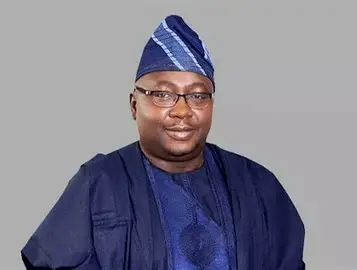
Adebayo Adelabu’s tenure as power minister, despite his impressive resume and policy reforms, fell short, casting a shadow over his Oyo governorship bid. KEHINDE ADEGOKE writes.
Adebayo Adelabu wants to swap Abuja’s power corridors for Agodi’s governorship seat. However, his record as power minister—marked by blackouts, missed targets, and public apologies—may burden his bid rather than boost it.
Who is Adelabu?
Adebayo Adelabu — nicknamed “Penkelemesi,” a Yoruba rendering of “peculiar mess” inherited from his grandfather Adegoke Adelabu — is no political novice. His grandfather was one of Ibadan’s most revered pre-independence politicians. Adelabu himself has strong credentials: a first-class degree in Accounting from OAU. He also served as Executive Director/CFO at First Bank at 39, and was appointed Deputy Governor (Operations) of the Central Bank by President Jonathan.

On paper, he is arguably one of the most technically credentialed ministers the power sector has ever seen. The question is whether that credentialing translates into results.
What He Met on Ground
Adelabu entered a sector with a brutal history of failure. In 2020, Nigeria’s generation capacity was 7,792 MW. By 2022, it dropped sharply to 5,757 MW. When Adelabu took office in August 2023, it recovered to 6,428 MW.
Behind these numbers was deeper rot: gas supply shortfalls, decayed transmission infrastructure, technically bankrupt distribution companies, an unresolved revenue crisis, and a culture of impunity around grid vandalism. Installed capacity was about 13,625 MW, but the country required 30,000-100,000 MW to meet demand. He inherited a sector that had swallowed trillions of naira in interventions with negligible consumer impact—a sector that has embarrassed every minister before him.
His Claimed Achievements
Adelabu’s self-assessment in his resignation letter was, as expected, generous. He cited the Electricity Act 2023, which decentralised the electricity market. He listed increased transmission capacity through grid upgrades as part of the Presidential Power Initiative.
He also highlighted improved distribution supervision and revenue collection. On generation, his concrete milestone was March 2, 2025, when Nigeria reached a peak generation of 6,003 MW—a record for the country. His communications team announced this with excitement.
There is also a regulatory devolution angle. By 2025, eleven states—including Oyo, Lagos, Enugu, Ekiti, and others—had regulatory control over their electricity markets. This was a direct result of the 2023 Electricity Act.
The National Integrated Electricity Policy (NIEP) and its Tactical Implementation Plan were, according to the text, presented to President Tinubu before the individual’s exit. These represent a long-term framework. Whatever one thinks of the power situation, such a framework did not exist before.
The Unvarnished Reality
Here is where the candid assessments of critics and independent observers, as reported in various analyses, diverge sharply from Adelabu’s self-congratulatory narrative.
On generation targets, the record is one of broken promises. When he took office in August 2023, he promised that Nigeria would reach 6,000 MW by year’s end. The target was missed and pushed to 2025.
When the 6,003 MW peak was finally achieved in March 2025, it was celebrated as a breakthrough. However, this level lasted only briefly. In recent weeks, actual grid supply hovered around 3,331 MW. That is barely enough for Lagos, let alone over 200 million Nigerians.
On grid stability, the story is worse. The national grid collapsed at least 12 times in 2024. In 2025, there were only two major collapses—a brief improvement. Early 2026 quickly reversed that trend, with multiple collapses within days. This signalled a worrying regression.
The trajectory of actual delivered power is the most honest metric. In February 2024, average capacity was about 5,285 MW. By February 2025, it had dropped to around 4,892 MW, then further to 4,384 MW in February 2026. This was the lowest in 21 months, according to the Foundation for Investigative Journalism.
As Adelabu exits, consumers are now receiving less power than at any point during his tenure, let alone more than when he arrived.
About 86 million Nigerians still lack access to power. The average daily supply has been 3,300–4,300 MW. This is far below what a nation of over 200 million needs.
To his credit, Adelabu sometimes publicly owned the failure. Weeks before his resignation, he apologised at a press conference in Abuja. He admitted blackouts had worsened hardship for homes, businesses, schools, and industries during the peak dry-season heat. The apology was sincere but structurally insufficient.
The Tariff Issue
One of the most controversial decisions under his watch was the 2024 electricity tariff hike. It hit Band A customers hard. Economists and experts said it was needed to restore commercial viability to the DISCOs and GenCos. However, it came at a time of peak economic hardship under the Tinubu reforms. The optics were poor: higher bills, same darkness.
The Delayed Resignation
There is a political dimension to his conduct in office that deserves scrutiny. Reports say President Tinubu set a March 31, 2026, deadline for ambitious appointees to resign. Yet Adelabu’s resignation letter is dated April 22, 2026—almost three weeks late.
By early 2026, many Nigerians reportedly felt the minister cared more about his 2027 gubernatorial ambition than his mandate for the power sector. Air or not, this became part of his political identity near the end of his tenure.
The Governorship Calculus
The central question: can his ministerial antecedents be leveraged to ride to Agodi Government House?
The honest answer is that, according to political analysts, his record as minister is a net political liability, not an asset, at least in its current framing. Election campaigns are usually about presenting achievements, but Adelabu may find himself defending the performance of a sector that, according to polls and media coverage, has frustrated millions of Nigerians.
He must be able to convince the voters in Oyo that he can govern the state better, even though his name is nationally associated with persistent power outages and grid collapses.
His political task is harder in Oyo. He lost to Makinde in 2019 under the APC. Then, he ran under the Accord Party in 2023 and finished third. This is his third attempt—each previous bid has been a loss. His return to the APC and Tinubu’s backing give him access to the national structure. But Oyo has never been an easy state for the APC.
Within the party, Teslim Folarin—the 2023 governorship candidate—is a strong rival. Senator Fatai Buhari and others want the ticket too. As the grandson of Adegoke Adelabu, he holds political capital in Ibadan.
He is said to have built structures in Ibadan and has reportedly developed a relationship with Governor Makinde. Makinde’s endorsement—or neutrality—could be decisive. Returning to the APC, along with Tinubu’s alleged blessing, could boost his primary chances if the party unites.
The Directing Traffic Optics
That video of him directing traffic in Ibadan is, frankly, raw political theatre of the most obvious kind. It is the “I am a man of the people” signal — the elite technocrat descending from the ministerial SUV to share the people’s daily frustrations. Oyo voters are sophisticated enough to dissect it for what it is. Whether it works depends on whether it is followed by substance on the ground, not just symbolism.
Verdict
Adebayo Adelabu leaves the power ministry with a record best described as structurally ambitious but operationally lacking. He brought real policy intellect: the decentralisation in the Electricity Act, the NIEP framework, and PPI transmission work. But Nigerians judge a power minister by a basic metric—if the lights are on. By this measure, his rating was mostly poor.
The World Bank estimates power outages cost Nigeria $29 billion annually—about 10 per cent of GDP. That figure has not improved. His ambition for governorship is legitimate and understandable.
But in Oyo, the question “Minister, why did the lights go off?” will dog his campaign. Policy plans and peak generation stats won’t suffice. He will need an Oyo-specific governance vision that breaks from the national power story. Voters, like other Nigerians, know who was in charge when the grid failed, and the heat was worse.
Agodi is possible. It is not inevitable. And if it happens, it will be despite his power record, not because of it.