From ministries to multinationals, Nigeria’s most powerful institutions are united by one thing: silence. The Freedom of Information Act promised transparency — but citizens are met with closed doors, unanswered letters, and a culture of secrecy that corrodes democracy. KEHINDE ADEGOKE writes in this Exclusive Investigation.
The Hidden Document
It arrived without fanfare. No press conference, no ministerial briefing, no headlines. Just a quiet upload to the Ministry of Justice’s website — https://justice.gov.ng/public-institutions-that-did-not-submit-foia-report-for-2025/ -a compliance report on the Freedom of Information Act (FOIA). Buried deep inside was ‘Appendix D’: “PUBLIC INSTITUTIONS THAT DID NOT SUBMIT FOIA REPORT FOR 2025.”
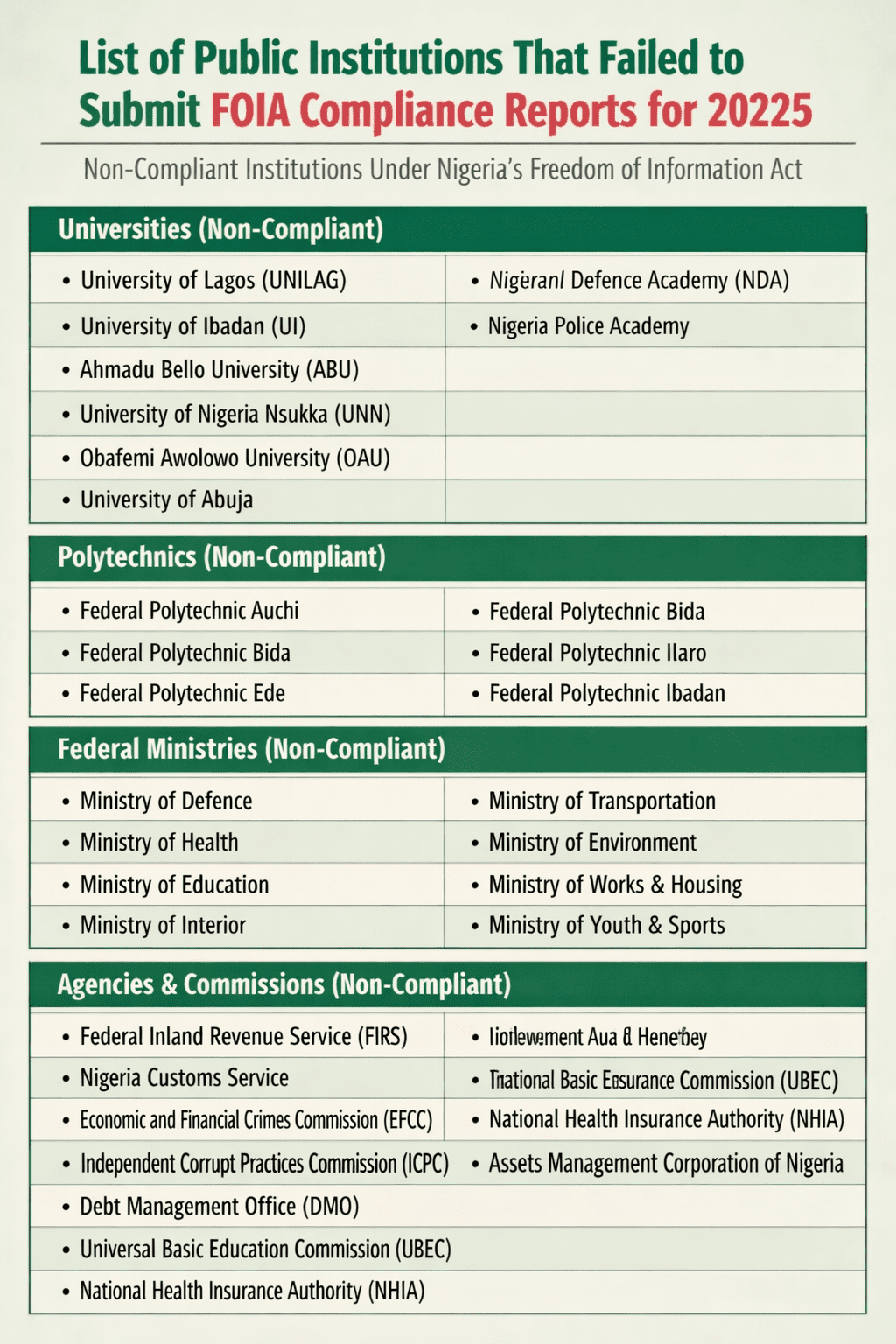
But Appendix D is no ordinary bureaucratic list. It is a roll call of shame that exposes over 170 of Nigeria’s most powerful institutions — universities, polytechnics, ministries, agencies, and commissions — all failing to comply with the FOIA’s most basic requirement.

The Freedom of Information Act, passed in 2011, was meant to be Nigeria’s bold leap into transparency. It gave citizens the right to request information from public institutions and required those institutions to submit annual compliance reports to the Attorney-General of the Federation. Appendix D reveals how hollow that promise has become.
The Institutions Named
The appendix reads like a who’s who of Nigerian public life.
Universities
The University of Lagos, University of Ibadan, Ahmadu Bello University, University of Nigeria, Nsukka, Obafemi Awolowo University, University of Abuja — all absent. These are Nigeria’s flagship universities, training the next generation of leaders, yet they have ignored the law that guarantees citizens access to information.
Polytechnics
Auchi, Bida, Ede, Ilaro, Ibadan — institutions meant to drive technical education and innovation, but silent when asked to account for their compliance.
Specialized Schools
The Nigerian Defence Academy, the Nigerian Police Academy, the Nigerian Maritime University, and the Air Force Institute of Technology — institutions entrusted with national security and specialised training, yet unwilling to submit transparency reports.
Federal Ministries
Defence, Health, Education, Interior, Agriculture, Transportation, Environment, Works & Housing, Youth & Sports — ministries that shape the daily lives of Nigerians, all failing to comply.
Agencies & Commissions
The Federal Inland Revenue Service (FIRS), Nigeria Customs Service, Economic and Financial Crimes Commission (EFCC), Independent Corrupt Practices Commission (ICPC), Debt Management Office (DMO), Universal Basic Education Commission (UBEC), National Health Insurance Authority (NHIA), Assets Management Corporation of Nigeria (AMCON). These are the very institutions tasked with fighting corruption, collecting taxes, managing debt, and delivering basic services.
The breadth of non-compliance is staggering. It is not a few rogue agencies. It is systemic.
The Law They Ignored
Section 29 of the FOIA is clear: every public institution must submit an annual report to the Attorney-General detailing how it handled information requests. These reports are meant to be collated, published, and scrutinised.
By failing to submit, the institutions listed in Appendix D are not just breaking the law. They are undermining the very principle of transparency.
The refusal of 170 public institutions to file their FOIAs with the AGF in 2025 is a testament to the fact that Freedom of Information in Nigeria is a theory rather than a practice. Media organisations and civil society groups have been finding it very difficult to access public-interest information from the government at all levels. Corporate organisations, too, have keyed into the same attitude, as FOIA and Right of Replies are ignored without any consequences.
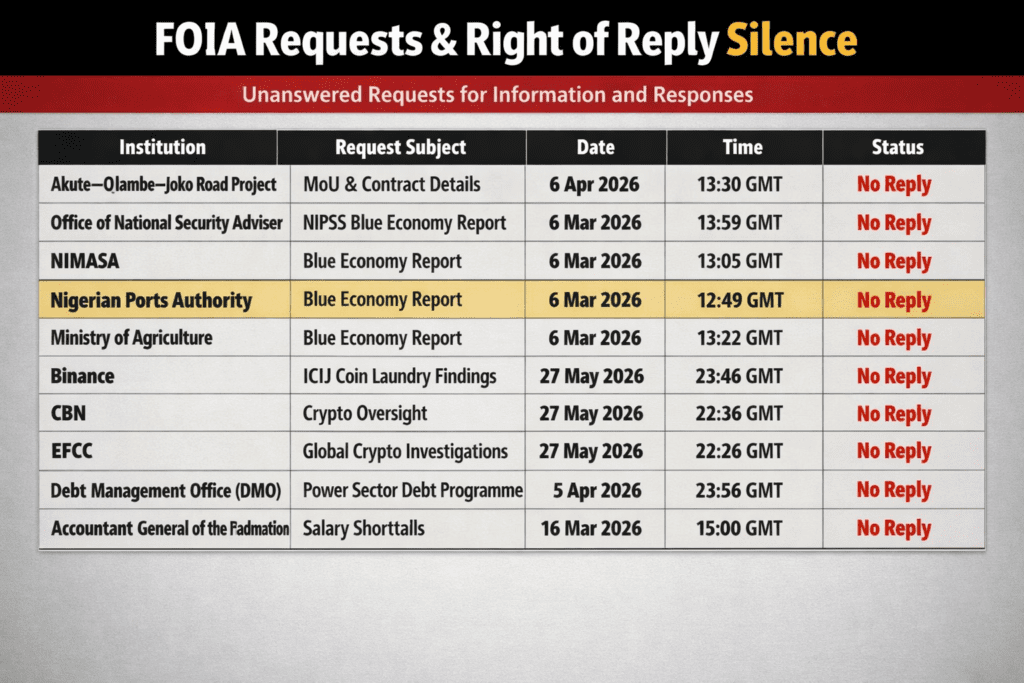
TheDiggernews.com has filed nothing less than 7 FOIA requests and 14 right of reply requests to government institutions and corporate organisations, without a single response. Ironically, right-of-reply requests sent to companies and institutions outside Nigeria were met with prompt responses.
The FOIA Trail
This investigation transcends reading the Ministry of Justice’s Appendix D. It tested the system in real time through a series of FOIA requests sent to public institutions whose transparency performance should matter most.
The first request, for the Akute–Olambe–Ijoko Road Project MoU and contract details, was sent on 6 April 2026 at 13:30 GMT. It was a straightforward public-interest request seeking information about a road project with clear governance and accountability implications.
On Friday, 6 March 2026, at 13:59 GMT, a request was sent to the Office of the National Security Adviser at State House, Abuja, seeking the implementation report on NIPSS Senior Executive Course 47 (SEC 47) and the Presidential Parley Report on Blue Economy and Sustainable Development. On the same subject, another request went out at 1:05 GMT to the Nigerian Maritime Administration and Safety Agency (NIMASA), Maitama, Abuja.
That same day, a request was sent to the Nigerian Ports Authority (NPA) in Abuja for the same report. Also on 6 March 2026, at 13:22 GMT, the Federal Ministry of Agriculture and Food Security in Abuja received the same FOIA request, while the Federal Ministry of Marine and Blue Economy in Apapa, Lagos, received the request at 12:22. These requests were aimed at institutions central to Nigeria’s blue economy agenda and public sector reporting on it.
On 4 March 2026 at 18:03, a separate FOIA request was sent to the National Bureau of Statistics (NBS) seeking the methodology for measuring unemployment and labour force survey data. That request, too, was part of the same accountability effort.
This paper trail matters because it shows the investigation is not merely describing non-compliance in theory. It is documenting a live challenge to institutions that are supposed to uphold openness, and it preserves the timestamps and subjects of those requests as part of the record.
The Right of Reply Trail
The right-of-reply process was equally extensive and equally important.
On 27 May 2026 at 23:46, a right-of-reply request on the ICIJ Coin Laundry findings was sent to Binance. At 22:36 on the same day, a request on crypto oversight and policy direction was sent to the Central Bank of Nigeria (CBN). At 22:33, another right-of-reply request on crypto regulation and global accountability went to the Securities and Exchange Commission (SEC Nigeria). At 22:26, the Economic and Financial Crimes Commission (EFCC) received a right-of-reply request on Nigeria’s role in global crypto investigations.
Earlier, on 9 May 2026, a right-of-reply request was sent to Uthman Saheed, Regional Director of NWC Education Nigeria, regarding an investigative report into NWC Education Nigeria and its UK parent company, Sisi Alagbo, as its brand ambassador. On 10 May 2026 at 22:11, a request for clarification and a right of reply was sent to Access Holdings Plc regarding the dividend suspension, regulatory breaches, private placement, and the compelled divestment of foreign subsidiaries.
On 5 April 2026 at 23:56, a right-of-reply and document request was sent to the Debt Management Office (DMO) regarding interest cost and fiscal exposure under the Presidential Power Sector Debt Reduction Programme. At 23:29 on the same day, a similar request was sent to the Managing Director and Board of Nigerian Bulk Electricity Trading Plc (NBET) regarding settlement agreements and the SPV structure. At 00:05 on 6 April 2026, a follow-up right-of-reply was sent to Olu Arowolo-Verheijen, Special Adviser to the President on Energy, on the President’s announcement of the ₦3.3 trillion power sector settlement.
On 5 April 2026 at 23:15, Dr Joy Ogaji, Chief Executive Officer of the Association of Power Generation Companies (APGC), received a right-of-reply request on the same settlement announcement.
The trail also includes inquiries into labour and salaries. On 16 March 2026 at 15:00, the Office of the Accountant-General of the Federation received a right-of-reply request concerning February 2026 salary shortfalls. At 15:30, Standard Chartered Bank received a related inquiry regarding access to civil servant salaries. At 14:50 the same day, another right-of-reply request was sent to the Office of the Accountant-General concerning the February 2026 salary delay.
This is significant because it shows a consistent editorial practice of giving institutions a chance to respond before publication. It also underscores how often the state and its institutions are asked to explain themselves — and how often the answers are missing, delayed, or outrightly ignored.
The Bigger Picture
Nigeria has long positioned itself as a champion of anti-corruption and open government. It has signed international commitments, joined global partnerships, and pledged reforms. Yet Appendix D tells a different story: domestic compliance is collapsing.
Civil-society groups have warned of this for years. Media Rights Agenda described Nigeria’s FOIA implementation as “more aspirational than functional,” while the International Press Centre noted that fewer than 20 per cent of institutions had even designated FOI Desk Officers. TheDiggerNews.com experience is deeply frustrating and incredibly disturbing.
But Appendix D is different. It is not an NGO’s estimate or a journalist’s investigation. It is the government’s own list, published by the Ministry of Justice, confirming that the majority of Nigeria’s institutions are flouting the law.
The Implications
The consequences are profound:
Citizens denied access: Without compliance reports, Nigerians cannot know how institutions respond to FOIA requests. Transparency becomes guesswork.
Accountability gaps: Ministries and agencies evade scrutiny over budgets, contracts, and policies. Corruption thrives in the shadows.
Weak enforcement: The Attorney-General’s office has published the list since April 8 and has not taken any publicly known visible action against defaulters. The law exists, but enforcement is absent.
Erosion of trust: When universities, ministries, and regulators fail to meet transparency obligations, citizens lose faith in governance.
A Culture of Secrecy
Appendix D is not just a list. It is a mirror held up to Nigeria’s governance. It shows a culture of secrecy that spans classrooms, barracks, ministries, and boardrooms.
The institutions that should model openness — universities, regulators, anti-corruption agencies — are instead modelling evasion. The ministries that should lead by example — Defence, Health, Education — are instead breaking the law.
This is not merely an administrative failure. It is a public signal that transparency remains negotiable in a system that is supposed to be governed by law.
Why This Matters
Nigeria’s FOIA was hailed as a landmark in 2011. It was supposed to empower citizens, strengthen democracy, and fight corruption. Fifteen years on, Appendix D reveals how far reality has drifted from promise.
The law is clear. The institutions are known. The failures are documented. Yet enforcement is missing.
This is not just about paperwork. It is about whether Nigeria is serious about transparency.
The Dig
Appendix D is more than a bureaucratic oversight. It is a reckoning. It shows that Nigeria’s transparency crisis is not abstract. It is concrete, documented, and systemic.
The question is no longer whether Nigeria has a transparency problem. The question is whether anyone will act on the government’s own evidence.
𝐊𝐞𝐡𝐢𝐧𝐝𝐞 𝐀𝐝𝐞𝐠𝐨𝐤𝐞 𝐢𝐬 𝐚𝐧 𝐚𝐰𝐚𝐫𝐝-𝐰𝐢𝐧𝐧𝐢𝐧𝐠 𝐢𝐧𝐯𝐞𝐬𝐭𝐢𝐠𝐚𝐭𝐢𝐯𝐞 𝐣𝐨𝐮𝐫𝐧𝐚𝐥𝐢𝐬𝐭 𝐰𝐢𝐭𝐡 𝐦𝐨𝐫𝐞 𝐭𝐡𝐚𝐧 𝟏𝟓 𝐲𝐞𝐚𝐫𝐬 𝐨𝐟 𝐝𝐢𝐬𝐭𝐢𝐧𝐠𝐮𝐢𝐬𝐡𝐞𝐝 𝐞𝐱𝐩𝐞𝐫𝐢𝐞𝐧𝐜𝐞 𝐞𝐱𝐩𝐨𝐬𝐢𝐧𝐠 𝐬𝐭𝐨𝐫𝐢𝐞𝐬 𝐭𝐡𝐚𝐭 𝐦𝐨𝐮𝐥𝐝 𝐩𝐮𝐛𝐥𝐢𝐜 𝐝𝐢𝐬𝐜𝐨𝐮𝐫𝐬𝐞. 𝐖𝐢𝐭𝐡 𝐭𝐡𝐫𝐞𝐞 𝐢𝐧𝐝𝐮𝐬𝐭𝐫𝐲 𝐧𝐨𝐦𝐢𝐧𝐚𝐭𝐢𝐨𝐧𝐬 𝐭𝐡𝐫𝐨𝐮𝐠𝐡𝐨𝐮𝐭 𝐝𝐢𝐯𝐞𝐫𝐬𝐞 𝐛𝐞𝐚𝐭𝐬, 𝐡𝐞 𝐡𝐚𝐬 𝐞𝐚𝐫𝐧𝐞𝐝 𝐫𝐞𝐜𝐨𝐠𝐧𝐢𝐭𝐢𝐨𝐧 𝐟𝐨𝐫 𝐟𝐞𝐚𝐫𝐥𝐞𝐬𝐬 𝐫𝐞𝐩𝐨𝐫𝐭𝐢𝐧𝐠, 𝐢𝐧𝐜𝐢𝐬𝐢𝐯𝐞 𝐚𝐧𝐚𝐥𝐲𝐬𝐢𝐬, 𝐚𝐧𝐝 𝐚 𝐜𝐨𝐦𝐦𝐢𝐭𝐦𝐞𝐧𝐭 𝐭𝐨 𝐚𝐜𝐜𝐨𝐮𝐧𝐭𝐚𝐛𝐢𝐥𝐢𝐭𝐲. 𝐀𝐬 𝐌𝐚𝐧𝐚𝐠𝐢𝐧𝐠 𝐄𝐝𝐢𝐭𝐨𝐫 𝐚𝐧𝐝 𝐂𝐄𝐎 𝐨𝐟 𝐓𝐡𝐞𝐃𝐢𝐠𝐠𝐞𝐫𝐍𝐞𝐰𝐬.𝐜𝐨𝐦, 𝐀𝐝𝐞𝐠𝐨𝐤𝐞 𝐥𝐞𝐚𝐝𝐬 𝐚 𝐩𝐢𝐨𝐧𝐞𝐞𝐫𝐢𝐧𝐠 𝐧𝐞𝐰𝐬𝐫𝐨𝐨𝐦 𝐝𝐞𝐝𝐢𝐜𝐚𝐭𝐞𝐝 𝐭𝐨 𝐞𝐱𝐩𝐨𝐬𝐢𝐧𝐠 𝐮𝐧𝐬𝐞𝐞𝐧 𝐭𝐫𝐮𝐭𝐡𝐬, 𝐚𝐦𝐩𝐥𝐢𝐟𝐲𝐢𝐧𝐠 𝐦𝐚𝐫𝐠𝐢𝐧𝐚𝐥𝐢𝐬𝐞𝐝 𝐯𝐨𝐢𝐜𝐞𝐬, 𝐚𝐧𝐝 𝐞𝐬𝐭𝐚𝐛𝐥𝐢𝐬𝐡𝐢𝐧𝐠 𝐧𝐞𝐰 𝐬𝐭𝐚𝐧𝐝𝐚𝐫𝐝𝐬 𝐢𝐧 𝐢𝐧𝐯𝐞𝐬𝐭𝐢𝐠𝐚𝐭𝐢𝐯𝐞 𝐣𝐨𝐮𝐫𝐧𝐚𝐥𝐢𝐬𝐦.
𝐓𝐡𝐞𝐃𝐢𝐠𝐠𝐞𝐫𝐍𝐞𝐰𝐬.𝐜𝐨𝐦 | 𝐰𝐰𝐰.𝐭𝐡𝐞𝐝𝐢𝐠𝐠𝐞𝐫𝐧𝐞𝐰𝐬.𝐜𝐨𝐦 | 𝟎𝟖𝟎𝟑𝟗𝟏𝟑𝟓𝟒𝟕𝟐 | 𝐈𝐛𝐚𝐝𝐚𝐧, 𝐍𝐢𝐠𝐞𝐫𝐢𝐚
editor@thediggernews.com
Copyright © TheDiggerNews.com