
ICPC tracking reveals abandoned constituency projects in Surulere, Ikeja, and Ikorodu, while CCB data shows thousands of public officers failing to declare assets — exposing systemic flaws in Nigeria’s governance. KEHINDE ADEGOKE reports.
Nigeria’s anti-corruption agencies are uncovering troubling patterns. The Independent Corrupt Practices Commission (ICPC) has tracked billions of naira in constituency projects, exposing abandoned health centres, privatised boreholes, and inflated road contracts in Lagos. The Code of Conduct Bureau (CCB) reports that fewer than 55% of public officers complied with asset declaration laws in 2025.
Taken together, these findings reveal a structural failure in accountability: money allocated but projects abandoned, laws enacted but ignored, citizens promised development but delivered deprivation. Lagos, Nigeria’s commercial capital and the “Centre of Excellence”, has become a microcosm of this national crisis.
Case Studies: Lagos Constituencies

In Lagos, the ICPC’s constituency project tracking uncovered a troubling pattern: projects budgeted and awarded, yet abandoned, privatised, or inflated. Each constituency tells its own story of broken promises and systemic corruption.
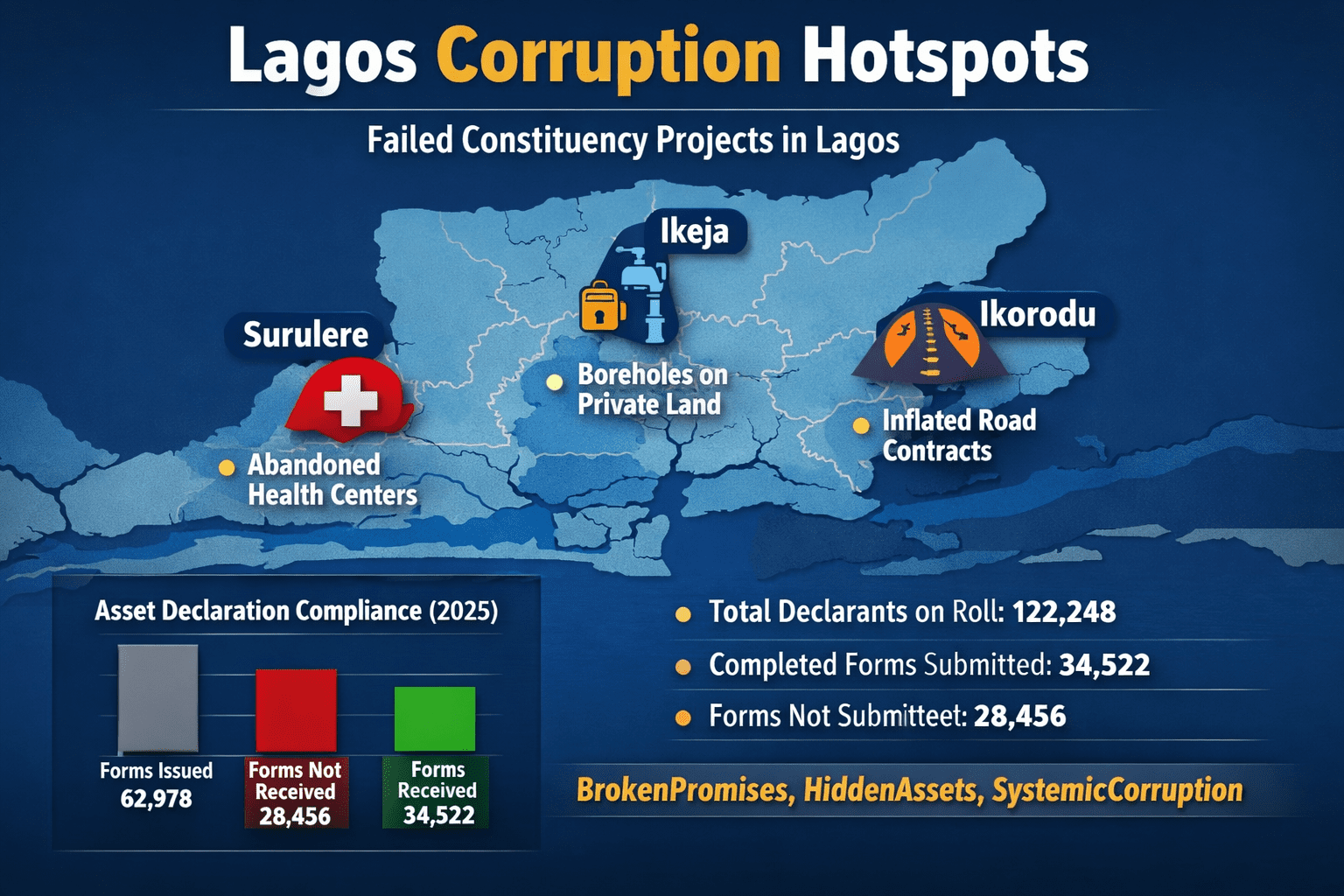
Surulere
In Surulere, residents were promised new primary health centres — facilities that could have transformed access to maternal and child care. Contractors collected mobilisation fees, but the sites were left idle, skeletal structures standing as monuments to neglect. “We were promised a health centre, but the building is empty. Mothers still travel miles for antenatal care,” one resident lamented. The hidden angle here is stark: public funds were diverted, accountability vanished, and communities were left to fend for themselves.
Ikeja
In Ikeja, boreholes and water supply schemes were budgeted to ease the burden of residents who rely on sachet water. Yet ICPC investigators found many of these projects sited on private properties belonging to political associates. Locals complain bitterly: “The water is there, but only for those connected to the politician. The rest of us buy sachet water.” What was meant to be public infrastructure became privatised, captured by elites who turned development funds into personal assets.
Ikorodu
Ikorodu’s story is one of inflated contracts and collusion. Road rehabilitation projects were awarded, but costs were padded, and contractors colluded with aides to siphon funds. The result? Roads left incomplete, commuters navigating potholes that swallow vehicles daily.
“They said it was rehabilitated, but potholes swallow our vehicles,” a frustrated commuter explained. Here, the hidden angle is the institutionalisation of corruption networks — not just failed projects, but a system designed to enrich insiders while eroding budget credibility.
Together, Surulere, Ikeja, and Ikorodu illustrate the anatomy of corruption in Lagos: promises made, funds allocated, but projects either abandoned, privatised, or inflated. The human voices — mothers without clinics, families without water, commuters without safe roads — bring the statistics to life. And beneath each case lies the deeper angle: elite capture, collusion, and systemic failure.
The CCB Compliance Gap
While ICPC exposes failed projects, the CCB’s compliance data shows how accountability is undermined at the personal level.
The CCB records show that out of 62,978 forms issued, only 34,522 completed forms were returned. Over 45% of public officers failed to comply with asset declaration laws.
Discrepancy between acknowledgement slips (49,161) and completed forms (34,522) raises questions about record-keeping integrity.
This compliance gap means thousands of public officers may be hiding assets, even as communities suffer from failed projects.
Systemic Flaws Exposed
The failures in Surulere, Ikeja, and Ikorodu are not isolated incidents. They are symptoms of deeper structural weaknesses that run through Nigeria’s governance system.
Budget duplication is one such flaw. Constituency projects are often inflated at the planning stage, with the same projects appearing in both ministry and constituency budgets. This not only wastes resources but also creates opportunities for double-dipping and fraud.
Political discontinuity compounds the problem. Projects are frequently abandoned when legislators leave office, leaving half-built clinics, unfinished roads, and idle boreholes scattered across communities. Development becomes tied to political tenure rather than long-term community needs.
Weak enforcement is another critical gap. Asset declaration laws, designed to hold public officers accountable, are ignored by thousands. The Code of Conduct Bureau’s own data shows that nearly half of officers failed to submit their forms in 2025, undermining one of Nigeria’s key anti-corruption safeguards.
Finally, collusion networks institutionalise corruption. Contractors, aides, and political insiders work together to inflate costs, abandon sites, or divert projects onto private land. What looks like incompetence is often deliberate — a system designed to enrich insiders while leaving citizens deprived.
Together, these flaws show that corruption in Nigeria is not incidental but systemic. It is embedded in the very processes of budgeting, project execution, and accountability. The Lagos case studies are simply the most visible cracks in a much larger structure of governance failure.
The Dig
ICPC’s recoveries are reactive; systemic corruption persists. CCB’s compliance gap shows accountability mechanisms are failing. Lagos is a microcosm of Nigeria’s wider governance crisis: money allocated, projects abandoned, assets undeclared.
The combination of failed constituency projects and weak asset declaration compliance paints a picture of a governance system where corruption is embedded at every stage — from budget planning to project execution to personal accountability.
Conclusion
Without structural reforms, constituency projects will remain patronage tools, and asset declaration laws will remain toothless. The combined ICPC and CCB findings show Nigeria’s corruption problem is not incidental but systemic — and Lagos is the frontline.
For citizens, the message is clear: until accountability is enforced both in public projects and personal asset declarations, promises of development will remain broken, and hidden assets will continue to erode trust in governance.
𝐊𝐞𝐡𝐢𝐧𝐝𝐞 𝐀𝐝𝐞𝐠𝐨𝐤𝐞 𝐢𝐬 𝐚𝐧 𝐚𝐰𝐚𝐫𝐝-𝐰𝐢𝐧𝐧𝐢𝐧𝐠 𝐢𝐧𝐯𝐞𝐬𝐭𝐢𝐠𝐚𝐭𝐢𝐯𝐞 𝐣𝐨𝐮𝐫𝐧𝐚𝐥𝐢𝐬𝐭 𝐰𝐢𝐭𝐡 𝐦𝐨𝐫𝐞 𝐭𝐡𝐚𝐧 𝟏𝟓 𝐲𝐞𝐚𝐫𝐬 𝐨𝐟 𝐝𝐢𝐬𝐭𝐢𝐧𝐠𝐮𝐢𝐬𝐡𝐞𝐝 𝐞𝐱𝐩𝐞𝐫𝐢𝐞𝐧𝐜𝐞 𝐞𝐱𝐩𝐨𝐬𝐢𝐧𝐠 𝐬𝐭𝐨𝐫𝐢𝐞𝐬 𝐭𝐡𝐚𝐭 𝐦𝐨𝐮𝐥𝐝 𝐩𝐮𝐛𝐥𝐢𝐜 𝐝𝐢𝐬𝐜𝐨𝐮𝐫𝐬𝐞. 𝐖𝐢𝐭𝐡 𝐭𝐡𝐫𝐞𝐞 𝐢𝐧𝐝𝐮𝐬𝐭𝐫𝐲 𝐧𝐨𝐦𝐢𝐧𝐚𝐭𝐢𝐨𝐧𝐬 𝐭𝐡𝐫𝐨𝐮𝐠𝐡𝐨𝐮𝐭 𝐝𝐢𝐯𝐞𝐫𝐬𝐞 𝐛𝐞𝐚𝐭𝐬, 𝐡𝐞 𝐡𝐚𝐬 𝐞𝐚𝐫𝐧𝐞𝐝 𝐫𝐞𝐜𝐨𝐠𝐧𝐢𝐭𝐢𝐨𝐧 𝐟𝐨𝐫 𝐟𝐞𝐚𝐫𝐥𝐞𝐬𝐬 𝐫𝐞𝐩𝐨𝐫𝐭𝐢𝐧𝐠, 𝐢𝐧𝐜𝐢𝐬𝐢𝐯𝐞 𝐚𝐧𝐚𝐥𝐲𝐬𝐢𝐬, 𝐚𝐧𝐝 𝐚 𝐜𝐨𝐦𝐦𝐢𝐭𝐦𝐞𝐧𝐭 𝐭𝐨 𝐚𝐜𝐜𝐨𝐮𝐧𝐭𝐚𝐛𝐢𝐥𝐢𝐭𝐲. 𝐀𝐬 𝐌𝐚𝐧𝐚𝐠𝐢𝐧𝐠 𝐄𝐝𝐢𝐭𝐨𝐫 𝐚𝐧𝐝 𝐂𝐄𝐎 𝐨𝐟 𝐓𝐡𝐞𝐃𝐢𝐠𝐠𝐞𝐫𝐍𝐞𝐰𝐬.𝐜𝐨𝐦, 𝐀𝐝𝐞𝐠𝐨𝐤𝐞 𝐥𝐞𝐚𝐝𝐬 𝐚 𝐩𝐢𝐨𝐧𝐞𝐞𝐫𝐢𝐧𝐠 𝐧𝐞𝐰𝐬𝐫𝐨𝐨𝐦 𝐝𝐞𝐝𝐢𝐜𝐚𝐭𝐞𝐝 𝐭𝐨 𝐞𝐱𝐩𝐨𝐬𝐢𝐧𝐠 𝐮𝐧𝐬𝐞𝐞𝐧 𝐭𝐫𝐮𝐭𝐡𝐬, 𝐚𝐦𝐩𝐥𝐢𝐟𝐲𝐢𝐧𝐠 𝐦𝐚𝐫𝐠𝐢𝐧𝐚𝐥𝐢𝐬𝐞𝐝 𝐯𝐨𝐢𝐜𝐞𝐬, 𝐚𝐧𝐝 𝐞𝐬𝐭𝐚𝐛𝐥𝐢𝐬𝐡𝐢𝐧𝐠 𝐧𝐞𝐰 𝐬𝐭𝐚𝐧𝐝𝐚𝐫𝐝𝐬 𝐢𝐧 𝐢𝐧𝐯𝐞𝐬𝐭𝐢𝐠𝐚𝐭𝐢𝐯𝐞 𝐣𝐨𝐮𝐫𝐧𝐚𝐥𝐢𝐬𝐦.
𝐓𝐡𝐞𝐃𝐢𝐠𝐠𝐞𝐫𝐍𝐞𝐰𝐬.𝐜𝐨𝐦 | 𝐰𝐰𝐰.𝐭𝐡𝐞𝐝𝐢𝐠𝐠𝐞𝐫𝐧𝐞𝐰𝐬.𝐜𝐨𝐦 | 𝟎𝟖𝟎𝟑𝟗𝟏𝟑𝟓𝟒𝟕𝟐 | 𝐈𝐛𝐚𝐝𝐚𝐧, 𝐍𝐢𝐠𝐞𝐫𝐢𝐚