
Nigeria’s fiscal backbone has shifted: VAT and corporate taxes now outmuscle oil levies. April’s record N2.257 trillion FAAC payout leaned on a N250 billion savings boost, underscoring how non-oil revenues — not crude profits — are carrying federation receipts.
TheDigger Intelligence Unit
The Federal Government, states and local government areas shared N2.257 trillion from April 2026’s Federation Account revenue — the largest distributable sum so far this year. But buried in the FAAC communiqué are four underreported signals that matter more for Nigeria’s fiscal outlook than the headline number.
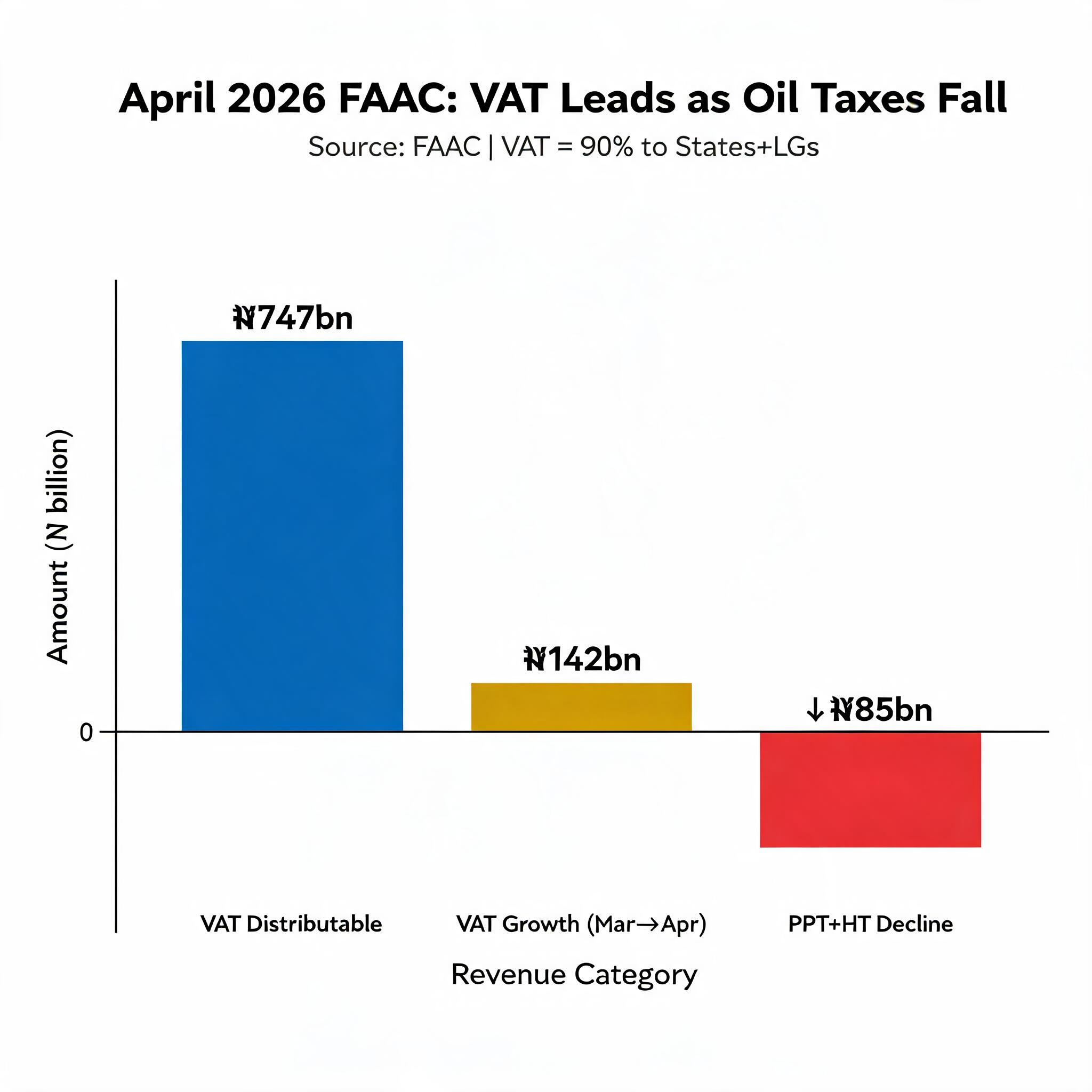
The May 2026 FAAC meeting in Abuja approved sharing from a gross revenue of N3.184 trillion. After N113.756 billion for cost of collection and N813.839 billion for transfers, refunds and savings, N2.257 trillion remained for distribution. The distributable comprised: statutory revenue N1.260 trillion, VAT N747.088 billion, and augmentation N250 billion.

“Augmentation” Exposes Oil Revenue Weakness Despite a Record Gross
April’s gross revenue rose sharply from March: statutory revenue climbed by N678.224 billion to N2.378 trillion, and VAT rose by N142.192 billion to N806.617 billion. Yet FAAC still injected a N250 billion “augmentation” to reach the N2.257 trillion distributable. FAAC uses “augmentation” to mean transfers from savings, the Nigeria Sovereign Investment Authority (NSIA) or the Nigeria Governors’ Forum (NGF) to top up shortfalls.
A telling line in the communiqué noted that “Petroleum Profit Tax, Hydrocarbon Tax decreased considerably.” While Companies Income Tax, VAT, royalties and import duties rose “significantly,” oil profit taxes fell. The unreported implication: even when headline receipts look strong, the federation required savings to balance the account. If Petroleum Profit Tax and Hydrocarbon Tax remain depressed, a recurring N250 billion monthly top-up will be unsustainable. States that budget assuming current FAAC levels are effectively budgeting on borrowed time.
VAT Has Quietly Become the Subnational Lifeline, Not Oil
Of the N747.088 billion VAT distributable, the split was: Federal Government N74.709 billion, states N410.898 billion and local governments N261.481 billion — the current 10:55:35 formula. That means states and LGs together received 90% of VAT. April’s N142.192 billion VAT growth versus March translated into roughly N128 billion extra for subnational governments, not the federal purse.
Unreported angle: the fiscal balance of power has shifted. For every N100 of VAT paid by Nigerians, N90 now funds state and local budgets. The Federal Government’s role is increasingly that of a VAT collector for subnational governments — a dynamic that public debate still frames as “oil money to Abuja.”
Derivation: N157.254 Billion to Nine States, Zero to Oil-Producing LGs
FAAC allocated N157.254 billion as “13% of mineral revenue” to benefiting states (derivation), implying mineral revenue of N1.209 trillion for April. Constitutionally, derivation is meant as compensation for oil-producing communities. In practice, the 13% goes to state governments, not to the local government areas where extraction occurs.
Unreported angle: the 774 LGs, including those in Bayelsa, Delta and Rivers, received nothing directly from this N157 billion derivation line. All derivation cash passed through state treasuries — a structural gap that rarely features in FAAC coverage.
The Silent Crisis: PPT/HT Collapse Despite High Oil Prices
FAAC notes that “PPT, Hydrocarbon Tax decreased considerably” during a month of elevated global crude prices, pointing to several possibilities: reduced production because of theft and sabotage, prolonged downtime at NNPC/IOC facilities, or lower remittance of assessed taxes. PPT and Hydrocarbon Tax are direct levies on oil company profits; their decline suggests output or remittance problems, not price weakness.
Unreported angle: Nigeria’s fiscal health is increasingly decoupled from oil prices. Overall revenue growth in April was driven by VAT and Companies Income Tax, not oil profit taxes. Yet many state budgets for 2026 remain anchored on oil-price assumptions rather than sustained VAT growth — a mismatch likely to force mid-year revisions.
Deductions Swallowed 29% of Gross Revenue
Of the N3.184 trillion gross, N927.595 billion — 29.1% — was deducted for “cost of collection, transfers, refunds and savings” before sharing. For every N100 earned, N29 never reaches FGN, states or LGs.
Unreported angle: FAAC communiqués provide limited detail on what these monthly “transfers and savings” entail. Greater transparency is needed on where almost a third of gross receipts are redirected.
What This Means for the Next Six Months
April 2026 may mark a turning point: VAT and CIT are now carrying federation receipts while oil profit taxes decline. If PPT and Hydrocarbon Tax fall further, augmentations will rise and savings will be depleted, causing FAAC figures to shrink even if VAT remains high. States that fail to grow internally generated revenue (IGR) will feel the impact first.
Three Questions FAAC Should Answer Next Month
What specific factors caused Petroleum Profit Tax and Hydrocarbon Tax to fall “considerably” in April 2026?
Which account supplied the N250 billion augmentation, and what is its remaining balance?
Will the government consider amending the derivation formula to direct a portion of derivation payments to oil-producing local government areas instead of only states?
Record or Illusion?
Nigeria shared a record N2.257 trillion in April. The real story is not the record number itself but that it was propped up by savings, funded largely by VAT, and exposed a decline in oil profit taxes.
The communiqué did not provide a state-by-state breakdown. Based on FAAC formulae, states with high derivation and VAT collections typically top the list, while low-population, non-oil states rank lowest. TheDiggerNews.com is seeking the full April 2026 distribution table from the FAAC Secretariat to publish the exact top five and bottom five states.