

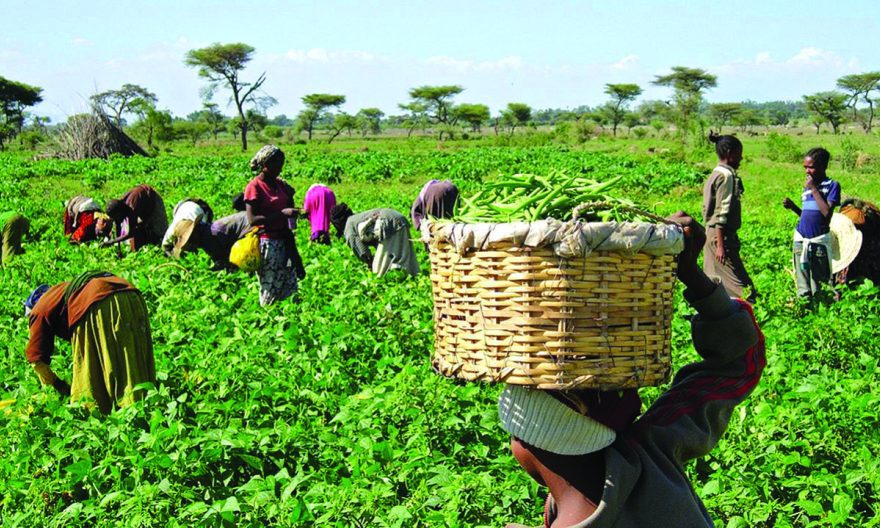
Lafia: Sasakawa Africa Association Nigeria (SAA Nigeria), an international non-governmental agricultural extension service provider, has begun the distribution of farm inputs to farmers in six states for the 2025 wet season farming activities.
Mr Moses Nongoatse, Communication Officer of the association, disclosed this in a statement made available to the News Agency of Nigeria (NAN) on Saturday in Lafia.
He listed the benefiting states as Kano, Jigawa, Gombe, Nasarawa, Benue, and Kwara.
He said the initiative, which also includes the setting up of demonstration plots, was funded by The Nippon Foundation (TNF).

According to him, the exercise is part of the 2025 wet season farming intervention launched to improve food security, increase household incomes, and promote climate-smart farming practices among smallholder farmers in Nigeria.
“About 45,000 smallholder farmers will benefit indirectly from the initiative. Certified seeds, fertilisers, and agrochemicals are among the inputs being distributed.
“Before the distribution, SAA Nigeria conducted a preseason Training-of-Trainers (ToT) for a total of 116 participants in the intervention states, equipping frontline extension agents with the technical skills needed to cascade regenerative agriculture and other good agronomic practices to farmers,” he said.
He said SAA also set up 360 community demonstration plots in 90 rural communities across the six states.
“These Farmer Learning Platforms (FLPs) showcase regenerative agriculture practices, including intercropping, relay cropping, Urea Deep Placement (UDP), mulching, integrated pest and weed management, soil fertility strategies, and other good agronomic practices tailored to local agroecological contexts.
“The demonstrations serve as living classrooms, reinforcing SAA’s broader commitment to sustainable agricultural intensification,” he said.
The statement quoted Dr Godwin Atser, Country Director of SAA Nigeria, as saying that the association had worked side by side with Nigeria’s smallholder farmers for more than 30 years, delivering practical, field-tested innovations.
“Our interventions have consistently improved yields, from 1.9 metric tons per hectare to 5.5 metric tons per hectare in maise and from 1.8 metric tons per hectare to 6 metric tons per hectare in rice production.
“In the case of soybean and cowpea, yields have improved from 0.6 metric tons per hectare to 2.5 metric tons per hectare. This is a result of blending improved inputs with hands-on extension and community-based learning,” Atser said.
Also, Dr Bello Shehu, Technical Coordinator for Regenerative Agriculture at SAA, appealed for strict adherence to the organisation’s protocols for the demonstration plots.
He encouraged farmers to leverage SAA’s extension network to deepen their understanding of regenerative agriculture and build resilience to climate shock.
Representatives of some of the benefitting states expressed delight over the intervention by SAA Nigeria.
Dr Barnabas Mallet, the Commissioner for Agriculture Animal Husbandry and Cooperatives in Gombe State, said SAA has consistently demonstrated a high level of commitment to improving farmers’ livelihoods in the state.
“Their interventions, especially in training, extension support, and timely input delivery, have contributed meaningfully to nutrition, food security and economic development in our rural communities,”
Also, Dr Farouk Kurawa, Managing Director of the Kano State Agricultural and Rural Development Authority (KNARDA), represented by the SAA Kano State coordinator, Mr Kassim Safiyyanu, said Sasakawa’s approach was timely, practical, and results-driven.
“Early input distribution sets the tone for a productive season and motivates our farmers to adopt early planting, which is critical for optimal yields,” he said.
Similarly, Mrs Salome Sabo, SAA State Coordinator in Nasarawa State, acknowledged the timeliness and relevance of the distribution exercise.
“This input distribution is not just about seeds and fertilisers; it is a clear affirmation of SAA’s leadership in the sector.
“The early support enables our farmers to plan better and embrace innovations that significantly improve productivity and livelihoods,” she added.