

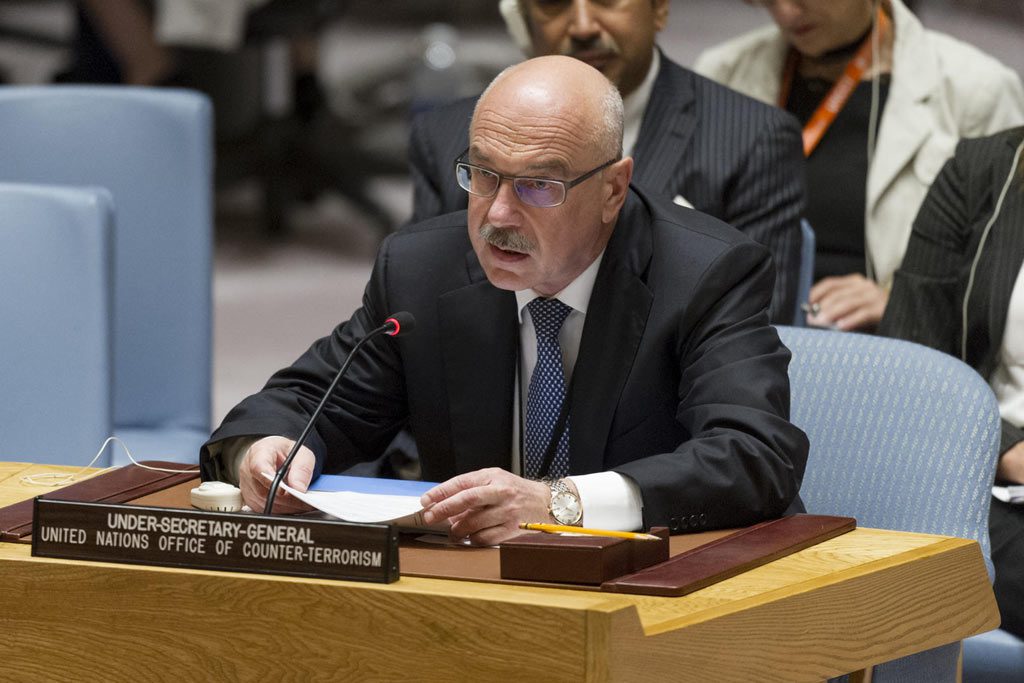
New York: The UN has issued a warning about the growing threat posed by ISIL, also known as Da’esh, emphasising that Africa is currently witnessing the highest level of terrorist activity worldwide.
Even though several key leaders within the group have died, Vladimir Voronkov, head of the UN Office of Counter-Terrorism, informed the Security Council that ISIL continues to demonstrate its operational resilience.
The organisation maintains its influence through various regional affiliates and extensive financial networks, which are crucial to its ongoing activities.
The threat is especially severe in Africa’s Sahel region, where ISIL affiliates such as the Islamic State West Africa Province have become prolific producers of terrorist propaganda, attracting foreign recruits.

Although there have been significant national and international efforts to counter Da’esh, which rose to prominence in 2014 after conquering large parts of Iraq and Syria, the continuing threat underscores the urgency of immediate and sustained global cooperation.
In Afghanistan, ISIL-Khorasan remains one of the most serious threats to Central Asia and beyond, targeting civilians and exploiting discontent with the country’s de facto authorities.
Meanwhile, Da’esh remains active in Iraq and Syria despite military defeats in Mosul and Raqqa in 2017. The group is making an effort to rebuild its operational capacity in Iraq’s Badia region. This vast desert area provides cover for the group’s activities, and renewing efforts to destabilise local authorities.
In Syria, where the situation remains fragile since the takeover by Hay’at Tahrir al-Sham, ISIL continues to exploit security gaps, conduct covert operations, and incite sectarian tensions.
“The security, humanitarian and human rights situation in camps and other facilities in northeast Syria remains deeply concerning,” Voronkov said.
Camps such as al-Hol currently host tens of thousands of individuals, primarily women and children, many with alleged ties to ISIL, who remain in prolonged detention under unsafe and undignified conditions.
“These environments present serious risks of radicalisation to terrorism and are contrary to obligations under international law,” he added, calling for the “safe, voluntary, and dignified repatriation of all concerned individuals, with a particular focus on children.”
Elisa de Anda Madrazo, President of the Financial Action Task Force, a close UN partner, highlighted the increasing integration of digital tecnologies with conventional terrorist methods.
“There is a marked increase in the interlinkage of diverse methods and the integration of digital technologies with conventional techniques,” she told ambassadors.
“The use of emerging technologies and artificial intelligence by Da’esh remains a growing challenge, particularly as the group employs these tools to raise funds and expand its communications network.
“As we stand at the crossroads of technological transformation and geopolitical uncertainty, the threat of terrorism is more diffuse and complex,” said Nathalia Gherman, head of the Counter-Terrorism Committee Executive Directorate (CTED).
“Prevention remains our best response to terrorism and violent extremism conducive to terrorism,” Voronkov emphasised.
He stressed the importance of long-term, principled approaches that address the root drivers and enabling conditions of terrorism.
He stressed that it is not only more effective but also more cost-efficient to prevent terrorism than to remedy its impact.

