


A report finds that death rates from cancer and heart disease have declined since 2010 in roughly 150 countries.
In a study reported by Mohana Basu, the chance of dying from chronic illnesses such as heart disease, cancer, and diabetes declined in four out of five countries between 2010 and 2019, finds a study of 185 countries published in The Lancet.
The study, which involved rigorous data collection and analysis, is considered a significant contribution to our understanding of global health trends.
Non-communicable diseases (NCDs) are the leading cause of death globally. Recognizing the severity of this issue, the United Nations has set the ambitious goal of reducing deaths from these diseases by one-third by 2030. Achieving this goal would significantly improve global health and quality of life.

This comprehensive study, the first of its kind to investigate the change in NCD mortality across countries, reveals a global trend. From 2010 to 2019, the probability of dying from an NCD before the age of 80 fell in 152 countries for women and in 147 countries for men, underscoring the widespread impact of chronic diseases.
Despite these gains, more than half of the countries saw slower declines in the 2010s compared with the previous decade.
“Around the beginning of the millennium, we saw significantly lowered mortality rates, but despite political attention suddenly over the last decade, things are not doing as well as before,” says Majid Ezzati, a co-author and global-health researcher at Imperial College London.
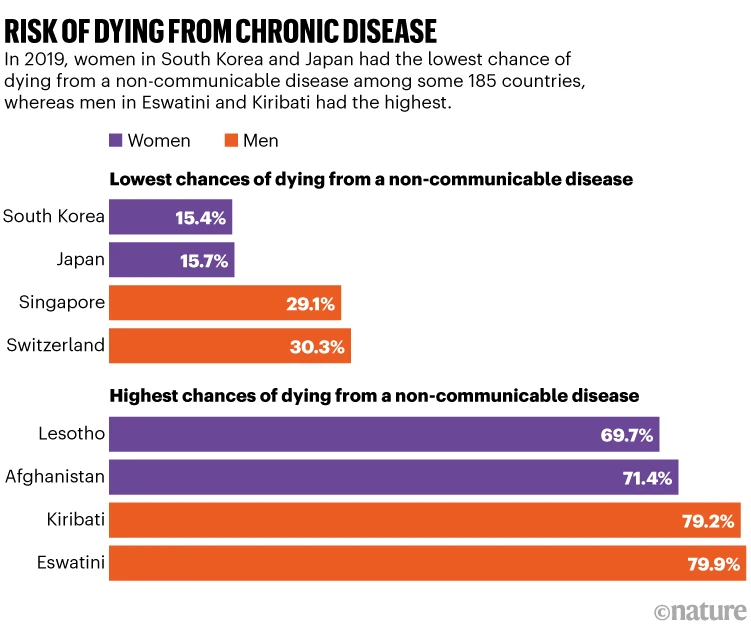
In 2019, women in Japan and men in Singapore had the lowest risk of dying from an NCD among the countries studied, while women in Afghanistan and men in Eswatini had the highest (see ‘Risk of dying from chronic disease’).
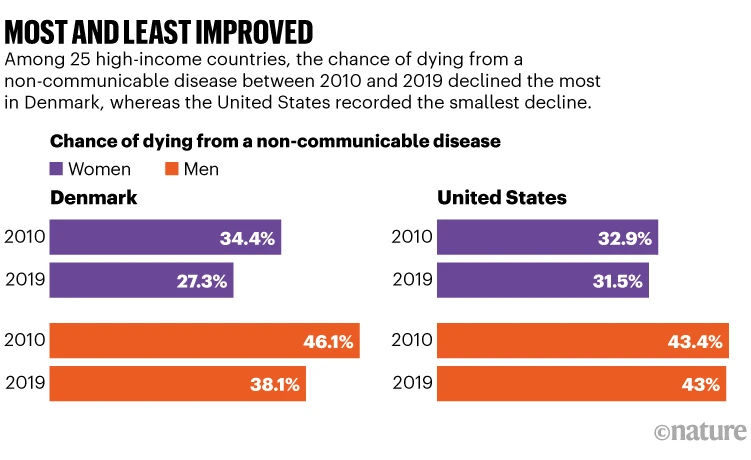
All 25 high-income countries in the data set saw declines in NCD mortality between 2010 and 2019, with Denmark recording the most significant drop for both sexes and the United States the smallest (see ‘Most and least improved’). China, Egypt, Nigeria, Russia, and Brazil had a reduction in chronic-disease deaths, whereas India and Papua New Guinea experienced an increase in NCD deaths over the same period.
Veronica Le Nevez, a public-policy specialist at the George Institute for Global Health in Sydney, Australia, underscores the crucial role of health-care systems in the report.
She points out that the biggest drivers of improvements in death rates were embedding better treatments and preventions, the widespread adoption of statins and hypertensives to lower the risk of heart attack and stroke, and the development of vaccines for hepatitis and cervical cancer.
Government restrictions on tobacco and alcohol have played a significant role in reducing mortality from diseases linked to their use, such as lung cancer and alcohol-use disorder. This underscores the potential for further improvements in mortality rates through effective policy measures.