

Inside the CBN’s Fintech Strategy
Nigeria’s fintech ecosystem is booming, yet fragile. The Central Bank of Nigeria’s (CBN) landmark report “Shaping the Future of Fintech in Nigeria: Innovation, Inclusion and Integrity” reveals a sector brimming with ambition but weighed down by regulatory bottlenecks and infrastructure gaps.
This investigation uncovers the contradictions, risks, and opportunities that will determine whether Nigeria becomes Africa’s fintech rule-setter—or stalls at the starting line.
The report exposes cross-border dreams marred by regulatory nightmares, with 62.5% of firms planning regional expansion and strong support for regulatory passporting frameworks to enable seamless, compliant expansion into peer African markets.

It is established that AI is already widely used in fraud detection and credit scoring, while real-time payments infrastructure is viewed as both a strength and a model for other digital rails.
Infrastructure gaps resulting in the digital divide are another Germaine issue. Stakeholders cited the lack of universal access to digital ID verification, limited broadband penetration, incomplete data-sharing systems, and limited open-data frameworks as barriers to scaling.

Presently, innovation is under siege as compliance costs are the silent killer. In the report, 87.5% of respondents said the cost of meeting regulatory and risk requirements significantly impacts their capacity to innovate.
Furthermore, 62.5% of firms say regulatory timelines materially impact product rollouts, with over one-third waiting more than 12 months to bring a new product to market due to compliance bottlenecks.
In terms of regulation, it is a case of a divided house as exactly half of the respondents view the regulatory environment as enabling, while the other 50% find it restrictive.
This split perception reflects a deeper tension: regulators’ cautious oversight versus innovators’ demand for speed.
In terms of appetite for engagement -a rare consensus- though, 75% of respondents favour the creation of regular, high-trust engagement forums with regulators, and 100% expressed willingness to collaborate through policy pilots, regulatory sandboxes, or working groups.
Strategic Priorities Under the Microscope
Policy Promises vs. Reality
The report analyses the engagement platform: Will it be transparent or tokenistic?
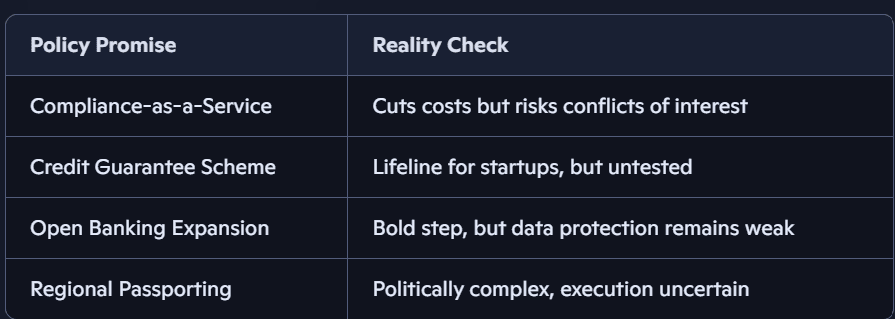
The CBN highlights that compliance-as-a-service could reduce costs but cautioned that such could risk conflicts of interest.
They also consider a Credit Guarantee Scheme (CGS) lifeline for startups, but doubt its sustainability, as it is untested.
“Open Banking Expansion” is a bold step, according to the report, but data protection remains weak,” they posit.
Similarly, their findings reveal that regional passporting is “politically complex,” and the “execution is uncertain.”
Conclusion: Nigeria’s Moment of Truth
Nigeria’s fintech is vibrant yet fragile—poised between innovation and regulation, opportunity and constraint. The CBN’s report is both a roadmap and a warning: without decisive reforms, Nigeria may remain a frontrunner but fail to become a rule-setter.
Exclusive Insight: According to the report, collaboration cannot be ad hoc. It must be structured, frequent, and high-trust. With the right reforms and a unified vision, Nigeria can move from fintech frontrunner to fintech rule-setter.