

PART FOUR: Stomach Infrastructure in a Kaftan
Mass weddings in Northern Nigeria have become a recurring spectacle: governors sponsor ceremonies, dowries are paid, household items are distributed, and hundreds of couples are ushered into matrimony under the banner of “social intervention.” Yet behind the pageantry lies a deeper question — do these programmes alleviate poverty or entrench it? This five‑part series by KEHINDE ADEGOKE examines the political, economic, cultural, and social dimensions of mass weddings, arguing that what appears as welfare may in fact function as patronage, perpetuating vulnerability rather than resolving it.
“Stomach infrastructure” in Nigerian politics means buying votes with food—rice, seasoning, water—at rallies. It is cheap, highly visible, and effective amid poverty.
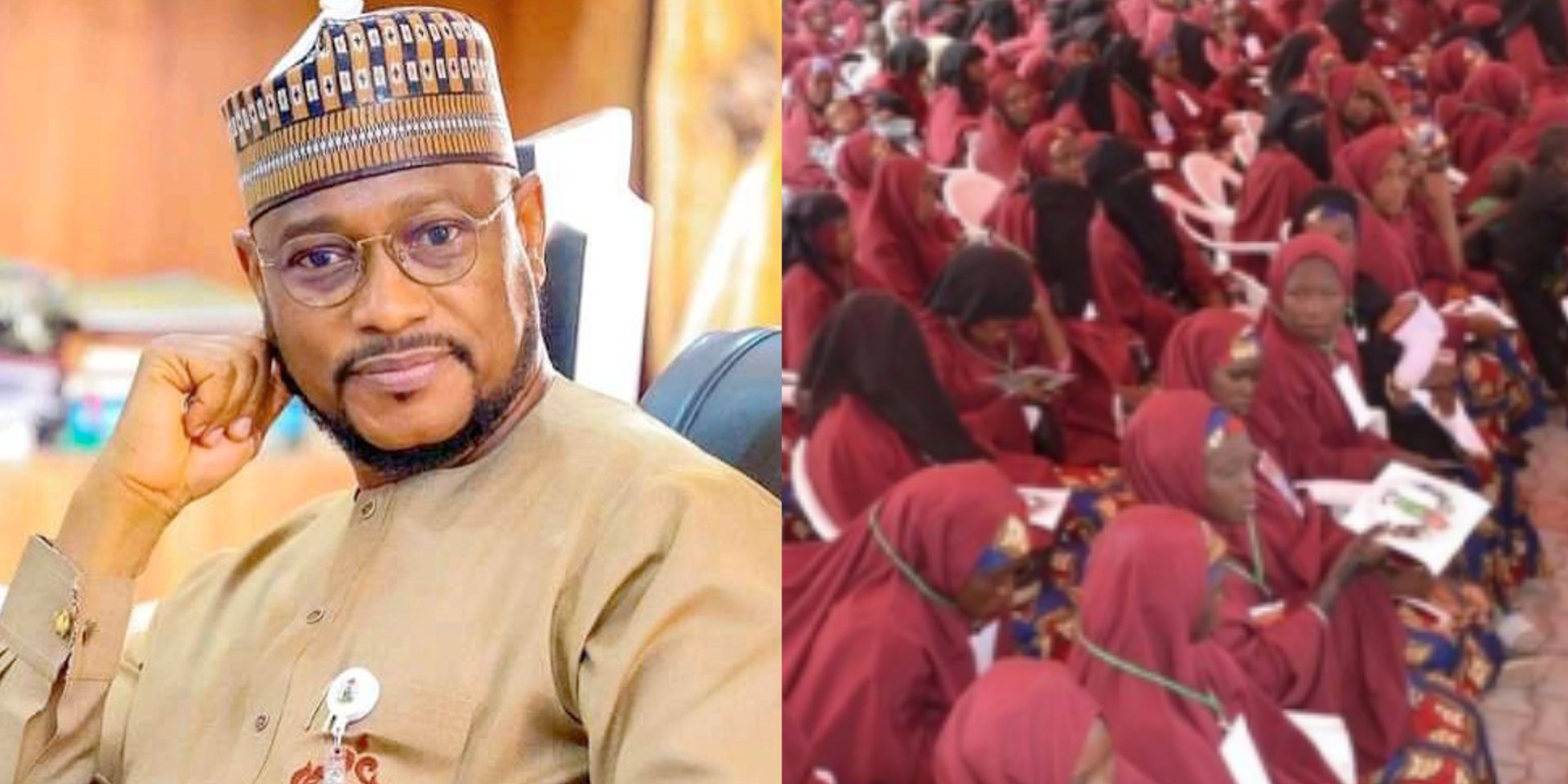
The mass wedding is a stomach infrastructure in a kaftan: state resources turned into political loyalty, clad in religious ceremony and social welfare. To see why this persists, you must understand the system that produces it.
Northern Nigerian states do not primarily fund themselves through taxation. They receive federal allocations from oil revenue, distributed by formula from Abuja. This matters enormously for governance incentives. A government that taxes its citizens must justify its spending to those citizens. A government that receives money from the centre and distributes it downward has a different accountability structure — or rather, no accountability structure at all. It is accountable to the federal formula, not to the people it governs.

State and local governments in Nigeria depend almost entirely on federal oil revenue, which governors then distribute as patronage with no accountability. Because citizens pay little in taxes and receive only minor benefits, they are structurally reluctant to hold officials accountable. Lagos is the exception: it collects taxes, funds services, and creates a civic contract. Its literacy rate is 92%. Its fertility rate is 3.6 children per woman. These are not coincidences.
The gap between Northern and Southern Nigeria on virtually every human development indicator is not the product of culture or geography. It is the accumulated product of governance choices made over decades. Lagos literacy rate: 92%. Kano literacy rate: 49%. Zamfara female literacy in some LGAs is below 15%. Lagos fertility rate: 3.6 children per woman. Zamfara: 6 to 7 children per woman. Northeast Nigeria’s absolute poverty rate 71.5%, with more than half the population malnourished.
These figures do not describe a cultural gap. They describe a governance gap — between states that invested in education, health, and economic infrastructure, and states that converted public funds into patronage networks.
The North was not left behind. It was held back by leaders who found it more profitable to govern poverty than to end it.
The Zamfara mass wedding cost roughly N30 million. Let us be specific about what N30 million buys in development terms. One functional primary health centre with staff and equipment costs between N40 and N60 million. Training and one year’s salary for 50 community health workers costs between N25 and N35 million. Scholarships for 300 girls through one year of secondary school cost between N15 and N20 million. The governor chose to spend equivalent resources on a ceremony that will generate 600 to 700 new births into households with no access to any of the above.
Northern governors have a documented pattern of this substitution. The same governments that cannot maintain school roofs fund Hajj pilgrimages for political allies. The same governments that cannot supply hospitals with drugs commission elaborate Islamic architecture. In a region where millions of children wander as almajiri — Quranic students with no secular education and no economic future — the spectacle of governance has entirely replaced its substance.
Twenty-seven of Nigeria’s 36 states have adopted the Child Rights Act of 2003, which sets the minimum marriage age at 18. Nine states, largely in Northern Nigeria—specifically, Zamfara, Kano, Katsina, Sokoto, Kebbi, Niger, Bauchi, Borno, and Gombe—have not adopted the Act.
This omission is intentional. The nine states that have not adopted the Act—Zamfara, Kano, Katsina, Sokoto, Kebbi, Niger, Bauchi, Borno, and Gombe—are primarily in Northern Nigeria. Adopting it would make mass wedding ceremonies involving underage brides legally problematic. Not adopting it means the governor who sponsors such ceremonies is not legally accountable under that state’s law.
The governance failure is not just cultural or institutional. It is architecturally embedded — built into the state’s legal structure to protect the political economy of early marriage.
The complete circuit works as follows. Federal oil revenue flows to state governments by formula. The state executive captures the allocation, with minimal institutional expenditure. Resources are dispersed as visible, emotionally resonant patronage — weddings, pilgrimages, public prayers. Religious and traditional authorities endorse the gesture, providing political cover. Recipients become symbolically indebted to the governor. Poverty continues. The next generation becomes the next constituency. The cycle repeats with each electoral cycle.
The mass wedding is not a governance failure. It is the system’s intended function.