

By Mohammed Betara Aliyu, Esq.
In an era where Nigerian politicians typically measure success by electoral victories and cabinet appointments, Dr. Umar Ardo has built his reputation on something less glamorous but arguably more consequential: a two-decade record of litigation that has shaped the jurisprudential architecture of the nation’s democracy.
1. A historian by training and a political activist by conviction, for nearly two decades Ardo has taken his grievances to court not once or twice, but across seventeen separate cases spanning three political platforms and multiple levels of the judicial hierarchy, and costing him over half a billion naira. His name appears in the Nigerian Law Reports not as a footnote, but as a cited authority.
2. The case of Ardo v. Nyako [2014] 10 NWLR (Pt. 1416) 591, decided by the Supreme Court, established foundational principles for constitutional review of party democracy under Section 223(1)(a) of the Constitution. The judgment has since been relied upon by lower courts, including the 2021 FCT High Court in Anyakorah v. PDP, which cited it to hold that aggrieved party members have “a wider platform” to challenge undemocratic internal conduct. Three years later, Ardo v. INEC & 5 Ors (2017) CLR 3(b) (SC) reinforced the right to fair hearing as “the fulcrum round which every adjudication revolves” – a principle now quoted in judgments ranging from electoral disputes to labour matters. The case addressed waiver doctrine, proper party joinder and interpretation of the Electoral Act, 2006.

3. In 2014, Ardo also challenged President Goodluck Jonathan’s eligibility for re-election at the Court of Appeal, Abuja, filing as a PDP member against his own party’s endorsement. The case, backed by a published constitutional analysis, represented a direct confrontation with the sitting president at a time when such challenges carried significant political risk.
4. Ardo proceeded with the case to the Supreme Court, where seven justices of the Nigerian apex court sat at the nation’s Court One, presided over by the Chief Justice of the Federation. Yet they failed to hear the matter, instead insisting on its withdrawal – a procedural rebuke that denied the substantive constitutional questions that day in court.
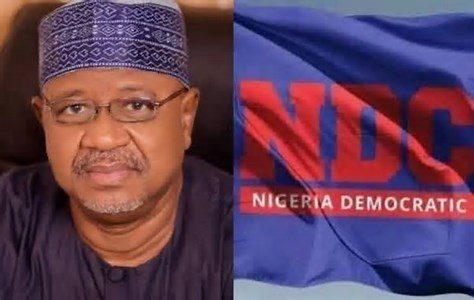
5. His current battle against the Nigerian Democratic Congress (NDC) registration – which he has described as “judicial murder” – alleges that the party secured court-ordered registration without completing mandatory INEC constitutional procedures. “INEC published names of party officers that were never part of the court judgment,” he stated in a recent interview. “That is the worst perversion of justice.” He notes the disturbing disparity in judicial timelines: the NDC secured judgment in 33 days, while his own case has languished for over five months without positive resolution.
6. Ardo’s 2023 Adamawa governorship bid under the SDP ended with a Supreme Court unjust dismissal in January 2024, without hearing the substantive case. He has never held elective office. Yet his litigation record addresses the full spectrum of Nigeria’s electoral architecture: state-level party democracy, electoral administration, presidential eligibility and party registration. “I am not doing this because I did not get registration,” he insists. “I am doing this to protect our democracy.”
7. The dangers of the system Ardo fights are existential. When candidates or political parties emerge through fraudulent processes, governance becomes predatory. When courts overlook procedural violations in party registration, institutional trust erodes. When legitimate avenues for political ascent are closed, violence becomes inevitable. His cases strike at the two pillars of electoral authoritarianism in Nigeria: Party Capture (Ardo v. Nyako): The ability of incumbents and financiers to control party structures through fraudulent primaries and manipulated delegate systems. By constitutionalizing party democracy, his case creates legal leverage for challengers. Then there is the issue of procedural manipulation which Ardo v. INEC resolved.
8. The ability of electoral management bodies to dismiss challenges, exclude evidence or rush to judgment without fair hearing was challenged. By proceduralizing electoral justice, his case slows down the machinery of predetermined outcomes. Together, the two cases represent a strategy of institutional defense – using courts to protect the spaces where democratic contestation occurs, even when the immediate political outcome is unfavorable.
9. On the whole, Ardo’s cases aimed to transform Nigeria’s democracy. They contribute to what scholars would recognize as transformative constitutionalism – the use of litigation to enforce constitutional values against institutional resistance. In the Nigerian context, where the Constitution’s Chapter II (Fundamental Objectives and Directive Principles) is explicitly non-justiciable, his cases demonstrate that other constitutional provisions can be mobilized for democratic ends. Thus, his numerous cases helped establish that, jurisprudentially, technical compliance cannot override substantive fairness. The right to fair hearing is not a formality to be waived or bypassed; it is the condition of possibility for legitimate outcomes.
10. This is politically consequential because it imposes due process constraints on electoral management bodies. INEC cannot simply dismiss challenges, exclude evidence or rush to judgment without affording parties full opportunity to be heard. Thanks to Ardo’s judicial struggle, these cases construct a complementary framework for electoral justice in Nigeria.
11. As a senior lawyer myself of 43 years at the bar, reviewing Ardo’s body of work, I can say that such sustained, principled engagement with the judiciary is “extraordinarily rare in our jurisprudence – a citizen who treats the court not as a casino for personal jackpot but as a temple for democratic reconstruction.” Ardo’s record stands as “a masterclass in strategic patience: seventeen cases across two decades, each building upon the last, slowly compelling the judiciary to acknowledge that party autonomy cannot be a license for electoral fraud.”
12. In a political culture that rewards accommodation, such persistence carries few electoral dividends. But the Law Reports tell a different story – one where a single litigant’s refusal to accept institutional decay has inscribed principles of democratic participation and procedural fairness into Nigerian jurisprudence. Whether the political system he seeks to reform will ultimately ever honour that contribution remains an open question. Another question is whether anyone is still listening.