
World leaders gather in Geneva, hungry for the text, as Washington and Tehran offer conflicting takes — and billion-dollar reconstruction plans hang in the balance.
Kehinde Adegoke | International Agencies
Geneva, Switzerland: As twilight fell over Lake Geneva, leaders from the Group of Seven walked away from a terrace dinner still unsure what was actually in the agreement President Donald Trump said he had struck with Iran.
The informal meeting, billed as a working dinner to tackle major international challenges, stretched nearly two hours. Despite “frank” exchanges, several participants left just as puzzled about the compact’s substance as when they arrived, according to two officials familiar with the conversations.

Only a handful of people reportedly have seen the one-and-a-half-page memorandum that Trump electronically signed in a virtual ceremony on Sunday. Neither Washington nor Tehran has published the text, and officials on both sides have offered diverging descriptions. Even inside the U.S. administration, accounts of how the plan would operate have varied.
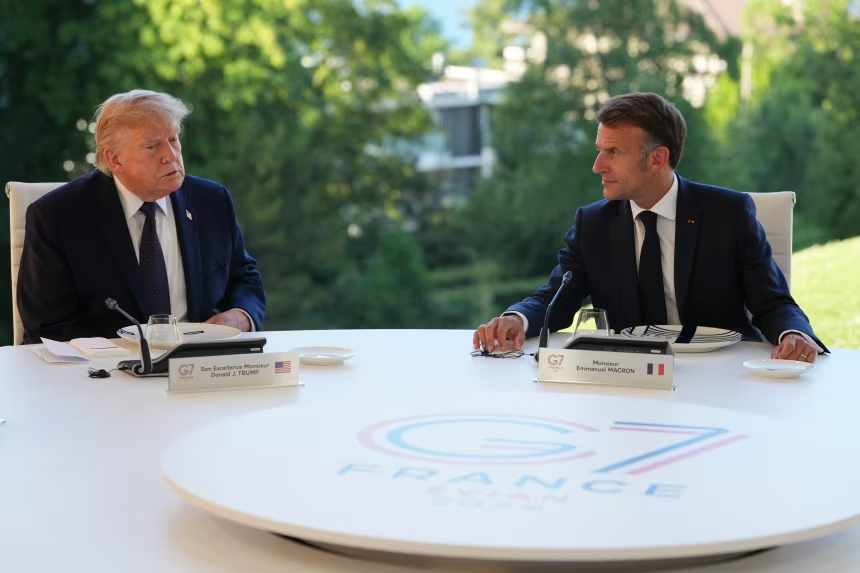
Vice President J.D. Vance is slated to attend a formal signing ceremony in Switzerland on Friday, but it remains unclear whether the document will be public before then. One senior U.S. official said the memorandum’s text would be released “a day or two” before the ceremony in the interest of transparency. Hours later, Trump, seated beside French President Emmanuel Macron, suggested a different timeline: “I want it to be released. So, probably pretty soon. I would say sometime after Friday.”
G7 leaders, including Macron and British Prime Minister Keir Starmer, have publicly congratulated Trump for brokering the arrangement but, like the rest of the world, say they have not seen the agreement’s language. Before a stray comment by Vance on Monday morning, even the question of whether the document had been signed remained uncertain.
A senior administration official claimed Iran’s parliament speaker, Mohammad Bagher Ghalibaf, signed for Tehran and suggested Supreme Leader Mojtaba Khamenei “just doesn’t sign these agreements.”
Tuesday’s summit sessions above the lake offer another chance for clarity. Macron invited the rulers of Egypt, Qatar and the United Arab Emirates to a midday discussion; Qatar in particular has played an active role in the behind‑the‑scenes diplomacy.
Washington also expects Gulf states to help fund a proposed $300 billion reconstruction fund for Iran, an initiative that will be harder to sell if the fund’s conditions hinge on unseen terms.
Trump framed the next round of talks as easier than the negotiations that produced the memorandum. “It goes to a second stage, which I think will be actually easier,” he said, even as officials acknowledge that technical talks must still resolve thorny issues, including Iran’s nuclear stockpiles, centrifuge capabilities and the scope of inspections.
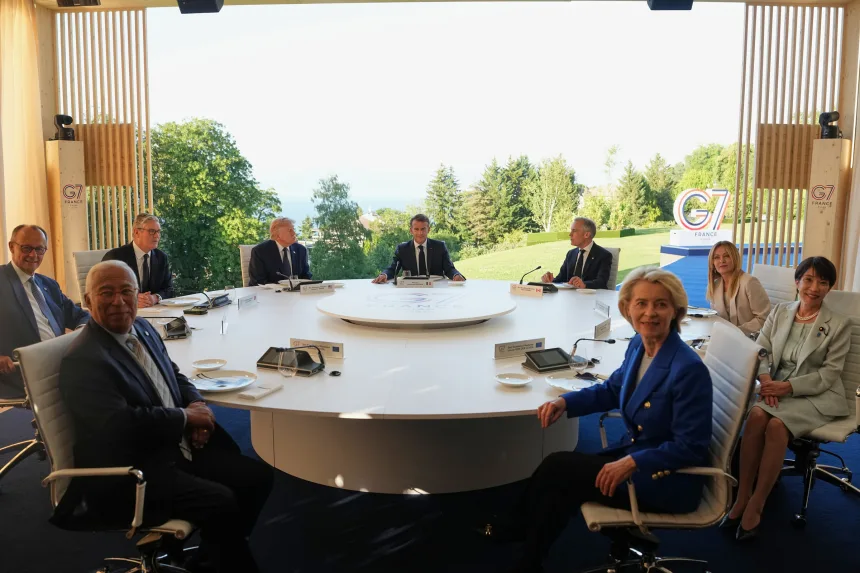
Secrecy around the pact has generated unease on multiple fronts. European governments say they cannot pledge operational support — such as mine‑clearing in the Strait of Hormuz — without knowing how the agreement addresses the strait’s future.
Trump has asserted the waterway will remain “permanently toll‑free,” while Tehran has signalled it expects to control the passage and could levy fees. Vance described a U.S. “expectation” of toll‑free transit but said final terms would be decided in technical negotiations.
The absence of a public text has also rattled some conservative backers. “Why can’t we, the people, see the damn MOU?” commentator Mark Levin asked on X, reflecting broader frustration among commentators and some lawmakers who have been left to read briefed summaries and leaks.
On sanctions and economic relief, the administration says Tehran won’t receive financial benefits until it meets unspecified commitments. A senior official described sanctions relief as linked broadly to Iran “behaving more appropriately,” not to a single defined action. Another official suggested small, early “gestures” — limited sanctions relief or the unfreezing of certain assets — could be used to build confidence while more detailed terms are negotiated.
Gulf governments that Washington hopes will invest in the reconstruction fund will be represented at Tuesday’s expanded talks. Officials characterise the effort as an attempt to “corral other countries to make investments,” but whether those nations will commit significant sums before seeing the memorandum remains an open question.
For now, the deal’s contours are being judged largely by comments and counter‑comments rather than by text. That opacity leaves world leaders and investors alike waiting — and wondering — what exactly the United States and Iran have agreed to.