

Table of Contents
Nigeria’s voting process is governed by three laws: the 1999 Constitution (as amended), the Electoral Act 2010 (as amended), and INEC Rules and Regulations.
These laws list offences such as voter registration fraud and campaign finance violations. Penalties can include fines, imprisonment, or both.
Loopholes in the Law
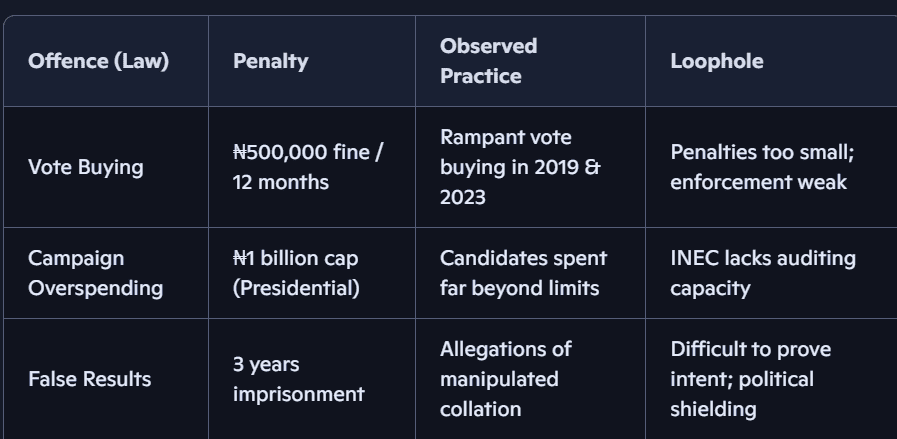
Despite the thorough framework, several weaknesses undermine enforcement. For example, minor offences result in trivial fines (₦100,000), whereas major offences incur severe penalties (₦50 million), highlighting the sharp disparity between penalties.
Alarmingly weak enforcement is a germane lacuna, as INEC and security agencies rarely prosecute offenders.

In terms of vote-buying, sanctions are too light given the scale of corruption. There is also a campaign finance oversight loophole: spending limits exist, but are often unenforced.
INEC and security officials evade real accountability for misconduct, as ruling parties brazenly exploit state media with impunity.
Violence and intimidation surge. Laws exist, but prosecutions remain alarmingly rare.
Law vs. Practice vs. Loophole (Case Studies: 2019 & 2023 Elections)

Reform Roadmap
To urgently close these gaps, the Federal Government must immediately strengthen penalties by scaling fines to the offence value and rigorously enforce forfeiture. The government must swiftly establish specialised, fast‑track courts for election‑related offences, as the current Electoral Offences Tribunals appear inefficient.
Independent oversight must be urgently strengthened to monitor INEC/security officials through external bodies. Real‑time disclosure of donations and expenditures must be strictly enforced. Cash transactions must be banned without exception, and mandatory electronic campaign spending must be imposed immediately.
Moreover, media fairness must be enforced to mandate equal airtime, with stiffer sanctions. Community monitoring must be entrenched, and local peace committees must document violations.
INEC should be required to publish annual prosecution records for public accountability.
Conclusion
Nigeria’s electoral laws are strong on paper but dangerously weak in practice. The unrelenting persistence of vote buying, overspending, violence, and official misconduct exposes critical systemic loopholes. Without urgent independent enforcement, tougher penalties, and dedicated institutions, elections will remain gravely vulnerable to malpractice.